
Azeem Azhar cuts AI agent costs to $6 daily
Serge Bulaev
Azeem Azhar says he cut the daily cost of his AI chief of staff agent to about $6, down from much higher spikes before. This was done by splitting up tasks so cheaper models do simple work, using expensive models only when needed, and setting a monthly spending cap. After finding and fixing some wasteful loops and adding prompt caching, his token use dropped a lot. Other teams may be able to copy these steps to save similar amounts, and falling model prices could mean even more savings. Azhar's approach suggests that running an AI agent for a few dollars a day might be possible for many workers if they use these cost controls.

Innovator Azeem Azhar cut his AI agent costs to just $6 daily for his 24/7 'chief of staff,' R. Mini Arnold, a dramatic reduction from previous cost spikes. This milestone, achieved through a series of audits and workflow optimizations on his OpenClaw assistant, demonstrates that advanced AI capabilities and falling operational costs can go hand-in-hand with careful system design. This case study offers a valuable blueprint for any organization looking to manage its AI expenses effectively.
How Azhar Achieved a $6 Daily Cost
Azeem Azhar reduced his AI agent's daily cost through implementing task decomposition, intelligent model routing, and strict budgeting practices. This involved decomposing tasks to use cheaper models for simple work, routing complex jobs to premium models only when necessary, and capping monthly spending with a fixed token allowance from OpenAI.
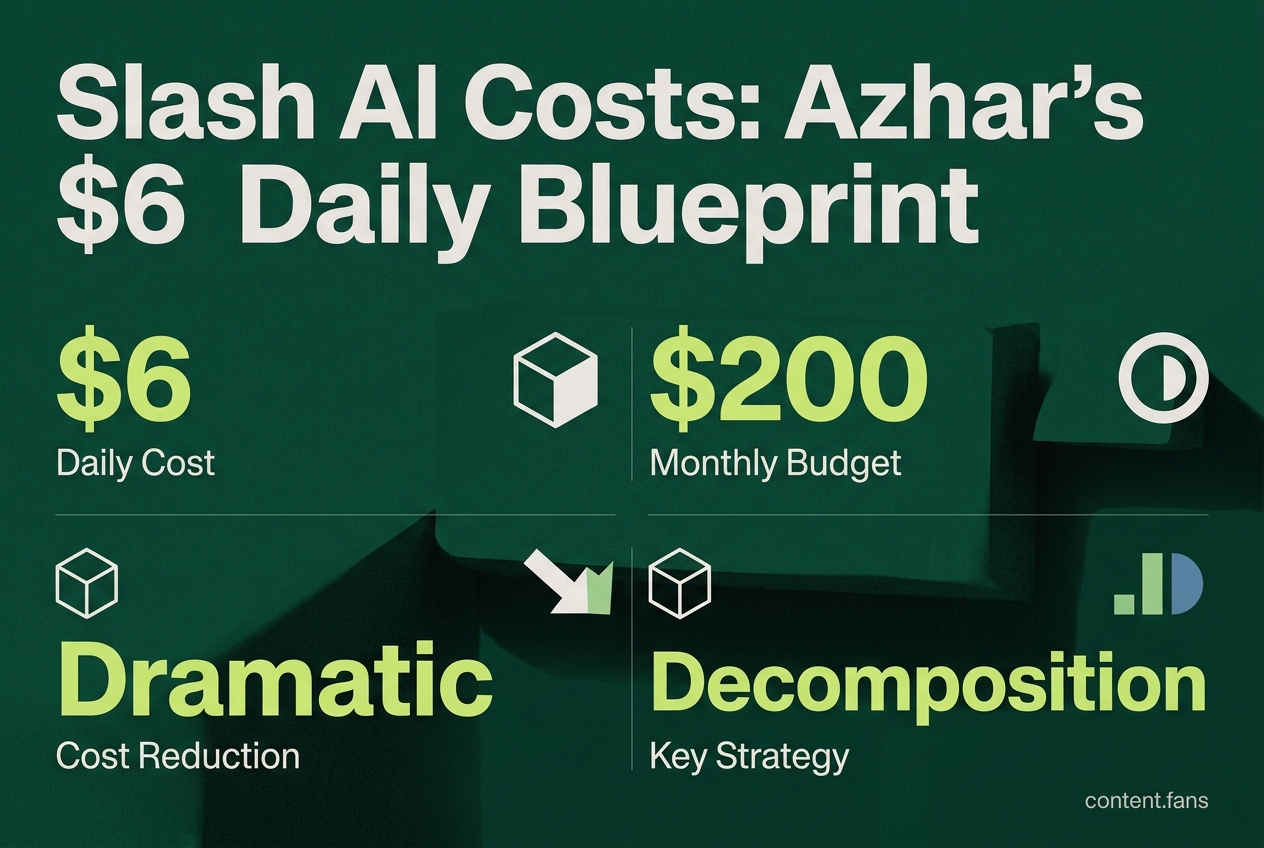
In an Exponential View post, Azhar detailed three key drivers behind the new cost structure:
- Task Decomposition: Simple tasks like formatting and outline generation are handled by cheaper, more efficient models.
- Intelligent Model Routing: For harder tasks, the system can use OpenAI's top model, Kimi K3, or Anthropic's Fable when needed.
- Strict Budgeting: A $200 per month OpenAI token allowance covers the majority of daily operations, preventing overspending.
He further explained in a behind-the-scenes note that his primary agent coordinates several specialized sub-agents for tasks like research and coding. Each sub-agent follows similar routing and budget principles, a system that he claims reduced "the cost of explaining what I want by an order of magnitude."
How the Audit Eliminated Waste
The cost-cutting initiative began after an audit prompted by a significant spending spike. Azhar discovered the excess costs were due to inefficient background processes and a legacy summarization loop that continuously appended context. By eliminating these loops and implementing prompt caching, he substantially reduced token consumption. This aligns with guidance from industry practitioners, who suggest similar techniques can deliver significant reductions in input token usage.
A Replicable Playbook for Enterprise Teams
The strategies Azhar employed reflect an emerging playbook for enterprise-level AI cost engineering. Industry best practices recommend the following steps:
1. Instrument and monitor all requests by model, task, and user before full deployment.
2. Route simple tasks to inexpensive models, escalating to premium models only upon failure.
3. Cache static system prompts and frequently retrieved documents to reduce redundant token use.
4. Implement hard token ceilings per-agent and per-team with automatic cutoffs.
5. Regularly review routing rules to adapt to market price changes.
According to industry reports, these controls can yield substantial combined savings, which is consistent with Azhar's real-world results.
Broader Market Trends Driving Down AI Costs
Azhar's personal cost-saving measures are amplified by intense competition in the broader AI market. As Reuters reported in July 2026, OpenAI cut prices on its GPT-5.6 Luna model by 80%. Analysts cited by CNBC note that this price pressure is causing enterprises to scrutinize token spend more closely. This market dynamic means future savings for users like Azhar will come from both external price wars and internal design optimizations.
Azhar's AI Agent Technology Stack
Azhar's setup demonstrates how a diverse set of tools can be unified under a single coordinator with a strict budget policy. His current stack includes:
- Host: Mac mini running the OpenClaw scheduler
- Scheduling: Manus API for calendar control
- Programming: Claude Code and OpenAI Codex
- File Handling: Prism for conversion and formatting
- Research: Elicit for literature triage
His experience confirms that running a sophisticated AI agent for just a few dollars a day is a realistic goal for knowledge workers who combine intelligent model routing, prompt discipline, and firm spending limits.
What is RMA and how does it achieve a $6 daily operating cost?
RMA (R. Mini Arnold) is Azeem Azhar's personal OpenClaw agent that functions as a 24/7 "chief of staff" running on a Mac mini. After extensive optimization, the system now averages approximately $6 per day (roughly $2,000 annually), a dramatic reduction from earlier cost spikes. The agent coordinates multiple specialized sub-agents to handle research, formatting, and writing tasks through an architecture that emphasizes task decomposition and intelligent model selection based on complexity.
How did Azeem Azhar cut his agent costs by an order of magnitude?
Azhar implemented a stepwise audit workflow to identify specific cost drivers within his agent pipelines, combined with strategic model routing that matches task complexity to appropriate price tiers. By defaulting to models covered by his $200 monthly OpenAI subscription for routine operations, he reduced marginal costs significantly. For complex reasoning tasks, the system escalates to premium models like 5.6 Sol, Kimi K3, or Anthropic Fable, while simpler workflows utilize cheaper alternatives. This approach reduced what Azhar describes as "the cost of explaining what I want" by an order of magnitude.
Which specific strategies prevent runaway token spending in multi-model agents?
The most effective cost controls involve hard budget caps, prompt caching, and context pruning. Enterprises are increasingly implementing per-agent and per-team ceilings with automatic stops to prevent single workflows from exhausting budgets. Aggressive caching of stable system prompts and tool schemas can deliver substantial reductions in token spend, while model routing policies provide significant total savings by directing simple requests to budget models. Azhar's setup demonstrates that even individual users can deploy these enterprise-grade techniques by utilizing token allowances and monitoring for model selection drift that often causes unexpected cost spikes.
What market forces are driving down AI agent costs?
Intense price competition between Anthropic and OpenAI is compressing API costs across the industry. OpenAI recently cut prices on its GPT-5.6 Luna model by 80% and Terra by 20%, while Anthropic launched Claude Opus 5 at $5 per million input tokens and $25 per million output tokens, the same as Opus 4.8. According to industry data, prices paid to leading U.S. labs have fallen by almost a quarter in recent months. Simultaneously, open-weight models from competitors like DeepSeek are providing credible lower-cost alternatives, forcing vendors to defend market share through discounts and efficiency features. This shift is prompting both individuals and enterprises to move from flat subscriptions toward usage-based billing with stricter spend controls.
Can others replicate this low-cost agent setup, and what are the entry barriers?
Yes, the barrier to entry is surprisingly low. Azhar notes that users can deploy a basic OpenClaw agent on a VPS for approximately $7 to $15 per month and connect it to Telegram or Slack, keeping it off home networks while maintaining utility. The key requirements are architectural discipline, specifically separating structure from prose, building outlines before drafting, and implementing sub-agent isolation rather than relying on single general-purpose agents. For those managing enterprise deployments, establishing observability stacks before launch and implementing chargeback/showback systems by business unit are becoming essential practices to maintain cost efficiency as capabilities expand.