
Anthropic's Opus 5 drives 2026 revenue growth amid pricing concerns
Serge Bulaev
Anthropic's Opus 5 appears to be a key driver of the company's revenue growth in 2026, mainly through higher-priced enterprise sales. The model's premium costs may boost revenue but might also cause businesses to limit their usage or reserve Opus 5 for complex tasks. Some reports suggest cheaper alternatives could push companies to switch for routine work, which may affect Anthropic's margins. The exact financial impact of Opus 5 is unclear because Anthropic does not share detailed revenue data by model. Overall, Opus 5 seems important for now, but its long-term role in revenue may depend on pricing strategies and competition.

Anthropic's Opus 5 is positioned as a premium flagship offering with pricing around $5 per million input tokens and $25 per million output tokens. Industry observers see Opus 5 as a test case for how a single high-performance model can define a provider's market position, even without detailed revenue data. This analysis examines the knowns - and unknowns - of the model's financial impact.
What the public data actually shows
Anthropic prices Claude Opus 5 at $5 per million input tokens and $25 per million output tokens, matching its predecessor (Anthropic launch post). The company does not disclose revenue by model, instead attributing its rapid growth to enterprise API usage, paid subscriptions, and long-term agreements.
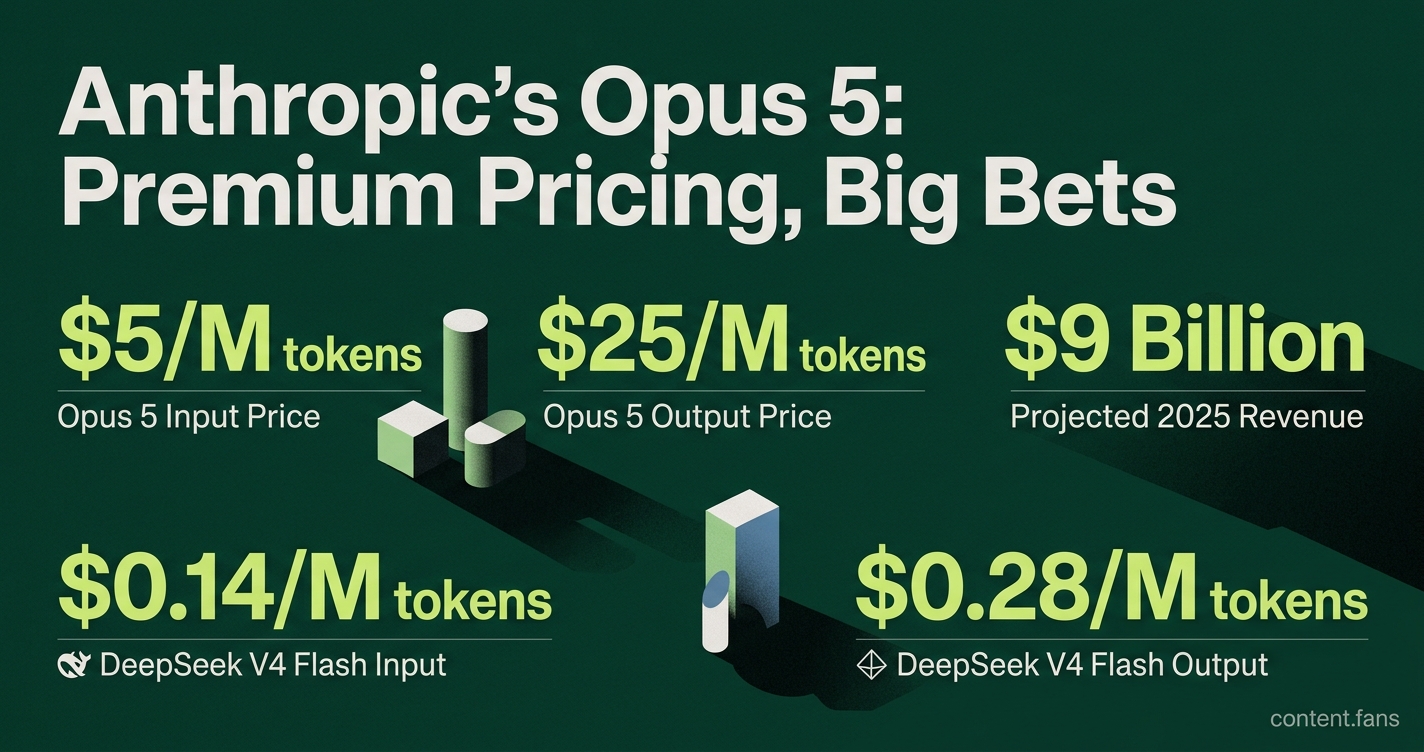
Anthropic does not report revenue by model, so the exact financial contribution of Opus 5 is unknown. Growth stems from enterprise clients, with publicly surfaced sources supporting about $7 billion run-rate in October 2025 and a projected $9 billion by end-2025. Opus 5's premium price suggests it is a key component within this enterprise mix.
This enterprise focus is substantial. According to industry reports, a significant number of business customers drive the majority of revenue, establishing the foundation for continued expansion (Reuters). Industry estimates suggest that many of these clients spend substantial amounts annually on Claude services.
Anthropic's publicly available information confirms growth acceleration, though specific future revenue milestones remain projections rather than confirmed results.
These figures point to significant volume across the Claude model family, but they do not confirm how much of that volume is specifically driven by Opus 5.
Revenue concentration risk
While premium pricing boosts average revenue per token, analysts warn it may cap usage as enterprises throttle consumption to control unpredictable costs. According to industry reports, vendors are increasing renewal prices significantly with AI add-ons, but this strategy requires clear, measurable ROI to succeed.
Opus 5's high price is therefore a double-edged sword, boosting short-term revenue while incentivizing customers to reserve the model for only the most complex tasks.
Competitive pressure from cheaper models
This dynamic is amplified by intense competition from lower-priced models. Companies are increasingly rerouting routine workloads to cheaper systems, with a June 2026 Reuters report noting competitive pricing pressures from alternatives like DeepSeek V4 Flash at around $0.14/$0.28 per million tokens and DeepSeek V4 Pro at $0.435/$0.87 per million tokens compared to frontier model pricing (Reuters price study). Industry reports suggest discounted alternatives can handle most daily tasks for a fraction of the cost of premium models.
As this substitution trend grows, Anthropic may be forced to adopt hybrid or bundled pricing to maintain its user base on the Claude platform. The challenge is significant, as many vendors struggle with cloud expenses, underscoring that pricing strategy is as critical as model performance.
What the numbers may indicate
- Enterprise adoption is the primary growth engine, with token volume outpacing declines in per-unit cost.
- Opus 5 likely accounts for a significant portion of high-margin revenue, though its precise contribution is not public.
- Price wars and cheaper alternatives threaten to compress margins, forcing premium providers to bundle models and demonstrate clear ROI.
Ultimately, the available data presents Opus 5 as a valuable yet vulnerable cornerstone of Anthropic's revenue. Without greater transparency into model-specific economics, its ability to support long-term growth remains a critical open question for customers and investors alike.