
Nebius, CoreWeave stocks surge on short-term AI cloud contracts
Serge Bulaev
Nebius and CoreWeave stocks rose sharply after they offered short-term cloud contracts to take advantage of the current GPU shortage. These short contracts, lasting three to twelve months, may let providers change prices quickly as AI demand changes, and help customers avoid being locked into longer deals. Analysts suggest customers pay more for these flexible terms to get GPUs now, but this may come with risks like higher renewal costs and less planning security for providers. It appears that this strategy could be a shift for smaller companies to compete with larger cloud providers and may keep prices high as long as GPUs are scarce.

The recent surge in Nebius and CoreWeave stocks is linked to their new strategy of offering short-term AI cloud contracts to capitalize on the ongoing GPU shortage. Investors have responded positively to the move, which involves three- to twelve-month deals that allow the companies to reprice capacity dynamically as AI demand fluctuates (source). This flexible approach signals a competitive shift, positioning these smaller "neoclouds" against hyperscalers who typically favor long-term, multi-year commitments.
Immediate market reaction
Nebius and CoreWeave are leveraging short-term contracts to maximize revenue during the current GPU scarcity. This strategy allows them to charge premium rates that reflect immediate market demand, unlike discounted long-term deals. Customers gain flexible access to high-demand hardware, while the providers capitalize on scarcity pricing.
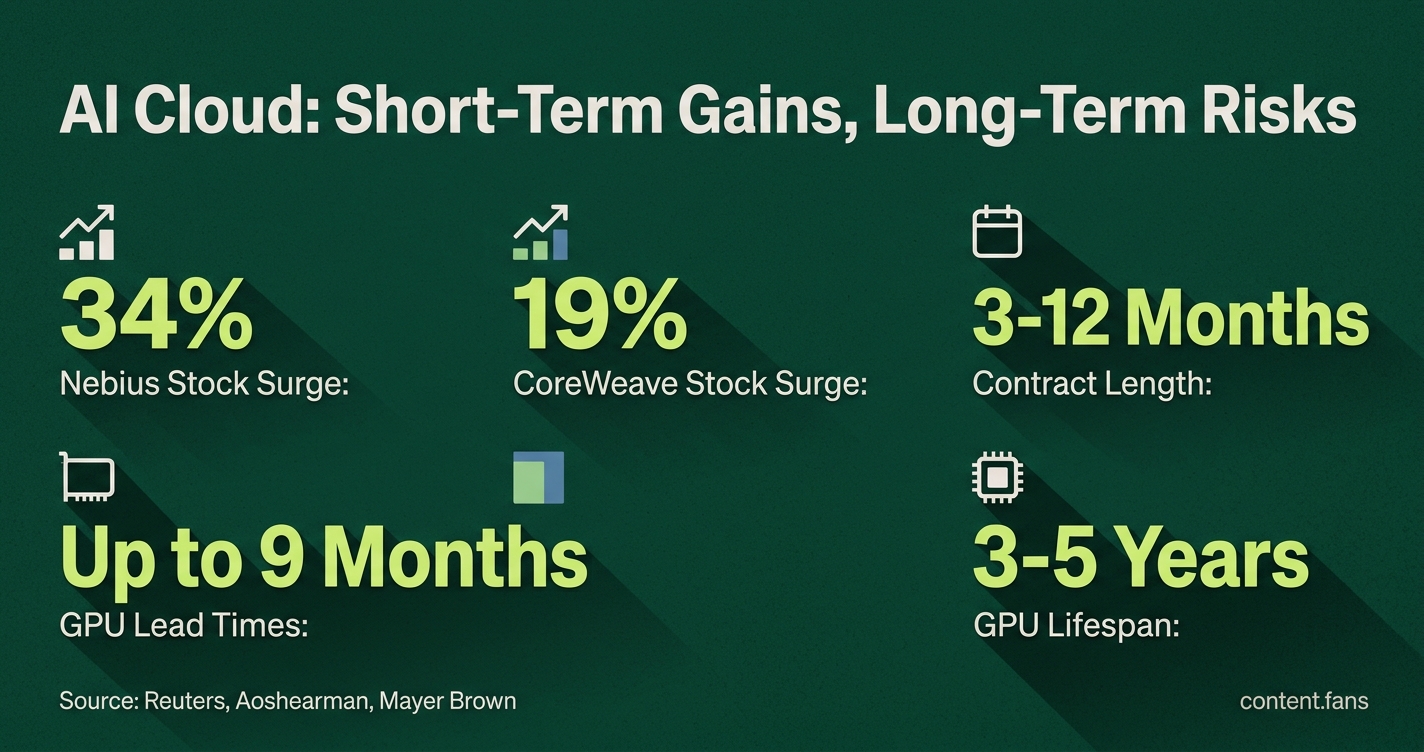
Following the announcement, the market reacted swiftly. Reuters reported an August 12 rally where Nebius stock surged 34% and CoreWeave gained 19% after management emphasized their "pricing power" (link). Industry reports suggest this pricing advantage is significant, with short-term capacity commanding substantially higher rates than longer contracts. Key performance indicators include:
- Nebius: Secured multiple significant AI cloud deals.
- CoreWeave: Increased prices on its H100 clusters in July.
Analysts view this price difference as a premium customers are willing to pay for immediate GPU access without long-term commitments.
Why short contracts appeal during a shortage
During a supply crunch, short-term contracts offer distinct advantages for both providers and customers. With GPU lead times extending up to nine months, research from Aoshearman indicates that agreements now prioritize "supply assurance." Shorter terms enable providers to upgrade to newer hardware, like next-generation NVIDIA chips, more rapidly. For customers, these deals reduce the risk of being locked in with obsolete technology, as a twelve-month contract covers only a small portion of a GPU's three- to five-year economic lifespan.
Risks that accompany the premium
However, this flexibility is not without risks. Industry analysts caution that customers on short-term deals face significant renewal risk, especially if GPU scarcity continues. For providers, the lack of long-term commitments reduces the predictable revenue streams often required for financing data center expansions. Furthermore, law firm Mayer Brown points to potential migration costs, as even short-term leases can create platform lock-in through specific networking and storage configurations, making it costly for customers to switch providers.
Competitive signals for the wider cloud market
This strategy positions Nebius and CoreWeave as agile competitors in a market dominated by hyperscalers, who have reportedly secured significant portions of NVIDIA's upcoming GPU production. By keeping capacity available for the spot market, these neoclouds convert the supply bottleneck into pricing power, avoiding the discounted rates of multi-year deals.
This model is drawing comparisons to energy spot markets, with developments like CME Group's proposed compute futures suggesting a future where AI compute capacity is traded and hedged like a commodity.
The financial results are compelling: Nebius reported that short-term contracts drove a majority of new bookings, while CoreWeave credited these deals for doubling its second-quarter revenue. This success indicates that scarcity pricing is holding firm, even as more H100 and H200 GPUs enter the market. While it remains to be seen how long customers will pay this premium, investors are currently rewarding the strategy of prioritizing high immediate margins over long-term contract stability.
Why are Nebius and CoreWeave prioritizing short-term AI cloud contracts?
Both companies argue that shorter-term deals allow them to capitalize on elevated prices for AI compute during the current tight GPU market. Rather than locking capacity into long-duration commitments, this approach emphasizes quick, high-margin transactions that monetize immediate demand spikes. By maintaining flexibility, these neocloud providers can adjust pricing dynamically as GPU scarcity continues to drive up market rates, effectively turning limited supply into higher per-unit returns.
How did investors respond to this contract strategy?
Investors reacted positively to the pitch, sending shares in both companies sharply higher following the presentations. The market movement suggests strong appetite for business models that can capture immediate pricing premiums in the AI infrastructure space. This rally reflects confidence that prioritizing short-term, high-margin transactions will deliver superior returns compared to traditional long-term contracting approaches during the current supply crunch.
What pricing advantage do short-term contracts offer?
Short-term contracts enable providers to maximize revenue per GPU by trading predictability for premium rates. While long-term commitments typically require discounted pricing to secure multi-year stability, short-duration deals allow providers to charge rates that reflect real-time scarcity. According to reports on Nebius and CoreWeave's short-term cloud deals, this strategy targets immediate margin capture rather than steady, recurring revenue streams, with customers paying a premium for flexible access to scarce AI capacity.
How does this approach differ from major cloud providers?
The strategy represents a deliberate departure from hyperscaler models. While Nebius and CoreWeave pursue short-term flexibility to monetize GPU scarcity, competitors like AWS are emphasizing longer-term commitments. This divergence highlights a market segmentation where neoclouds optimize for immediate margin extraction during capacity crunches, whereas traditional providers prioritize sustained revenue visibility through multi-year contracts that may offer lower per-unit returns during peak demand cycles.
What are the strategic trade-offs of this model?
For providers, the model offers higher utilization rates and pricing power but introduces revenue instability and renewal risk compared to locked-in, long-term agreements. Customers gain flexibility to access scarce GPU resources without lengthy lock-ins, though they sacrifice price predictability. As AI infrastructure evolves rapidly, this approach aligns provider incentives with immediate market conditions, though it requires sophisticated capacity management to avoid idle resources when demand fluctuates.