
Every expands AI training with compound engineering and writing workshops
Serge Bulaev
Every offers camps and workshops to help technical teams learn about AI-driven engineering and writing. Their main program is a four-week course for experienced engineers who want to use AI in their work. The course uses live classes, open work sessions, and case studies, and it may help teams in newsrooms and finance groups. Security is a focus, with lessons on limiting agent access and tracking actions, and writing workshops reportedly show how AI can help with brainstorming and summaries. Graduates get example projects and checklists, and they might use what they learn in their jobs within a month.

Every is expanding its AI training programs to meet rising demand from technical teams in newsrooms and finance, offering specialized workshops in compound engineering and AI-assisted writing. The flagship program, a four-week intensive called "Compound Engineering," is designed for experienced engineers, tech leads, and CTOs seeking to implement an AI-first development workflow.
The program features a blend of live online classes and open working sessions, leveraging insights from Every's internal R&D and past training engagements with organizations like The New York Times and several hedge funds. Its hands-on approach focuses on transferring practical skills for composing small AI agents into robust, reliable systems.
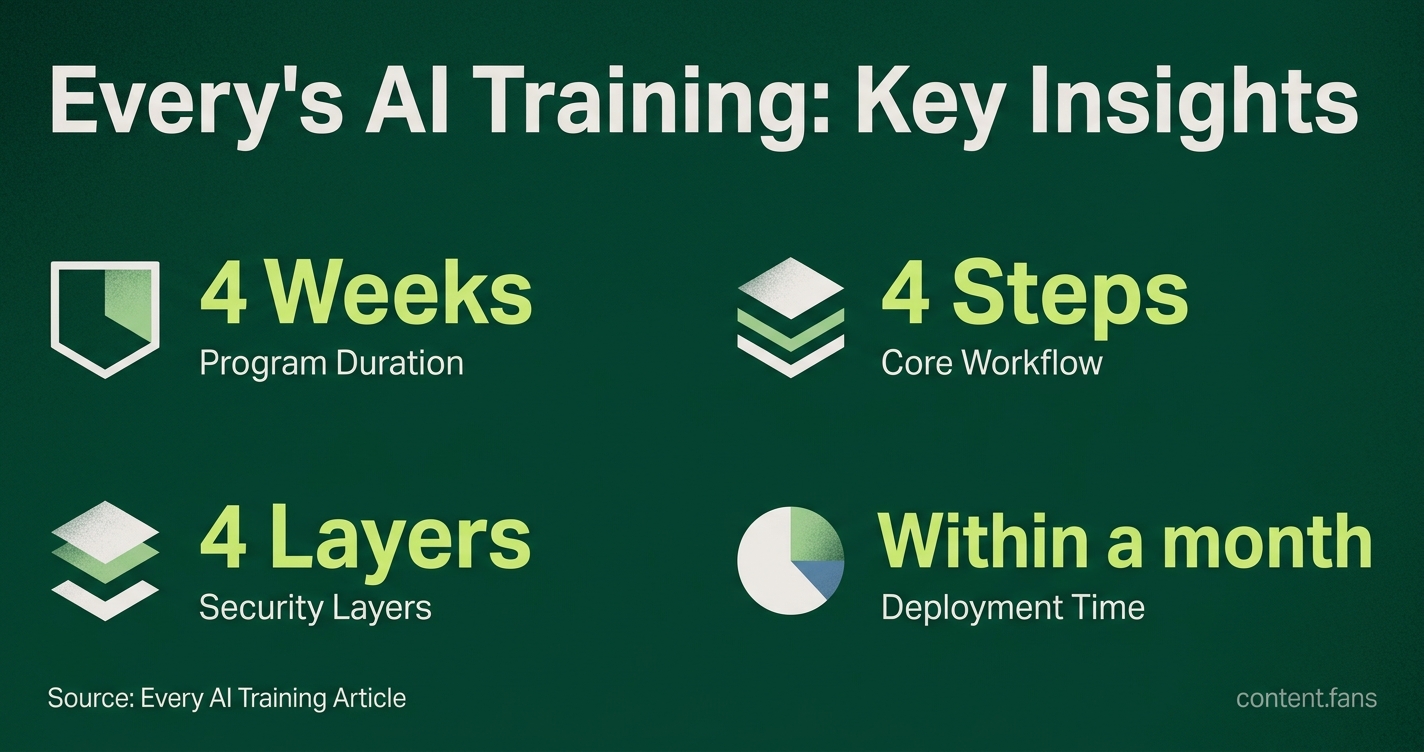
The curriculum is built on Every's core Compound Engineering workflow of four steps, with one update that expands the process with additional stages such as ideate, brainstorm, and polish, but it is not presented as a replacement of the original four-step loop. The GitHub tools supporting these patterns have gained significant traction in the developer community. The upcoming cohort will meet for live sessions on Tuesdays via Zoom, with optional co-working blocks on Thursdays. Full details on the format and schedule are available on Every's event listing and the camp page.
Why enterprises still sign up
Despite the absence of a formal enterprise package, the program consistently attracts senior engineers from large corporations. This trend suggests the curriculum addresses a critical need for operationalizing AI agent workflows within regulated industries, bypassing lengthy procurement processes. The course is taught by faculty including Kieran Klaassen, Entrepreneur in Residence at Every, and Trevin Chow, both maintainers of the company's Claude Code plugin.
Senior engineers enroll to gain hands-on skills for implementing secure, scalable AI agent systems in regulated fields like finance and media. The program's practical focus on operationalizing workflows, taught by experienced practitioners, allows teams to bypass long procurement cycles and deploy solutions quickly, often within a month.
Security philosophy taught in class
The course uses Every's own production security architecture as a central case study. The methodology is built on a four-layer approach to mitigate risks when AI agents interact with tools like Slack, email, or cloud services:
- Least access: Every agent is assigned a unique identity with the minimum permissions required for its designated task.
- Programmatic controls: An allowlist gateway governs tool invocation, restricting and scoping every agent action.
- Prompt-based controls: Untrusted inputs are delimited, validated, and summarized before being processed by the primary agent.
- Observability: Comprehensive logs and dashboards monitor all tool calls, enabling rapid revocation or remediation.
This layered security model aligns with industry best practices from Microsoft and OWASP, which also prioritize task-scoped authorizations and prompt sanitization.
Writing with AI section
A parallel workshop track is dedicated to enhancing writing workflows with AI. Instructors demonstrate how teams at The New York Times reportedly leverage AI for tasks like brainstorming, generating SEO headlines, and creating summaries, all while ensuring human oversight of the final content. For financial applications, the course covers techniques for accelerating memo drafting and summarizing earnings calls. A key focus is teaching attendees to separate data from instructions within prompts to prevent data leaks and maintain brand style guides.
What participants take home
Upon completion, graduates receive a portfolio of practical assets, including a reference implementation they built during the course, a deployment checklist for least-privilege agents, and sample prompts tailored for editorial and financial use cases. According to the camp's FAQ, participants are often able to adapt these materials for production use within a month. While no formal certification is offered, alumni gain access to a private Slack community for ongoing collaboration, code sharing, and security updates.
What is compound engineering and why is it critical for modern development teams?
Compound engineering is an AI-native development philosophy that involves composing systems from multiple AI models and agents rather than relying solely on manual code. Every's training treats AI as a collaborative partner, focusing on practical skill transfer from real-world deployments. This methodology also guides organizations in balancing security and speed by strategically reducing their attack surface while maintaining development velocity.
Who should participate in Every's AI training programs?
Every's workshops are designed for experienced engineers, technology leads, and CTOs who possess a technical background and need to operationalize AI workflows. The curriculum draws on direct experience from training teams at The New York Times and leading hedge funds. Participants learn through a combination of live workshops and weekly open working sessions, ensuring the skills are immediately applicable.
How does Every secure AI agents in enterprise environments?
Every teaches a four-layer security model to protect AI agents in enterprise settings: least access, programmatic controls, prompt-based controls, and observability. This framework involves granting agents unique, lifecycle-managed credentials with minimal permissions. To manage inputs, teams learn to apply prompt-based controls by isolating instructions from untrusted data and validating external content before processing, which ensures robust security without hindering workflow efficiency.
How are major publications like The New York Times actually using AI in their workflows?
Leading newsrooms like The New York Times use AI to support tasks such as article summarization, SEO headline creation, social media copy, and research analysis, always under strict human oversight. The Times uses internal tools like Echo for summarization and allows AI for coding and document analysis, but final accountability remains with journalists. This approach is similar to how financial firms use compound engineering for drafting investment memos and summarizing earnings calls.
What formats do Every's compound engineering workshops take?
Every's intensive training camps consist of four live workshops conducted via Zoom, complemented by weekly open working sessions for collaborative development. The curriculum covers both compound engineering and AI-assisted writing, drawing on Every's own successful experiments with agent-based systems. This format provides direct, hands-on skill transfer for teams looking to master and deploy complex AI workflows.