
Amazon's $1.8M Claude AI Project Ran 860% Over Budget
Serge Bulaev
Amazon spent $1.8 million on a Claude AI project that ran 860% over its budget and did not result in a finished product. The high costs were discovered only after five months, when engineers reviewed the usage data. This situation may suggest that big companies like Amazon have trouble tracking spending on generative AI projects. Industry research shows that many companies have poor visibility into their AI costs, and several common issues make forecasting hard. Experts recommend better tracking, real-time alerts, and clear accountability to avoid similar problems in the future.

An internal Amazon Claude AI project accumulated $1.8 million in costs over five months, running 860% over budget before being discovered. The experimental project, designed to match authors to book listings, never resulted in a shipped feature and highlights a significant challenge in managing generative AI expenses.
This incident suggests a critical visibility gap in how large enterprises track and control generative AI expenditures, a problem echoed across the industry.
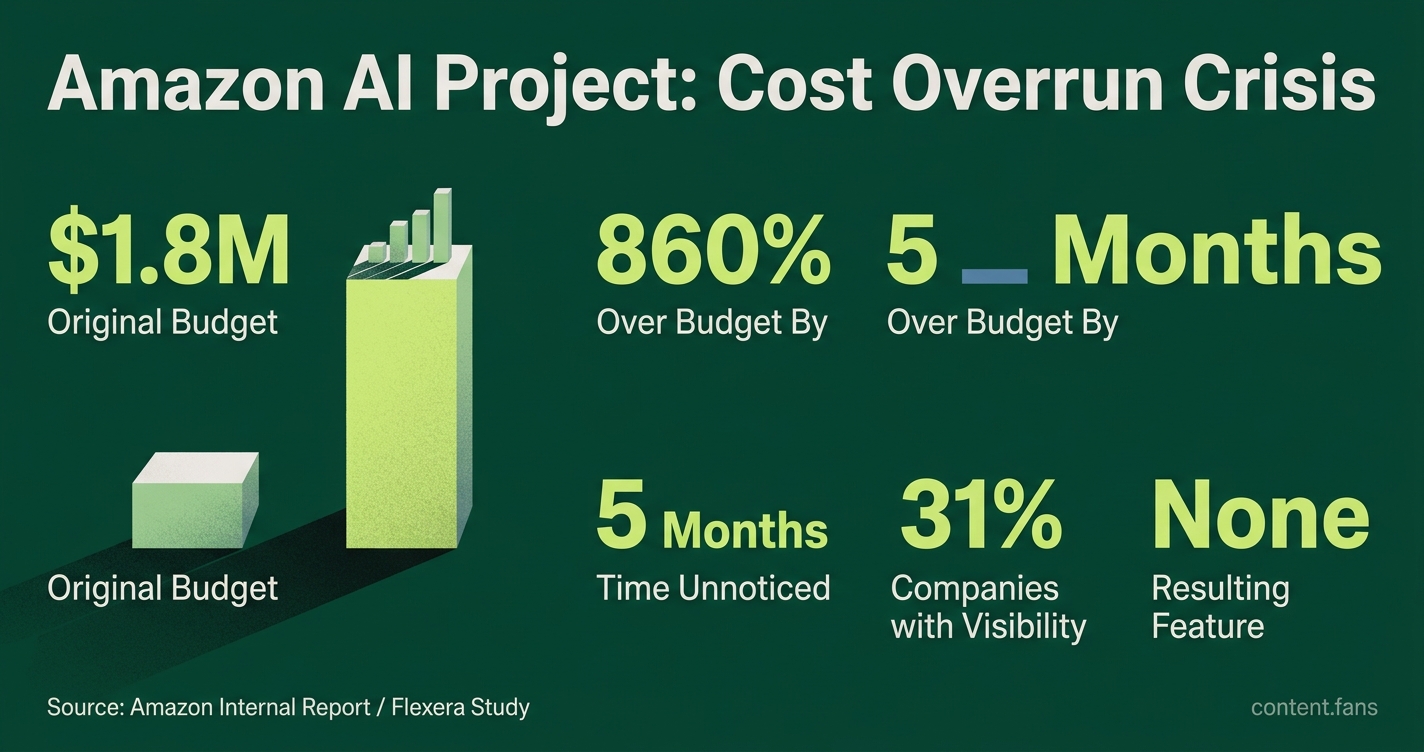
How the cost overrun unfolded
The project's costs went unnoticed for five months due to a lack of real-time spending alerts and clear cost ownership. The team reportedly had "no clear view" of the expenses, allowing API fees to accumulate until a manual review of internal usage metrics finally revealed the massive overrun.
Engineers at Amazon utilized Anthropic's Claude Sonnet model for an internal project matching book authors with product listings. The model ran continuously for five months, accruing substantial API fees before any alarms were raised, vastly exceeding initial budget estimates. While public Bedrock pricing for Claude 3.5 Sonnet is known, the project's specific token usage was not disclosed in internal reports.
Further internal audits revealed additional experimental AI projects that contributed significant unplanned spending. These multiple initiatives resulted in substantial surprise AI-related costs for the company beyond the initial $1.8 million overrun.
Why tracking AI spend is still hard
Amazon's situation is not unique. Industry surveys highlight a widespread pattern of poor cost control. According to a Flexera's 2026 study, only 31% of companies have accurate visibility into AI software costs. Furthermore, many companies miss their infrastructure forecasts by significant margins, and industry research indicates that a substantial portion of organizations struggle to confidently link AI spend to ROI.
Several structural factors make forecasting difficult:
* Variable Consumption Pricing: Costs fluctuate based on the model used, region, and traffic patterns.
* "Shadow AI" Projects: Unofficial experiments often bypass standard procurement and oversight.
* Fragmented Invoicing: Using multiple third-party APIs and cloud GPUs complicates cost tracking.
* Hidden Data Costs: Expenses for data preparation and integration are often excluded from model usage bills.
Emerging governance playbook
To prevent such overruns, experts cited in Deloitte's 2026 State of AI report recommend managing AI workloads as recurring operational expenses, not one-off projects. Key controls include tagging each API call with a business owner, setting up real-time alerts for budget deviations, and tying costs directly to business value. Additionally, early model sizing reviews can mitigate risk by preventing the use of unnecessarily powerful - and expensive - models.
Based on analysis from multiple sources, a concise governance checklist includes these key actions:
* Establish a Central AI Inventory: Create a single, sanctioned list of approved models, prompts, and endpoints.
* Assign Clear Ownership: Allocate every AI cost center to a specific, accountable team and business workflow.
* Implement Proactive Reviews: Conduct monthly variance reviews comparing actual spend against forecasted scenarios.
* Enable Real-Time Alerts: Shift from monthly bill reviews to real-time alerts that trigger on unexpected usage spikes.
The incident at Amazon serves as a powerful case study for why these governance measures are essential. Without granular cost tagging and real-time monitoring, a simple five-month experiment spiraled into a multi-million-dollar invoice, bypassing existing engineering review processes.
What exactly was Amazon's $1.8 million Claude AI project?
The project involved using Anthropic's Claude Sonnet to match author details with product listings internally. According to reports, this single initiative accidentally accumulated $1.8 million in costs while running 860% over budget, and critically, the project never shipped despite the substantial expenditure.
How does this specific overspend compare to other AI costs at Amazon?
The $1.8 million Claude project was part of a broader pattern of unplanned AI spending across multiple initiatives. Other projects included a financial auditing tool and a logistics network project that generated additional unexpected costs, illustrating how AI costs can proliferate across different departments simultaneously.
Why did the budget overrun go unnoticed for five months?
A senior employee cited difficulty in tracking AI-related costs as a core issue, highlighting how large-scale experiments with advanced models can produce substantial expenditures that evade immediate detection. This lack of visibility stems from complex, consumption-based pricing models and fragmented tooling that make real-time cost attribution challenging even for technology giants with sophisticated financial systems.
Is Amazon's experience with runaway AI costs unique in the industry?
Unfortunately, this reflects a broader systemic challenge rather than an isolated incident. Industry research indicates that many enterprises significantly miss their AI infrastructure forecasts, while a substantial portion of organizations struggle to confidently evaluate the ROI of their AI investments. As enterprises contend with mounting AI costs and multi-model tool sprawl, multi-million-dollar bills accumulated over months have become increasingly common across Fortune 500 companies.
What governance measures can prevent similar budget catastrophes?
Organizations must move beyond traditional cloud billing reviews and implement FinOps-style controls with workflow-level cost attribution. Key steps include creating comprehensive inventories of sanctioned and unsanctioned AI tools, mapping spend directly to specific business workflows rather than just infrastructure, and applying scenario-based forecasting with anomaly detection alerts. This approach allows finance and engineering teams to maintain shared visibility before experimental projects generate seven-figure bills.