
Reliable AI Requires Disciplined Workflows, Not Heroic Prompts
Serge Bulaev
The text suggests that reliable AI is achieved through disciplined and structured workflows, rather than relying on clever or complex prompts. It appears that using modular pipelines, clear validation steps, and observability from the start makes errors more visible and manageable. Human checks may be needed when the system is uncertain, and this can save time and increase safety. Metrics such as speed, error rates, and accuracy are closely monitored, and if issues are found, the system can switch to safer options. This approach may lead to smoother operations and easier problem-solving for teams.

Achieving reliable AI isn't about crafting heroic prompts; it's about building disciplined, production-grade workflows. Top engineering teams find that mature systems - which treat model calls as steps in traceable pipelines - are the key to making failure modes visible and recoverable. This approach confines surprises and delivers predictable, auditable results.
The disciplined pattern begins with a modular graph where each node has a single, well-defined responsibility and a strict input-output schema. As recommended in Anthropic's guide on Building Effective AI Agents, the simplest solution is often best. This means chaining retrieval, reasoning, and tool calls through hard-coded routes instead of allowing an unconstrained agent. A deterministic router can then select the most efficient model for each subtask, while orchestration tools like Airflow or Prefect manage retries, back-pressure, and alerts.
Validation and gating
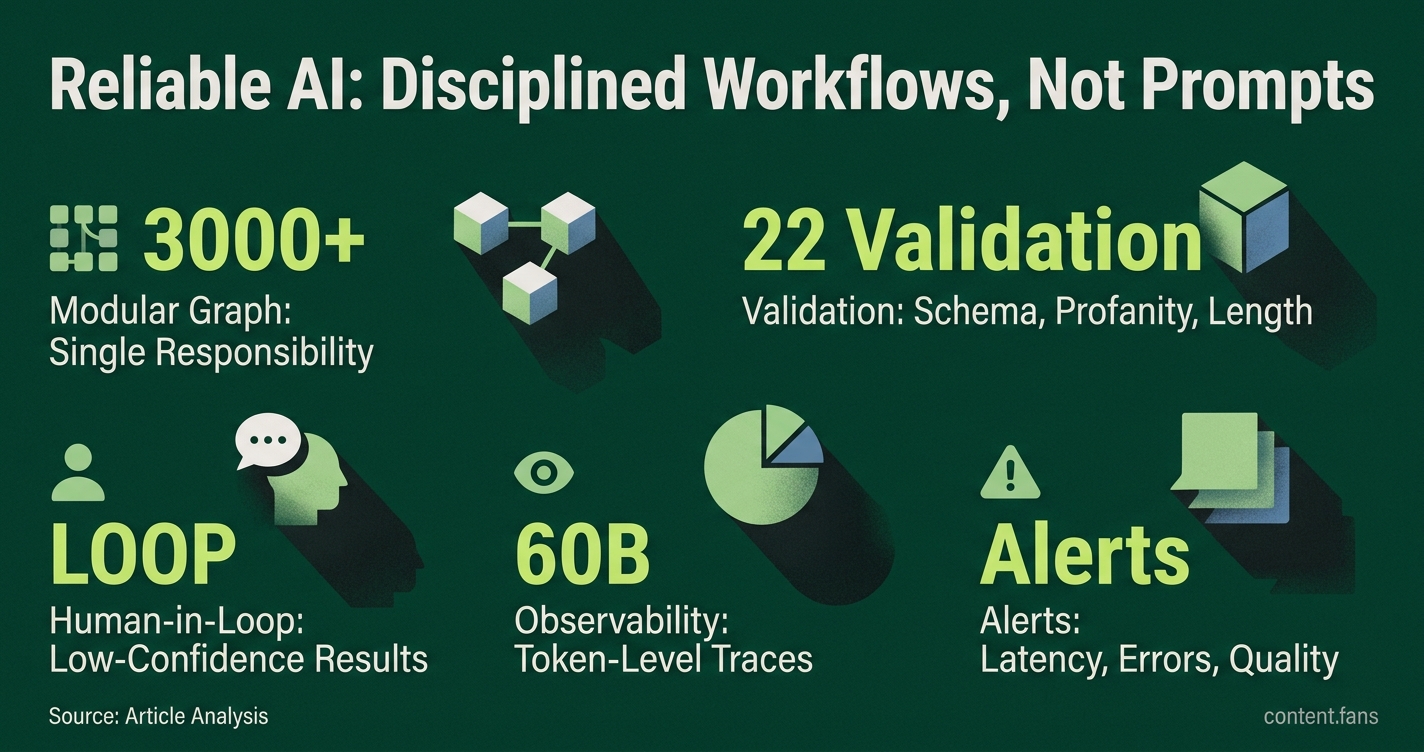
Reliable AI systems are built using disciplined workflows, not just clever prompts. This involves creating modular, traceable pipelines where every step is validated. By instrumenting observability from the start and using human-in-the-loop gates for low-confidence results, teams can manage errors and ensure predictable outcomes.
Component boundaries may use validators or checks where needed for traceability, schema enforcement, or model validation. Teams deploying document extraction successfully use JSON schema checks, profanity filters, and tokenizer length guards to enforce quality. Industry guidance highlights that blindly retrying a failed LLM call increases cost without improving results; a retry should only happen after an automatic transformation, like trimming context or switching to a higher-temperature sampler 10 best practices for building reliable AI agents in 2025. When confidence scores fall below a set threshold, the system must escalate. For example, industry reports show accounts-payable pipelines that automatically process standard invoices but route ambiguous ones to human reviewers, delivering significant time savings. This proves that human-in-the-loop gates offer both a safety net and a clear ROI.
Observability from day one
Effective workflows require engineers to instrument traces at the token level from day one. Production metrics commonly include time-to-first-token, time-per-output-token, and rolling error rates. Comprehensive logs must capture prompt versions, retrieval sources, model responses, and tool actions. These traces stream to a time-series backend where dashboards can visualize "goodput" - the rate of requests meeting all service-level objectives (SLOs). Alert rules typically monitor three critical channels: latency breaches, error rate spikes, and quality regressions. Because every component is versioned - prompts in Git, evaluation data in object storage, and DAGs with run hashes - rollbacks are fast and straightforward.
Implementation template
A production-ready implementation follows a clear, seven-step process:
- Ingest - Collect inputs via typed interfaces, rejecting malformed data immediately.
- Retrieve - Query a vector store and attach source citations for validation.
- Reason - Send a structured, token-limited prompt to the selected model.
- Act - Execute side effects like database writes using deterministic tools.
- Validate - Apply rubric scoring or regex guards, routing low-confidence outputs to a human review queue.
- Log - Emit structured events for every step, correlated by a request ID.
- Evaluate - Run nightly regression tests against golden datasets to catch performance drifts.
This entire directed acyclic graph (DAG) is scheduled by tools like Prefect or Airflow, with OpenTelemetry feeding an observability stack. New releases are promoted only after passing task-level acceptance thresholds in a staging environment that mirrors production traffic.
Metrics that matter
To maintain reliability, teams must focus on metrics tied directly to user experience and system health. Key service-level objectives (SLOs) include:
| Area | Example metric | Typical target |
|---|---|---|
| Latency | TTFT p95 | Use-case dependent |
| Reliability | Error rate | Low percentage |
| Output quality | Rubric score | Use-case threshold |
| Retrieval accuracy | Faithfulness trend | Non-decreasing |
| Cost | Tokens per success | Budget bound |
These SLOs should live alongside the code and be checked continuously by the orchestration layer. If any metric breaches its objective, the pipeline should automatically throttle traffic or switch to a safer fallback, such as a cached response or a smaller, more stable model.
Ultimately, mature workflows treat AI not as a magical autonomous agent but as a cognitive microservice: bounded, testable, and fully observable. Teams that adopt these disciplined engineering patterns report smoother upgrades, clearer audit trails, and a welcome reduction in late-night emergencies.
What makes an AI workflow "Level 5 reliable" instead of just prompt-driven?
Mature reliability is reached when the pipeline behaves like shipped software: every step is modular, every output is validated, and any failure is captured in metrics that trigger an alert or rollback. Instead of betting on a single heroic prompt, teams build a bounded graph in which deterministic workflows execute the majority of steps, and narrowly-scoped agents are used only for the remaining decision points[2][4].
How can I turn "quality" into a measurable SLO?
Treat AI outputs as another micro-service and write SLOs that mirror real user pain. A growing pattern adopted by leading platforms is:
| SLO area | Example threshold | How to instrument |
|---|---|---|
| Latency | TTFT p95 for chat | Stream-level tracing (first token timestamp) |
| Accuracy | Task-specific rubric | Nightly eval jobs with golden datasets |
| Data drift | PSI score triggers human review | Continuous prompt-topic distribution |
| Cost | Budget burn over plan | Token-meter and goodput dashboards |
This layered approach moves from "the model feels worse" to measurable quality degradation over time[1][7].
Which orchestration tools are proven in production for AI pipelines?
Airflow and Prefect remain the default for deterministic DAGs (ingest, transform, schema gates), while vector databases like Pinecone or Weaviate act as both retrieval layer and lineage store. A common pattern is:
- Airflow DAG - orchestrates deterministic steps: data validation → retrieval → deterministic prompt template → schema check.
- Prefect flow - runs final quality evaluation; if the rubric score falls below threshold, it triggers a Prefect retry or human review task.
- Vector DB callbacks - log embeddings + metadata so any rollback can reproduce the exact retrieval context[2][4].
When should a human actually be pulled into the loop?
Human-in-the-loop is not a blanket approval step; it is an exception handler. Industry deployments show common triggers:
- Confidence score below threshold (e.g. retrieval faithfulness below acceptable levels).
- Regulated domain (finance, health, insurance) where an audit trail is required.
- Cost spike predictor flags a request that would breach the daily token budget significantly.
Many companies cut manual effort substantially precisely because humans intervene only on the remaining edge cases[1].
How do I design a retry or rollback strategy that is safe for non-deterministic agents?
The key is to separate deterministic plumbing from agentic divergence:
- Retries belong to deterministic blocks only (network call, tool execution).
- Agent outputs are never blindly retried; instead, route the request back into a human approval queue or fall back to a simpler deterministic workflow.
- Version every immutable asset - prompts, tools, embeddings - so a rollback is as simple as pinning an Airflow variable to the previous git tag.
UiPath warns that retrying an agent usually amplifies variance, whereas rolling back the prompt version and its corresponding eval suite restores a known-good state[2].