
AI Fakery Becomes Top Boardroom Crisis for 2026
Serge Bulaev
AI fakery may become the top crisis for companies by 2026, as fake videos and images spread faster than real news. Boards now worry about synthetic clips of executives making false statements, which might cause people to doubt everything they see. Experts suggest organizations need to prove their content is real before people start to distrust all media. New strategies include using digital tags to show authenticity, checking images before sharing, and responding quickly to possible deepfakes. Legal and PR teams may need to work closer together because slow or uncoordinated responses could let false stories become permanent online.
AI fakery is rapidly becoming a significant reputation crisis, spreading with a velocity that most corporate boards are unprepared for. The concern has shifted from rumor blogs to hyper-realistic synthetic videos of executives in false scenarios, like announcing fabricated layoffs. This exposure to deepfakes cultivates a pervasive "truth fatigue," eroding audience trust in all digital media, according to industry reports.
The imperative for organizations is now clear: they must proactively prove the authenticity of their communications before widespread disbelief becomes the default.
Why AI Fakery Dominates Boardroom Agendas
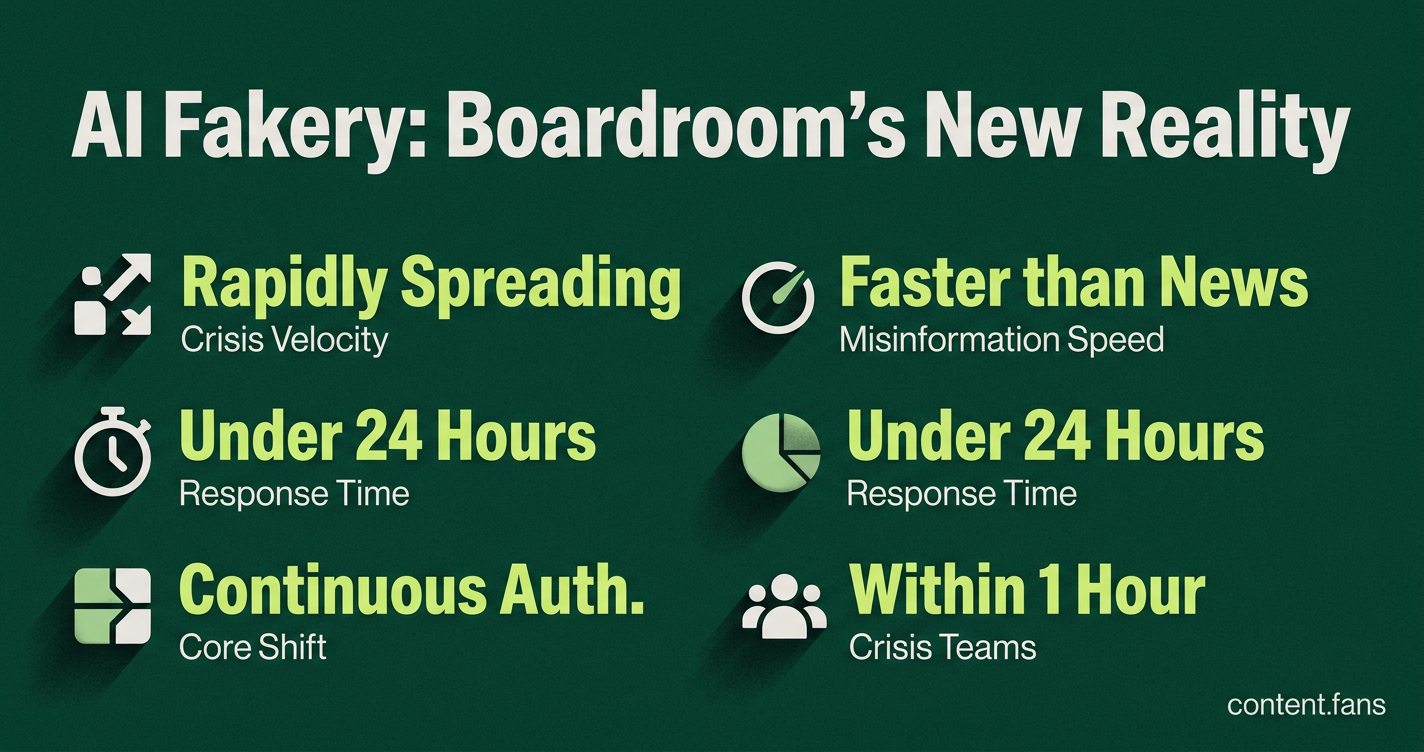
AI fakery dominates agendas because misinformation now proliferates significantly faster than verified news, making traditional 24-hour crisis responses obsolete. A single deepfake can manipulate market value before verification is possible, shifting corporate risk management from reactive defense to proactive, continuous authentication of all published content.
Market analysts confirm that misinformation travels substantially faster than verified news, a speed that renders legacy crisis playbooks obsolete. Industry reports highlight that even a brief deepfake of a CEO can impact share prices before verification protocols can engage. This reality has forced corporate reputation management to evolve from reactive rebuttals to a model of continuous provenance verification.
Core Shifts in Crisis Preparation
- Cryptographic Credentials: Implementing emerging standards to embed verifiable authenticity into corporate photos and videos.
- Real-Time Detection: Deploying automated tools to continuously scan social media and LLM outputs for brand-related fabrications or hallucinations.
- Mandatory Human Oversight: Requiring human-in-the-loop review for all AI-generated public statements to ensure accuracy.
- Integrated Crisis Response: Establishing cross-functional "digital war rooms" that unite legal, communications, and cybersecurity teams within the first hour of a detected threat.
Tactics to Counter Deepfake Amplification
- Embed Provenance Tags: Integrate machine-readable content provenance tags that allow journalists and automated systems to verify authenticity instantly.
- Verify Third-Party Visuals: Mandate reverse-image and metadata analysis before any third-party visuals are shared internally or externally.
- Prepare Rapid-Response Statements: Pre-draft holding statements to acknowledge a potential incident and announce an investigation as quickly as possible.
- Conduct Forgery Drills: Schedule quarterly tabletop exercises that simulate sophisticated voice-clone or video forgery attacks.
- Secure High-Value Transactions: Implement offline verification codes and protocols for critical financial approvals to prevent AI-driven fraud.
Governance, Culture, and the Human Firewall
Technical controls alone are insufficient; experts stress that they must be supported by a robust culture of verification. Effective governance includes training employees and board members to recognize sophisticated emotional manipulation tactics used in synthetic outrage campaigns. The legal imperative is also growing, with research linking AI hallucinations to significant fraud losses and reinforcing the need to classify disinformation as a formal risk. Concurrently, communications leaders are diversifying content across multiple trusted platforms to leverage the preference of AI ranking algorithms for multi-source corroboration.
Aligning Legal and Communications for a Unified Response
Significant coordination gaps between legal and PR teams, which adversaries readily exploit, are a critical vulnerability. Proactive organizations address this by developing a unified deepfake playbook that clearly defines decision rights and triage protocols. This ensures a single, coherent voice communicates with regulators, the media, and investors. Speed is paramount: corrections issued within 48 hours are more likely to be indexed correctly by AI retrieval systems, whereas delays risk allowing the false narrative to become a permanent part of the AI's training data.
The new standard of care for corporate reputation is defined by continuous monitoring, rapid authentication, and rigorous, cross-disciplinary rehearsals. Organizations that delay preparations for synthetic media threats will find the false narrative has already been permanently encoded into the internet's collective memory.
What makes AI-generated fakery the number-one boardroom threat for 2026?
Hyper-realistic deepfakes now spread significantly faster than verified news, and once an AI model ingests a false claim it becomes almost impossible to erase. A single fake CEO resignation video can move markets before compliance teams finish their first call, while "LLM grooming" lets attackers quietly seed training data so generative systems repeat lies with confidence. The result: truth fatigue among stakeholders and a permanent stain on corporate credibility if the story is not killed within the first 48 hours.
How should legal and communications teams align during an AI misinformation incident?
Best-run firms stand up a digital war-room where legal, PR, security and executives share one intelligence layer and operate from a pre-signed RACI matrix. Legal sets the liability threshold for synthetic media, shields messages with attorney-client privilege and blocks any wording that could waive rights; communications drafts the plain-language narrative, runs media-forensics tools and publishes the first "we are investigating" acknowledgment as rapidly as possible. Without this fusion model, industry reports show alignment scores decline significantly and responses stall in cross-border approval loops.
Which technical steps verify an AI-generated hoax before it scales?
- Run reverse-image or video search with InVID or Google to spot recycled footage.
- Inspect metadata and cryptographic credentials; missing or broken chains flag manipulation.
- Tokenize text, extract entities and cross-check against Wikidata or Google Knowledge Graph for date, name or place mismatches.
- Escalate any anomaly to a human verifier who consults sector-specific sources (e.g., Kaspersky for cyber, Chequeado for political claims).
- Document findings in the shared intelligence layer so every function bases its next move on the same verified facts.
What belongs in a 90-day pre-crisis rollout?
- Days 1-30: Approve a deepfake playbook, pick detection tools, designate backup spokespeople.
- Days 31-60: Stage a cross-functional tabletop simulating a voice-clone ransom call; launch weekly AI-output scans; publish pre-bunks for known hostile narratives.
- Days 61-90: Freeze a quarterly drill schedule, embed trust scorecards and set SLAs: first public statement within one hour, factual correction within 48 hours to stay visible to ChatGPT-style retrieval indices.
Why is proactive provenance cheaper than any cleanup?
A 2019 MIT study showed misinformation spreads significantly faster than truth, and the EU AI Act (effective 2024-2025) establishes transparency requirements for AI systems. Embedding tamper-evident watermarks or authentication credentials costs little per asset yet provides instant authenticity proof, sparing brands the substantial losses that can result from sophisticated deepfake attacks. In short, cryptographic provenance turns "plausible deniability" into verifiable truth before doubt can germinate.