
Media Hits Saturation: Time Spent Stagnates, AI Cuts Creation Costs
Serge Bulaev
Media time spent by people appears to have reached a limit, with only small increases in recent years. Doug Shapiro suggests that while content is becoming easier and cheaper to create through digital tools and AI, people's attention is spread thin and trust is now scarce. Companies may need to focus more on building trust, data, and real community, rather than just reaching more people. There also appears to be a shift in what people value, with authenticity and emotional connection seeming more important than high production quality. Experts warn that it might take years for new ways to make money off engagement to make up for falling ad revenue, as total time spent with media is not growing much.

The era of media hits saturation is upon us, as daily consumption time flatlines while AI drives content creation costs toward zero. This convergence creates immense monetization pressure and fragments audience attention, fundamentally reshaping the industry.
Doug Shapiro's influential 'mental model of media' provides a critical framework for this new reality. It offers executives a lens to understand how value shifts when content is abundant, time is finite, and consumer trust becomes the scarcest resource of all.
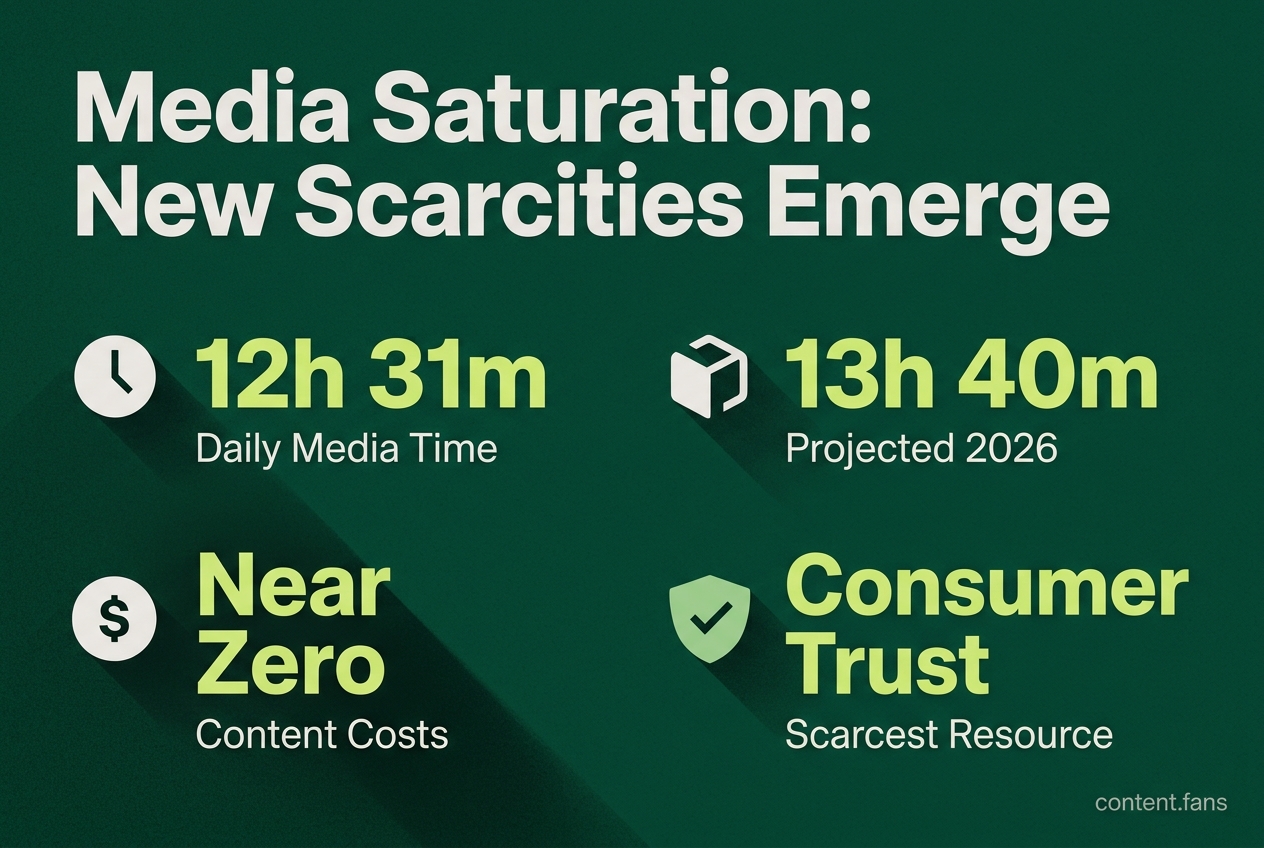
Stagnant time collides with widening choice
Media saturation means consumer attention has reached its upper limit, with total time spent on media growing minimally, if at all. This creates a zero-sum game where platforms and creators can no longer grow the overall attention pie but must compete fiercely to capture share from rivals.
Recent data reveals just how close we are to a ceiling. According to eMarketer, in 2023, U.S. adults spent 12 hours and 31 minutes daily with media; projections for 2026 indicate approximately 13 hours and 40 minutes [1]. Globally, industry reports suggest consumption growth has slowed significantly in recent years. As total hours stagnate, attention splinters across a widening array of choices, with gains in one area, like gaming, directly causing losses in another, such as linear TV.
Scarcity shifts to trust, data and community
In his Substack essay, Shapiro argues that as infinite content pushes prices toward zero, the strategic focus must shift to what remains scarce Media Mental Model. With attention at a premium, value migrates to a new set of limited resources that serve as competitive moats:
- First-party data
- Consumer trust
- Curated discovery
- Authentic creator relationships
- Community belonging
- In-real-life experiences
Leading companies are now prioritizing engagement tactics that cultivate these assets. Rather than chasing raw reach, they are building revenue from devoted audiences through memberships, live events, and exclusive merchandise - models that are resilient to falling ad CPMs.
Quality redefined, earnings per hour under strain
The very definition of 'quality' is being redefined by audiences. For Gen Z and millennials, attributes like authenticity and emotional connection now surpass high production value in importance, according to Deloitte. While short-form video dominates discovery, marketers recognize that earnings per hour are strained, as longer content formats are often required to build the trust necessary for monetization. This supports Shapiro's view of content as top-of-funnel marketing; its primary role is to drive downstream profits from scarce complements like merchandise, live events, and IP licensing. This strategic shift explains the rise of bundled publisher offerings and hybrid creator business models.
Implications for strategy
While breakout hits still matter for creating attention spikes and social proof, the declining probability of achieving one means strategy must evolve. Forward-thinking organizations are tightening their content-approval criteria, prioritizing formats with cross-platform potential, and investing heavily in data systems that identify and nurture fandoms. However, Shapiro warns that this transition is not immediate; it could take years for new engagement-based revenue to replace falling ad yields. In a world of stagnant attention, every new venture must steal share from an existing habit, which increases customer acquisition costs and proves the immense value of the loyalty assets being built today.
What does stagnant total media time mean for creators and platforms?
Global weekly consumption has largely flat-lined in recent years, while U.S. viewers are approaching record daily consumption levels according to industry reports. The ceiling turns media into a zero-sum tug-of-war: every minute TikTok gains is one linear TV loses. The implication is clear - growth now comes only from stealing share, not from growing the pie.
How is attention fragmentation changing discovery?
Many households now juggle multiple subscription apps and actively toggle between significantly more digital channels than in previous years. This splintering makes first-impression moments the new currency; content that does not hook within the opening seconds is swiped away. Industry reports suggest hold-rates drop substantially for every extra second of hesitation.
Why is monetization per hour under pressure?
Advertisers are migrating from attention payments to action payments - they now reward clicks, sign-ups or sales, not just views. Meanwhile, the share of time spent with ad-supported media has fallen to historic lows according to industry reports, squeezing CPMs. Short-form clips, the fastest-growing sector, score 3.5/5 for reach but only 1.9/5 for revenue, widening the reach-versus-revenue gap.
How are consumer definitions of quality shifting?
Industry reports suggest the sweet-spot length for short-form content has been stretching in recent years, rewarding value density over pure brevity. Polished studio aesthetics have been replaced by raw, user-generated authenticity as Gen Z scrolls past anything that looks overly produced. Posts labeled "authentic" generate 2.5× more engagement than their glossy counterparts.
What strategic pivot does the model recommend?
Shapiro's framework predicts that creation costs will trend toward zero thanks to GenAI, so content itself becomes a cost center rather than a profit center. Winners will:
- Treat video, audio or text as top-of-funnel marketing
- Sell scarce complements - live events, limited merch, or exclusive access
- Build trust and first-party data instead of renting attention
In short, monetize fandom, not footage.