
Europe Reconsiders Copyright for AI Training, Citing 1710 Statute of Anne
Serge Bulaev
Europe is considering using ideas from the 1710 Statute of Anne for AI training, which would give creators exclusive rights for a short time and then allow free public access. This approach may help Europe stay competitive, but the current EU copyright rules make AI training on data complicated and uncertain. The 2024 AI Act keeps some opt-outs for rightsholders and adds more transparency rules, but challenges remain, like different national laws and unclear access. Supporters suggest a fixed-term model might increase available data for AI over time, yet no new law has been proposed yet, and future rules remain uncertain.
As Europe reconsiders copyright for AI training, policymakers are drawing inspiration from the 1710 Statute of Anne. This historical model, which balanced limited creator exclusivity with eventual public access, offers a potential framework for allowing AI to train on data without harming creative industries. Proponents argue this "Anne-style bargain" could boost the continent's AI competitiveness, a critical goal given its lag in semiconductor and cloud infrastructure.
However, this policy discussion confronts the rigid realities of the EU's current legal framework. The 2019 Copyright in the Digital Single Market (CDSM) Directive allows text and data mining (TDM) under strict conditions. While Article 3 permits TDM for scientific research, Article 4 allows commercial AI developers to use data unless rights holders explicitly opt out. This opt-out system has created significant legal uncertainty and a fragmented compliance landscape across member states.
How the AI Act Reshapes the Bargain
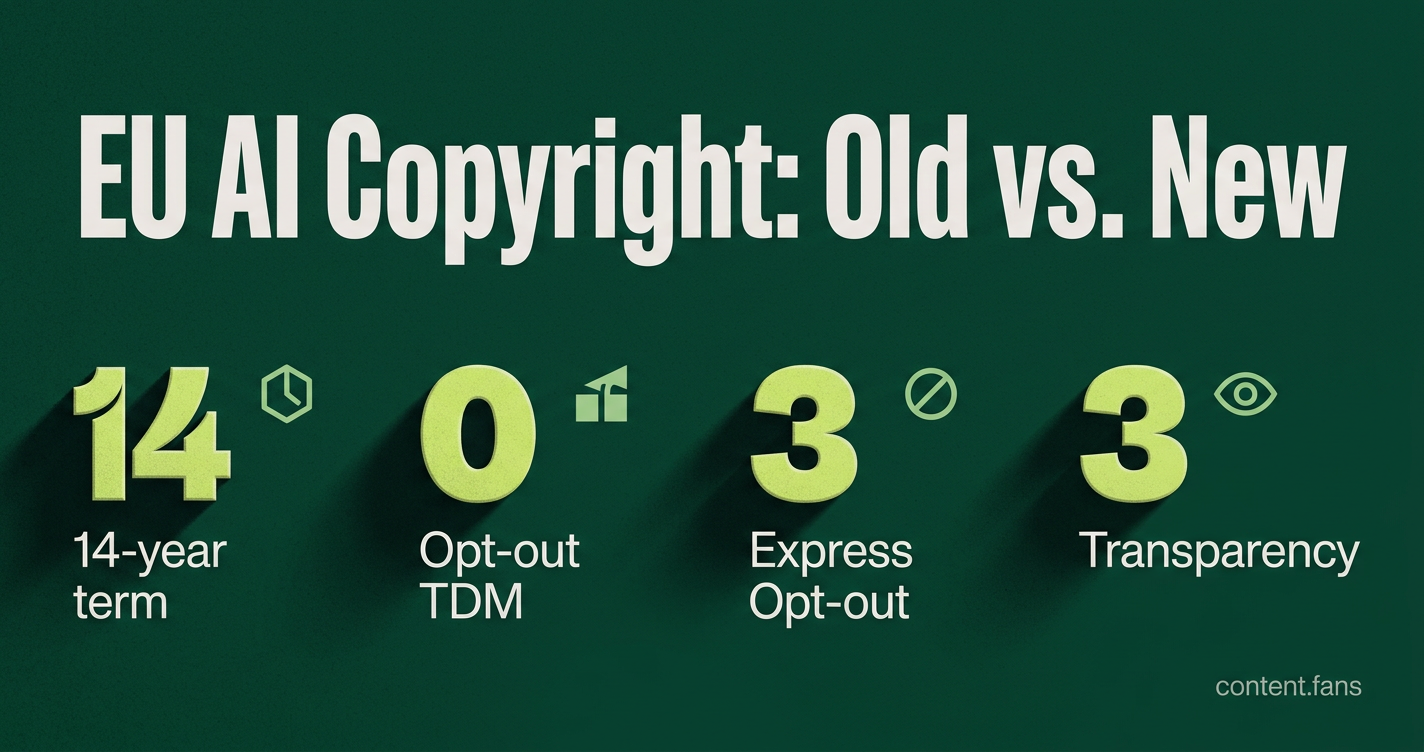
The EU AI Act (Regulation 2024/1689) requires that for general-purpose AI models, the opt-out from TDM must be 'expressly reserved in an appropriate manner' to be effective, tightening the previous standard. It also introduces new transparency obligations for GPAI providers. It clarifies that TDM is a form of reproduction requiring authorization or a legal exception. Furthermore, the Act mandates that AI providers publish summaries of their training data, an obligation that extends extraterritorially as noted in a Recital 105 analysis. While non-compliance isn't direct copyright infringement, it can lead to significant fines.
The EU currently manages AI training on copyrighted data through exceptions in its copyright directive. However, these rules are complex and allow rights holders to opt out, creating legal uncertainty for AI developers and fragmenting the rules across member states, which hampers innovation.
The Case for an "Anne-Style Bargain"
Proponents of reform advocate for an "Anne-style bargain for AI," arguing Europe's innovation relies on a robust public domain. Referencing Joel Mokyr's economic theories on knowledge compounding, they point to the original Statute of Anne's 14-year copyright term. After this period, works entered the public domain, creating a free reservoir for learning and new creation. A modern version would similarly pair a short, fixed copyright term with a guaranteed right to mine works after expiration.
Current Obstacles to AI Training in the EU
- Fragmented National Laws: Different member states have implemented the directive differently, meaning a model lawfully trained in one country may be illegal in another.
- Publisher Opt-Outs: Article 4 allows any rights holder to reserve their rights, creating a patchwork of permissions rather than a unified data environment.
- Unclear "Lawful Access": Verifying lawful access is nearly impossible for massive web-scraped datasets that mix public, paywalled, and user-generated content.
- Limited Scope: The TDM exception only covers data reproduction for training, leaving model outputs that adapt or redistribute content vulnerable to litigation.
- Regulatory Uncertainty: Future reviews of the CDSM Directive could overhaul these rules, but their direction remains unknown.
How a Fixed-Term Model Could Boost Innovation
A fixed-term copyright model would treat the public domain as essential "feedstock" for machine learning. By shortening the period of exclusivity, the volume of data available for training without complex licensing would steadily grow, potentially reducing Europe's dependence on foreign datasets. A harmonized system could lower compliance costs for developers while still protecting creators' initial commercial rights.
Currently, no formal proposal for a pure Anne-style law exists. However, the policy conversation is advancing. Industry reports suggest that policymakers acknowledge the current TDM exception was not designed to enable mass use by AI systems. Future policy may range from minor tweaks to a completely new system, determining whether Europe will prioritize broad data access for innovation or continue to rely on licensing as its primary framework.
What was the Statute of Anne and why does it matter for AI?
The Statute of Anne 1710 established the first modern copyright framework, granting authors 14 years of exclusive rights renewable once before works entered the public domain. This limited exclusivity was designed to "encourage learning" by ensuring knowledge eventually became freely accessible. The historical model offers a template for today's AI era: short-term incentives for creators balanced against long-term public access that enables knowledge to compound. Research on Joel Mokyr's economic theory confirms that sustained growth depends on exactly this kind of knowledge compounding - where new innovations build upon prior discoveries in a self-reinforcing cycle.
How does current EU law handle AI training on copyrighted material?
The EU relies on text and data mining (TDM) exceptions under the Copyright in the Digital Single Market Directive, but these create significant legal uncertainty:
| Exception | Scope | Key Limitation |
|---|---|---|
| Article 3 | Research institutions only | Scientific purposes only |
| Article 4 | Anyone including commercial AI | Rights holders can opt out via machine-readable tags |
The opt-out mechanism in Article 4 means AI developers face fragmented national implementations and must navigate complex compliance across member states. According to industry reports, this framework was not designed to enable mass use of copyrighted material by generative AI and does not satisfactorily address creator concerns. Future reviews of the CDSM Directive may introduce reforms.
Why does Europe risk falling behind in AI development?
Europe faces a structural competitive disadvantage compared to jurisdictions like the United States, where broad fair use doctrine allows AI training on copyrighted works more permissively. The EU's constraints are compounded by:
- Limited scope: TDM exceptions cover only reproduction, not adaptation or distribution
- Lawful access requirements: Difficult to operationalize for web-scraped content
- AI Act obligations: GPAI providers must adopt policies respecting Article 4 opt-outs and publish detailed training data summaries
While the EU AI Act (effective 2024) and GPAI Code of Practice (May 2025) provide compliance guidance, they cannot resolve the underlying fragmentation. The result is higher legal risk and compliance costs that hamper innovation precisely where Europe already faces weaknesses in semiconductors and compute infrastructure.
What would a modern Statute of Anne approach look like for AI?
A contemporary framework inspired by 1710 principles would feature:
- Limited exclusivity with clear term limits - protecting creator incentives without indefinite restrictions
- Broad TDM exceptions for lawful learning - allowing machines to learn from accessible material as humans do
- Streamlined opt-out mechanisms - reducing fragmentation and legal uncertainty
- Transparency requirements - building trust without blocking innovation
According to industry reports, voluntary licensing is expanding, suggesting market mechanisms can complement statutory exceptions. Meanwhile, purely AI-generated works remain in the public domain across major jurisdictions - a modern parallel to the Statute of Anne's public domain commitment.
How does knowledge compounding justify this balanced approach?
Joel Mokyr's research demonstrates that technological progress accelerates when propositional knowledge (understanding why things work) combines with prescriptive knowledge (knowing how to make them work). AI development exemplifies this fusion: models trained on scientific principles generate new insights that improve subsequent systems.
Restricting training data through overbroad copyright protection breaks this compounding cycle. The 14+14 year term structure of the Statute of Anne ensured that knowledge eventually fed back into the innovation ecosystem. A modern equivalent - limited exclusivity plus robust TDM exceptions - would preserve creator rewards while enabling the broad downstream innovation essential for European AI competitiveness.