
Amazon Updates AI Content Policy Amid Flood of AI-Written Books
Serge Bulaev
Amazon's Kindle marketplace is seeing a flood of AI-written biographies, which may make it hard for human authors to stand out. Amazon asks publishers to disclose AI-generated content, but buyers do not see this information, and undisclosed AI books might be removed. Researchers suggest that most new Kindle books now use some automation, and this surge appears to push human-written books lower in search results. Some legal uncertainty remains, as AI books are not protected by copyright, but creators may still face legal risks if their work closely copies others. Independent authors are trying new strategies, like focusing on unique topics and building direct connections with readers, to stand out from the automated books.

The latest update to Amazon's AI content policy addresses the flood of AI-written books overwhelming its Kindle marketplace. As low-cost AI models generate thousands of titles, human authors are struggling for visibility. This guide examines Amazon's new rules, the impact on discoverability, and strategies for writers to navigate this new landscape.
AI-Written Biographies Flood Amazon
Amazon's policy requires publishers to disclose AI-generated content internally during the upload process. This information is not shown to buyers. Failure to disclose can result in penalties, but the policy does not prevent the sale of properly disclosed AI-generated books on the platform.
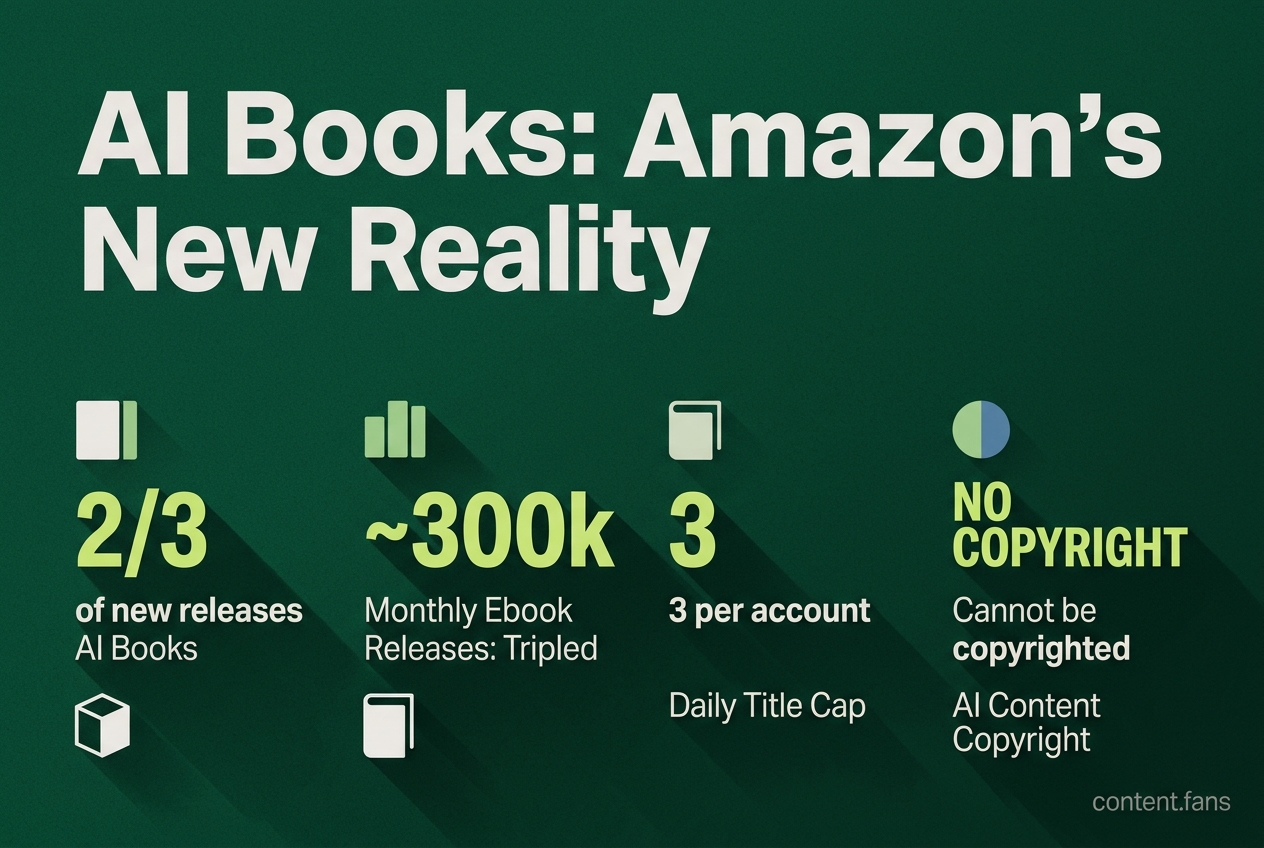
Under its official Artificial intelligence (AI) content policy, Kindle Direct Publishing (KDP) requires creators to declare if their work is AI-generated. However, this disclosure is for internal use only and is not visible to customers. While Amazon may remove undisclosed AI books, researchers estimate two-thirds of new Kindle releases now involve automation. This "slush tsunami" has seen a significant number of AI-assisted titles uploaded regularly, burying human-written books in search results, as detailed in an industry analysis.
Policy Enforcement and New Guardrails
To manage the influx, Amazon's recent enforcement strategy combines automated screening with strict account-level penalties for non-compliance. Key measures include:
- Immediate removal of undisclosed AI books and withholding of royalties.
- Account suspension for repeat offenders, potentially locking entire author catalogs.
- A daily cap of three new titles per account to slow bulk uploads.
- Stricter identity verification to deter the use of throwaway accounts.
These rules are enforced most aggressively in high-risk nonfiction categories like business, health, and legal advice, where misinformation poses a greater threat to readers.
Discoverability Fallout for Human Authors
The primary consequence for independent authors has been a catastrophic drop in organic search visibility. Monthly ebook releases on Amazon roughly tripled from 80,000 - 110,000 to nearly 300,000 per month since ChatGPT launched in late 2022, according to an a16z report citing an NBER working paper by Reimers & Waldfogel. In response, authors' groups note rising consumer skepticism, prompting readers to look for signals of authenticity. Consultants now advise writers to prominently feature original research, professional credentials, and verified sources in their marketing to prove human expertise.
The Surprising Legal Grey Zones of AI Content
A significant legal issue is that content generated entirely by AI cannot be copyrighted in the United States; it immediately enters the public domain. While this protects against some claims, publishers can still face liability. If an AI model recycles distinctive text from a copyrighted source, the uploader could be sued for infringement. Furthermore, draft legislation on "digital replicas" may hold publishers accountable for using a person's likeness, though a proposed exemption for biographical works could create a narrow legal path for factual, human-edited AI books.
Coping Strategies for Professional Biographers
To compete, professional biographers and nonfiction authors are adopting strategies that emphasize human value:
- Targeting Niche Topics: Focusing on deep archival histories or specialized subjects with less AI-generated competition.
- Building Direct Audiences: Creating loyal reader communities through dedicated newsletters, social media, and live events.
- Highlighting Authenticity: Emphasizing the use of documented primary sources and original interviews to differentiate their work from automated compilations.
Ultimately, industry experts believe that in a marketplace saturated with automated content, genuine expertise and carefully crafted narratives will command a significant premium, rewarding authors who invest in quality and reader trust.