
Cursor Realigns Product, Org for SpaceX's $60B Acquisition
Serge Bulaev
Cursor is changing its product plans and company structure as it may soon be bought by SpaceX for $60 billion. Leaders say these changes are to help prepare for more AI use after the deal is done. Cursor is making its product bigger, changing how teams work, and adding stronger rules for handling data. The company is also trying to keep workers informed and reduce worry by sharing updates often. These steps may help Cursor and SpaceX work better together once the deal closes, though some details still appear to be undecided.

In a strategic move preceding a landmark $60 billion acquisition by SpaceX, the AI coding assistant Cursor is realigning its product and organization. Executives confirm these changes are designed to prepare the company for deep AI integration following the deal's finalization.
The realignment is critical, as Cursor's parent company, Anysphere, has accepted a $60 billion all-stock offer from SpaceX, with the deal announced on June 16, 2026, and expected to close in Q3 2026, subject to regulatory approval Reuters. Proactively restructuring the business aims to maintain momentum and bolster employee confidence throughout the acquisition.
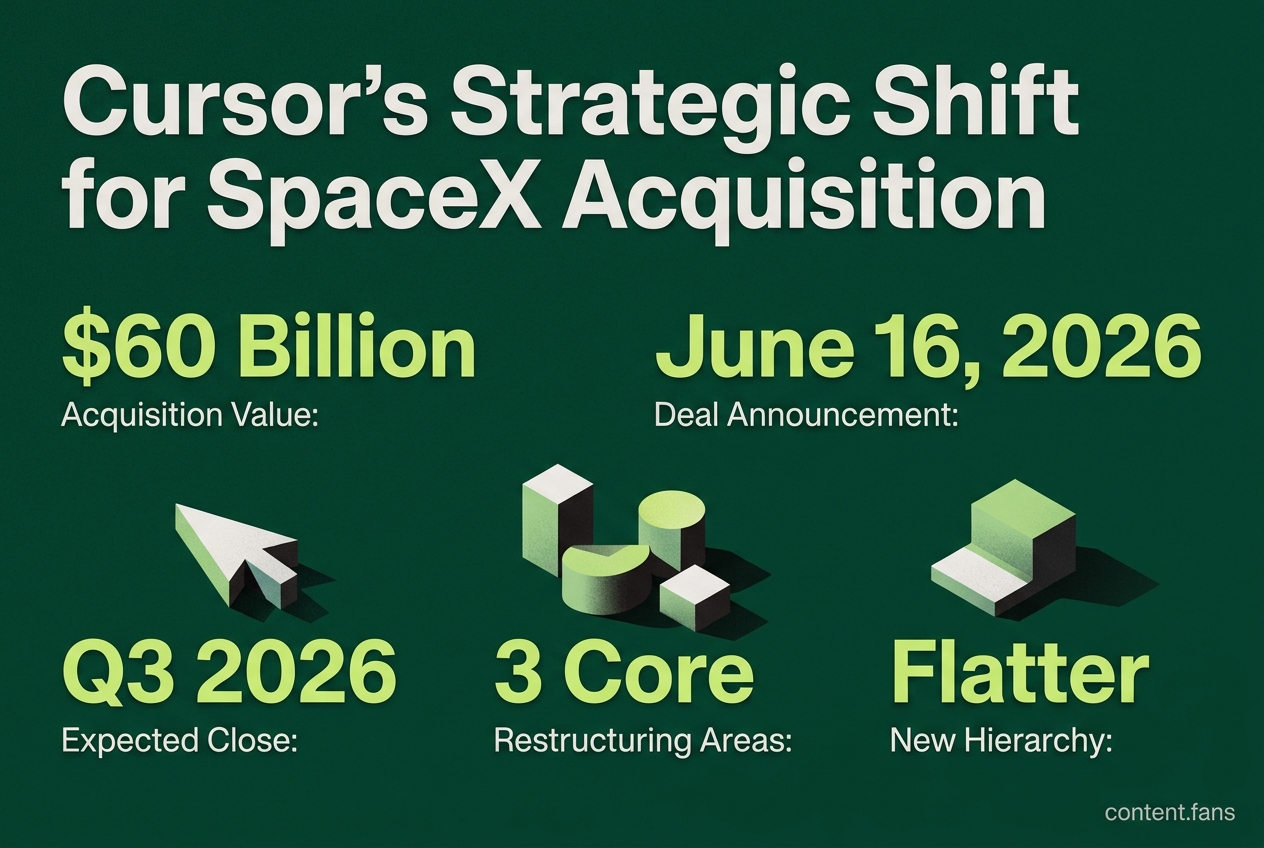
Core Areas of Restructuring
Cursor's leadership is strategically redirecting its product scope, organizational structure, and data governance policies. This realignment aims to transform the coding assistant into an enterprise tooling suite, preparing it to feed high-quality developer data into SpaceX's AI models and ensure operational synergy post-acquisition.
- Product Scope: Teams are expanding Cursor from a coding assistant into a comprehensive enterprise tooling suite. SpaceX is acquiring Anysphere (Cursor) to enhance xAI's Grok model by leveraging Cursor's access to developer data, targeting the AI coding market TechCrunch.
- Organizational Structure: Internal documents reveal a move toward a flatter hierarchy. This new structure will feature dedicated squads for security, compliance, and GPU efficiency, mirroring the engineering pod model used at SpaceX.
- Data Governance: New policies are being implemented to restrict external API calls and channel network traffic through encrypted gateways, designed to align with Starlink's stringent latency requirements.
Managing Internal Uncertainty During the Transition
To manage employee uncertainty, leadership has implemented a weekly all-hands meeting with a transparent four-point communication script: "what we know," "what we're evaluating," "what remains unchanged," and "next update." This approach, supported by HR research, prioritizes partial, transparent updates over silence. Managers are also conducting one-on-one check-ins to identify potential flight risks.
Employee retention incentives were reportedly front-loaded, with bonuses negotiated prior to the public announcement. This strategy aligns with expert advice from acquisition coaches, who caution that negotiating retention packages after an announcement can significantly increase costs.
Pre-Acquisition Checklist for Startups
- Draft an employee FAQ before the press release
- Segment talking points by role to avoid message dilution
- Lock retention bonuses for critical staff in the LOI
- Launch anonymous feedback channels within 48 hours
- Maintain existing customer SLAs to avoid signalling disruption
Key Takeaways from Cursor's Approach
Cursor's strategy highlights that successful pre-acquisition planning requires simultaneous focus on operational processes and employee morale. While full integration details with SpaceX are still being finalized, these proactive measures are positioned to minimize value erosion and accelerate the combined company's enterprise AI offerings pending regulatory approval.
What is the current status of SpaceX's acquisition of Cursor?
SpaceX has officially announced the acquisition of Anysphere, the company behind Cursor, for $60 billion in an all-stock transaction. The deal was announced on June 16, 2026, and is expected to close in the third quarter of 2026, subject to regulatory approval SpaceX locks in $60 billion Cursor deal to close gap with rivals in AI coding race. This represents the largest acquisition of a venture-backed startup ever recorded SpaceX Acquires AI Coding Tool Cursor For $60B In Year's Largest ....
Why is Cursor restructuring its product and organization before the deal closes?
Cursor is actively repositioning its roadmap and operations to align with SpaceX's broader AI infrastructure strategy. The acquisition will integrate Cursor's capabilities with xAI's Grok model, leveraging its access to developers and enterprise code to enhance SpaceX's AI models SpaceX locks in $60 billion Cursor deal to power AI coding push. This reinvention enables Cursor to scale beyond its current scope as a coding tool toward enterprise AI infrastructure.
How is Cursor managing internal uncertainty during the acquisition process?
To manage internal uncertainty, Cursor's leadership is implementing structured communication, including weekly all-hands updates and anonymous feedback channels. Best practices recommend identifying key employees 12-24 months before the target transaction date, but holding specific bonus conversations until after signing a Letter of Intent (LOI), not necessarily before the public announcement How to Tell Employees Your Business Is Being Sold (2026). The primary goal is to maintain operational normalcy by avoiding any disruptions to customer or vendor relationships.
What strategic shifts is Cursor making to support SpaceX's AI ambitions?
Cursor's reinvention supports SpaceX's plan to create vertically integrated AI infrastructure spanning rockets, Starlink satellites, orbital data centers, and AI models. The company is preparing to contribute to SpaceX's orbital AI data center initiative - targeting significant AI compute capacity powered by solar energy and Starship launches SpaceX Acquires xAI: Rockets, Starlink, and AI Under One Roof. This represents a pivot from standalone coding assistance toward infrastructure-scale AI compute.
What lessons can other startups take from Cursor's pre-acquisition approach?
Startups preparing for acquisition should prioritize three core areas: (1) Align roadmaps early with the acquirer's strategic goals; (2) Secure talent through retention planning, targeting less than 2% of headcount for critical knowledge holders with retention bonus amounts typically ranging from 10-15% of annual compensation for key roles, up to 25-30% for senior/specialized roles; and (3) Protect operational continuity by maintaining customer-facing stability and avoiding signals of distress. A structured four-week communication rollout - starting with deal rationale, then feedback channels, then concern reviews, then integration roadmaps - helps manage uncertainty without overpromising Employee concerns during a merger: What HR leaders need ....