
RadixArk launches with $100M seed round to expand open-source AI tooling
Serge Bulaev
RadixArk, a startup based in San Francisco, launched with a $100 million seed round at a $400 million valuation, which observers describe as a mega-seed. The company plans to use the money to grow its open-source AI tools like SGLang and a new managed platform, though details about customer adoption are still unclear. Investors such as Accel, Spark Capital, and tech companies like NVIDIA and AMD are involved, which may suggest strong interest in AI infrastructure. Some reports say deals of this size reflect a trend to secure resources early, but it is not certain if this funding will be enough for RadixArk's big goals. Future updates from RadixArk, such as customer numbers or partnerships, may show how well the company can meet its aim to make AI infrastructure widely available.

AI infrastructure startup RadixArk announced its launch with a landmark $100 million seed round, achieving a $400 million post-money valuation. The San Francisco-based company, founded by SGLang creators Ying Sheng and Banghua Zhu, will use the capital to expand its open-source AI tools and build a managed platform for frontier-grade AI development.
Understanding the Landmark "Mega-Seed" Round
RadixArk is an AI infrastructure company founded by the creators of the popular SGLang inference engine. It raised a $100 million "mega-seed" round to fund the significant capital expense required to build and scale frontier-grade training and inference hardware that can be accessed on demand by any developer.
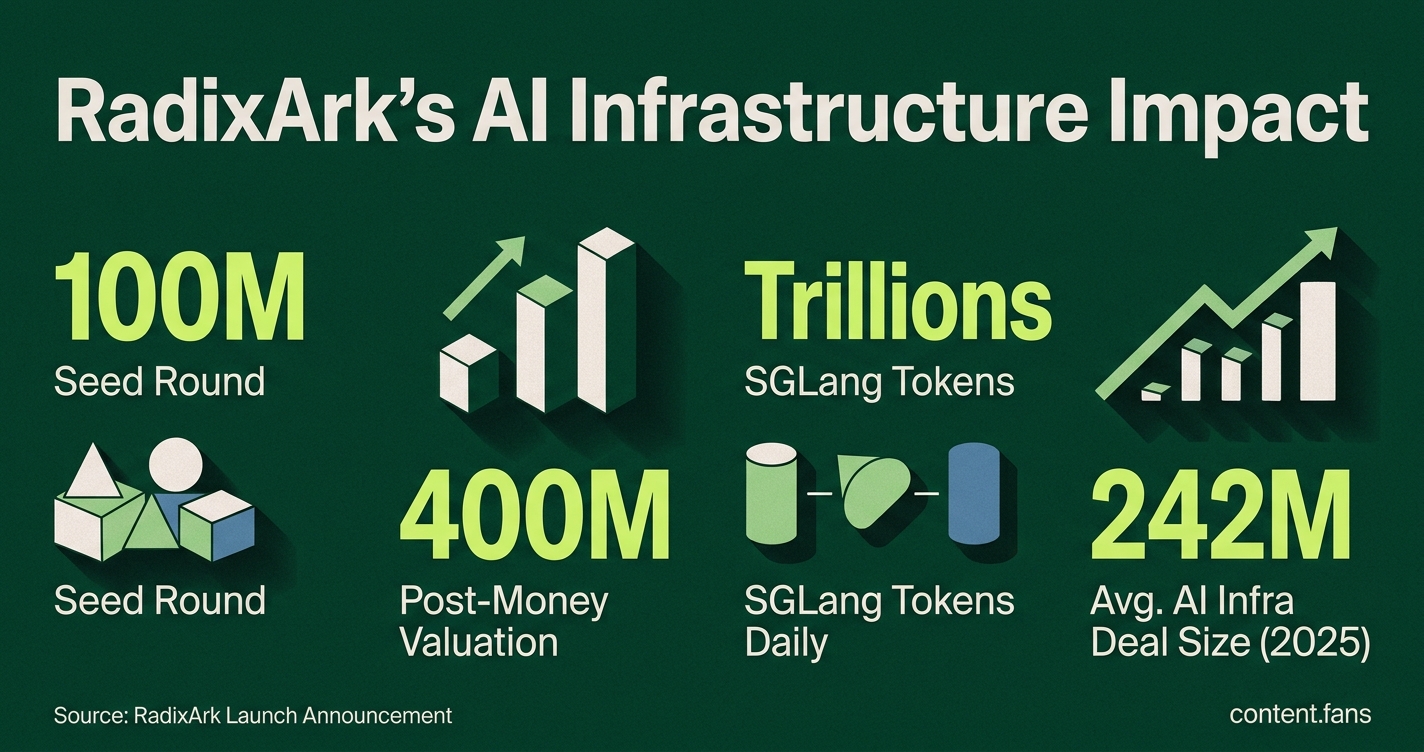
This financing event, described by observers as a "mega-seed," signals strong investor appetite for capital-intensive infrastructure plays that can secure essential compute and talent early. Accel led the round with Spark Capital co-leading, as detailed in the official Business Wire press release. Strategic backers include NVIDIA's NVentures arm, AMD, and Databricks. The involvement of major hardware manufacturers suggests a strategic interest in ensuring a smooth software pathway for their chipsets and cloud offerings.
How RadixArk Plans to Spend the Capital
According to the founders, the $100 million will be allocated across three core pillars:
- Scaling SGLang: Continuously developing the open-source inference engine, which already handles trillions of tokens daily for companies like Google and Microsoft, to support new model architectures and hardware.
- Expanding Miles: Growing the company's open-source reinforcement learning (RL) and post-training framework.
- Building a Managed Platform: Creating managed GPU clusters and cloud environments to allow customers to train, fine-tune, and serve frontier models without operating their own hardware. A waitlist for this commercial service is now open.
The Rise of the AI Infrastructure Mega-Seed
Such large seed rounds became increasingly common for AI infrastructure firms in 2025-2026. This trend allows startups to lock in scarce resources like GPUs and power contracts ahead of tightening competition. As a TechFundingNews report notes, investors now view this infrastructure as a long-lead asset rather than a product for quick iteration. The capital intensity required to compete with Big Tech's data-center footprint has driven funding requirements up, as reflected in recent industry data:
| Metric | 2022 | 2025 |
|---|---|---|
| Average AI infra deal size | $72 M | $242 M |
| Share of total AI funding from $100 M+ "mega-rounds" | 69 % | 79 % |
RadixArk's Mission to Democratize Frontier AI
RadixArk aims to provide every company with the same AI stack used by hyperscalers, but delivered as a utility. Its strategy relies on combining its open-source tools with a managed service:
- SGLang offers a high-throughput inference layer and compiler technology battle-tested on over 100,000 GPUs.
- Miles provides the RL and post-training pipelines that top AI labs currently must build from scratch.
- The Managed Platform abstracts away cluster management, allowing a small startup to deploy large models without owning a single server.
CEO Ying Sheng states the mission clearly: "AI infrastructure should be built once, built deeply and shared broadly, like electricity."
Market Outlook and Key Signals to Watch
RadixArk's raise is part of a broader industry land-grab, with numerous companies racing to secure energy and hardware before grid capacity is exhausted. The next 24-36 months may see significant consolidation as the market matures. RadixArk's oversized seed round serves as both growth fuel and strategic insurance in a sector where falling behind early can be irreversible. Future performance indicators include the adoption of its managed platform, community momentum around its open-source projects, and its ability to secure follow-on funding.