
OpenAI raises $122 billion at $852 billion valuation, largest private financing ever
Serge Bulaev
OpenAI has raised $122 billion at an $852 billion valuation, the largest private funding ever, according to the company's announcement. Major investors include Amazon, Nvidia, and SoftBank, with Microsoft keeping its large stake. The money may go toward building more infrastructure and powerful AI tools, as well as expanding cloud and chip partnerships. Some reports suggest OpenAI's costs could rise very quickly, and it is not clear if future revenue will keep up with this growth. OpenAI has not said when, or if, it might go public.

In what is now the largest private financing deal on record, OpenAI has raised $122 billion at an $852 billion valuation. According to the company's blog announcement, the unprecedented capital pool gives it fresh leverage over rivals and signals investors' growing appetite for multi-decade AI bets.
How the round came together
OpenAI secured $122 billion in a historic private funding round, achieving an $852 billion post-money valuation. The financing, the largest on record, was led by major commitments from strategic partners Amazon, Nvidia, and SoftBank, with Microsoft maintaining its significant existing stake.
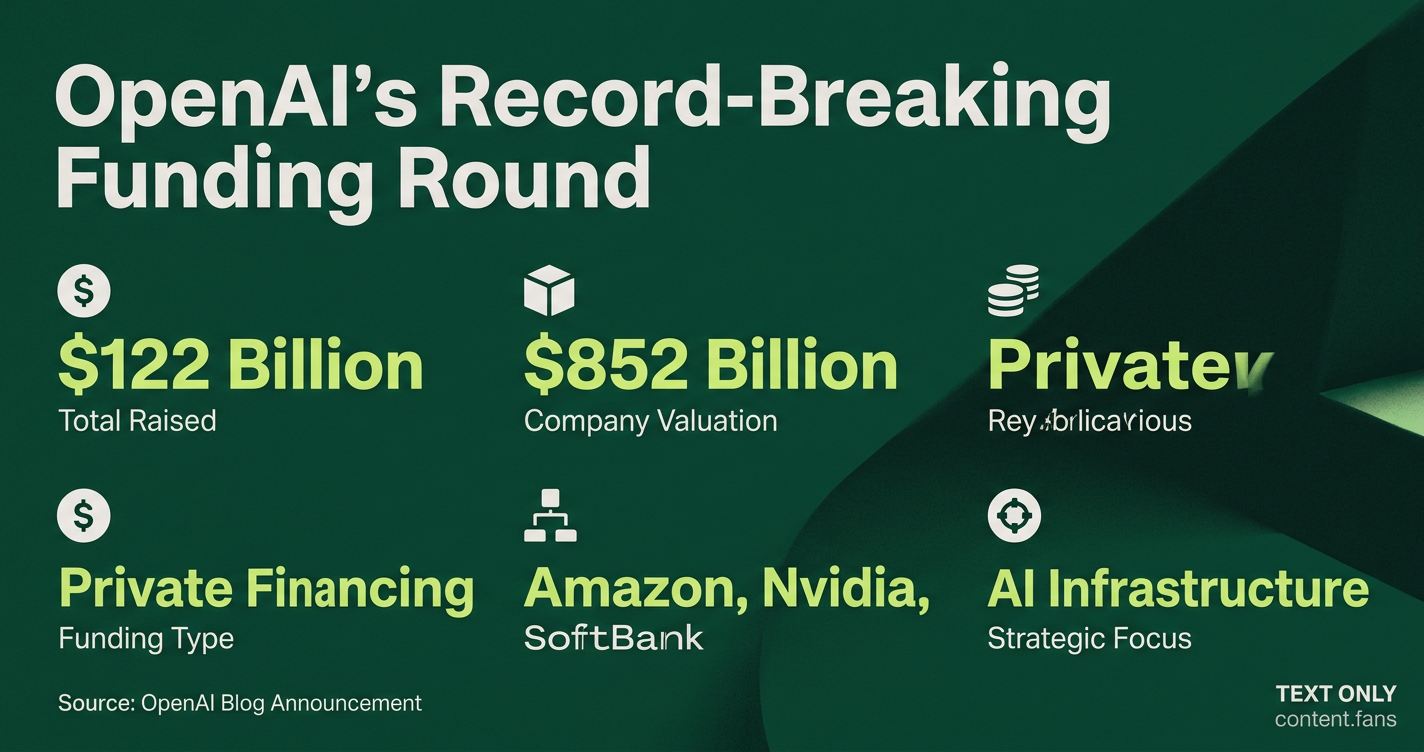
Initial commitments were $110 billion announced in February; final round closed at $122 billion with $852 billion post-money valuation. According to CNBC, the round was anchored by SoftBank with participation from Amazon, NVIDIA, and Microsoft, though specific check sizes were not disclosed.
Microsoft maintained its significant position in the company, though its new contribution was not detailed. The deal also included participation from individual investors and an expanded credit facility.
Where the money may go
OpenAI plans to use the funds to support its "next phase of AI," with a primary focus on building out its infrastructure. A key initiative is the Stargate supercomputer plan, which aims for significant capacity expansion in the U.S. Key spending areas include:
- A multi-vendor cloud strategy utilizing Microsoft, Oracle, AWS, CoreWeave, and Google Cloud.
- A diverse silicon stack featuring chips from Nvidia, AMD, AWS Trainium, Cerebras, and a custom chip co-developed with Broadcom.
- Significant partnerships for dedicated compute power across multiple providers.
According to industry reports, compute spending could reach substantial levels by 2030. While the company continues to grow revenue, analysts warn that annual expenses could escalate significantly in coming years.
Competitive and market signals
The substantial $852 billion valuation places OpenAI among the most valuable private companies, highlighting the intense capital arms race in the AI sector. The funding gives OpenAI a significant advantage to keep prices for its services low, secure critical GPU supply, and expand its data moat against competitors like Google's Gemini and Anthropic's Claude.
However, this massive influx of private capital also increases scrutiny on the company's governance and eventual path to public markets. With no IPO timetable announced, investors are exposed to a private company with substantial capital expenditure plans. Whether OpenAI's revenue growth can sustain such ambitious spending remains the key question for 2027 and beyond.
How much did OpenAI actually raise and at what valuation?
OpenAI closed $122 billion in fresh capital at a post-money valuation of $852 billion, vaulting it past every private tech fundraise on record. According to industry reports, the final tally exceeded initial expectations from early 2026.
Who are the anchor investors and how much did each commit?
The round was anchored by SoftBank with participation from Amazon, NVIDIA, and Microsoft. While specific check sizes were not disclosed, these strategic partners provided the majority of the funding, with additional participation from individual investors.
Where exactly will the new money go?
Per OpenAI's own roadmap, the capital underpins substantial compute investments through 2030 centered on:
- Stargate infrastructure - targeting significant U.S. capacity expansion
- Multi-cloud & multi-silicon strategy spanning Microsoft, Oracle, AWS, Google Cloud, plus chips from NVIDIA, AMD, AWS Trainium, Cerebras and a forthcoming custom Broadcom-designed chip
- Major partnerships for dedicated AI capacity through 2028
How does this funding change the competitive landscape?
By securing more capital than most competitors' lifetime totals, OpenAI has both widened its moat and raised the stakes. The substantial post-money valuation now places it among the most valuable private companies, intensifying pressure on rivals to match scale or risk being priced out of scarce data-center power and top-tier talent. It also delays any IPO, keeping competition within private markets where cash reserves now act as a proxy for runway.
What are the biggest risks ahead?
- Cash burn: industry reports suggest OpenAI could face substantial annual expenses in coming years
- Valuation bubble: analysts note the deal sets a new late-stage benchmark that may face scrutiny in public markets
- Strategic concentration: significant portions of the round come from key suppliers (Amazon cloud, NVIDIA silicon, SoftBank capital), potentially affecting future negotiations