
Optable Unveils How AI Agents Drive Publisher Revenue in 2026
Serge Bulaev
Optable suggests that by 2026, publishers who are ready for AI agents may see a competitive advantage, as AI now handles many ad tasks like audience targeting and campaign planning. Being "agent-ready" appears to mean having good data, technical connections, clear contracts, and strong rules for checking agent actions. Studies indicate that AI-driven bidding might be raising ad prices for high-quality online content and giving brands better returns. Early results from companies using these tools show faster planning and better measurement, but Optable stresses that publishers should set up proper rules and check their data before using AI agents. Experts predict that agent-managed ad budgets will keep growing, possibly making it harder for publishers who do not upgrade their systems.

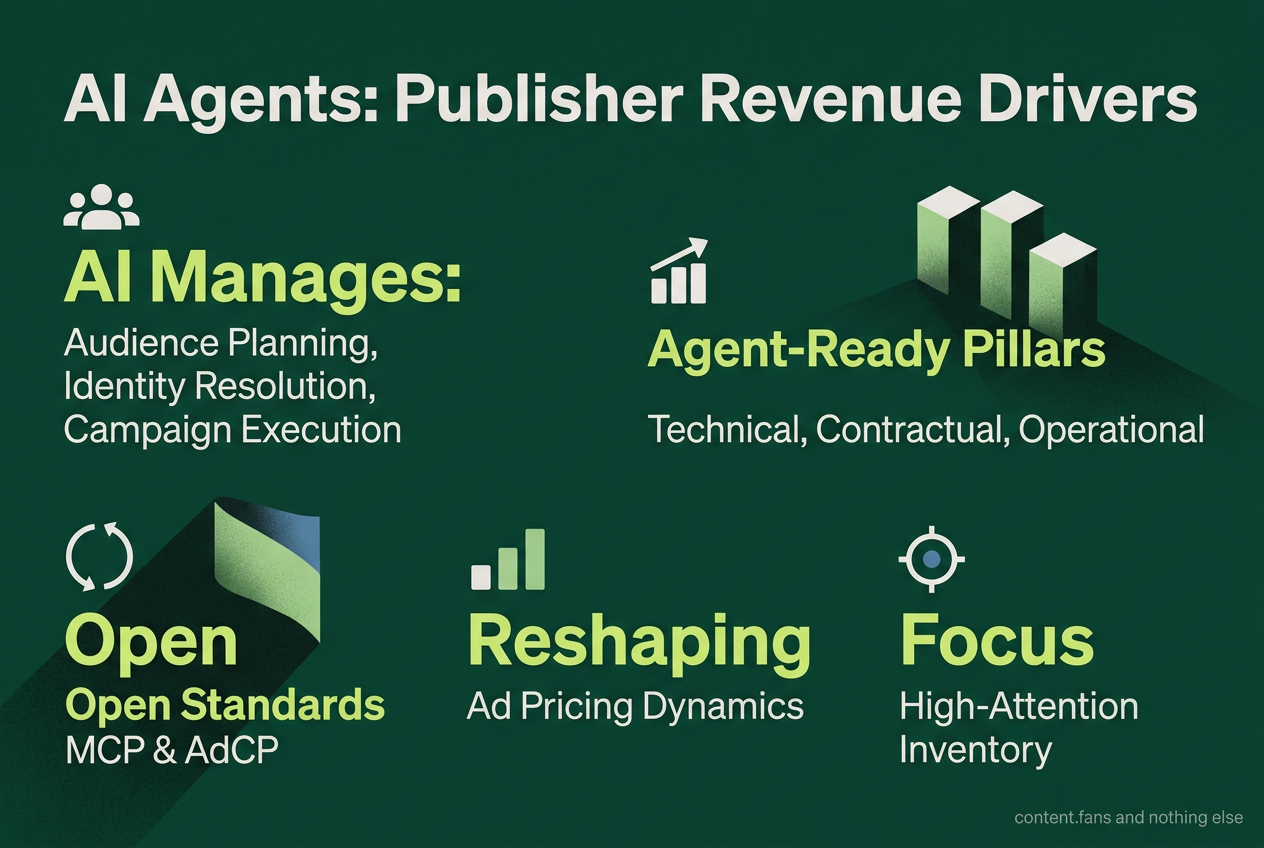
The agentic era is here, and AI agents are increasingly positioned to drive publisher revenue by automating workflows that humans once handled manually. According to industry reports, this shift means AI now manages audience planning, identity resolution, and campaign execution, offering a potential path to higher-value RFPs and premium CPMs for prepared media owners.
This shift highlights a critical insight: readiness is foundational. It starts with structured, queryable first-party data and extends through clear contracts and compliance frameworks. Publishers who achieve this readiness will attract significant incremental spending from buyers leveraging autonomous advertising tools.
What "agent-ready" looks like in 2026
Being "agent-ready" means having the technical, contractual, and operational infrastructure for AI to buy media. This includes standardized data protocols for discovery, legal frameworks for data use, and robust audit trails to ensure compliance and verify every automated action, enabling confident AI-driven ad buys.
Optable defines "agent-ready" across three core pillars that align with new industry standards:
- Technical Integrations - Platforms must support open standards like the Model Context Protocol (MCP) and Ad Context Protocol (AdCP), allowing planning or buying agents to discover audiences, negotiate terms, and activate campaigns seamlessly.
- Contractual Clarity - Following guidance from industry playbooks, publishers must secure input rights, exclusivity terms, and Responsible Scraping License conditions before exposing data to external AI models.
- Operational Guardrails - According to industry compliance guides, audit trails, provenance metadata, and automated quality checks are essential to ensure every agent action is traceable and verifiable.
Commercial signals: CPMs and demand patterns
Industry reports indicate autonomous bidding is fundamentally reshaping ad pricing dynamics. An ExchangeWire analysis shows rising open-web CPMs as AI concentrates bids on high-attention inventory, a trend driven by content scarcity and pressure from walled gardens. Industry sources suggest agents now optimize a significant portion of auctions on major DSPs, delivering incremental ROAS for brands by targeting premium supply.
This trend is already in motion. A PPC Land coverage highlights how Goodway Group professionals use Optable's Planner Agent for commerce campaigns, directing spend to inventory with clean identity signals. Company statements cite faster planning cycles and improved measurement, confirming strong buyer demand for agent-compatible supply.
Governance before automation
Optable stresses a "foundation before automation" approach, advising publishers to thoroughly audit data structures, taxonomy, and consent records before deploying AI agents. Similarly, industry ad-ops guides recommend automated health checks on all data syncs to act as real-time guardrails, catching anomalies before they are amplified by an agent. Contractually, industry playbooks warn that licensing agreements must explicitly define whether prompts or outputs can be used for external model training and specify the jurisdiction for dispute resolution.
A compact checklist for teams considering an agentic pilot:
- Audit data flows and identify gaps against MCP and AdCP schemas.
- Implement provenance tags and maintain logs for at least three years to meet EU AI Act requirements.
- Develop legal addenda that cover input rights, exclusivity, and indemnification.
- Deploy automated QA scripts to validate all agent outputs before they go live.
Looking ahead without definitive forecasts
Looking ahead, industry analysts project sharp growth in agent-managed budgets within programmatic ad spend through 2026. This trend signals a widening competitive gap between publishers who are prepared and those who remain reliant on manual workflows. Optable's core message is consistent and clear: publishers must prepare their data, adopt open standards, and implement strong guardrails. This allows AI agents to spend confidently while publishers maintain ultimate control and security.
What is "agentic advertising" and why does Optable say it is happening now?
Agentic advertising is the practice of letting AI agents autonomously run entire slices of a campaign - from audience planning and identity resolution to negotiation, activation and optimization. Industry insights stress that this is no longer a slide-deck concept: agencies are already deploying agents in live buys, and publishers who accommodate them are seeing increased interest from buyers and potentially higher CPMs. The shift is being driven by cookie loss, privacy rules and the need to compete with closed ecosystems.
Which three readiness pillars do publishers need before agents can spend money with them?
Optable lists technical integrations, contractual clarity and operational guardrails.
- Technical means exposing clean, standardized first-party data via open protocols such as AdCP and MCP so agents can read and act on it.
- Contractual requires clear terms on data use, attribution and compensation, taking guidance from industry AI intellectual property playbooks.
- Operational covers human oversight, audit trails and kill-switch controls that keep agents compliant with brand-safety and privacy mandates.
How high can CPMs go for "agent-ready" inventory?
Industry research points to significant CPM lifts. ExchangeWire notes that agents concentrate spend on inventory with verified first-party data and attention signals, reducing available premium supply and pushing open-web CPMs upward. Meanwhile, industry reports suggest that campaigns running through agentic pipes show substantial CPC improvements, freeing budget that agents immediately re-invest in the best-quality sites - the ones that expose the cleanest data.
What concrete steps should a publisher take this year to become agent-ready?
- Audit data readiness - structure, enrich and make first-party segments queryable via MCP-compatible APIs.
- Map integration points - ensure ad server, CMP and identity tooling expose endpoints agents can reach.
- Update IO templates - adopt industry-recommended language on IP, training-data use and provenance metadata.
- Deploy monitoring - set up real-time dashboards that log every agent action for at least three years, satisfying both industry guidelines and EU AI Act requirements.
Who is already using agentic workflows at scale?
Optable is working with Goodway Group traders who use Planner Agent to move from brief to booked plan in significantly reduced timeframes. PubMatic's new AgenticOS and IAB's AAMP initiative are wiring additional DSP, SSP and publisher systems together, while early CTV and linear publishers are layering agent-readable structured data on top of traditional rate cards to capture spend that would otherwise default to closed gardens.