
OpenAI Launches Deployment Company With $4 Billion, Acquires Tomoro
Serge Bulaev
OpenAI has started a new services company called OpenAI Deployment Company, which may have $10 billion in funding, with $4 billion already committed by 19 investors. This company aims to place engineers directly into client companies to help them use advanced AI systems in real situations. OpenAI plans to acquire Tomoro, a London AI consulting firm with about 150 engineers, once regulators approve the deal. The new company appears to have strong support from big investors and may soon have access to around 2,000 companies through these investors' networks. Some experts suggest this move could mean OpenAI wants more control over how its AI models are used in real businesses.

OpenAI has launched the OpenAI Deployment Company, a new services subsidiary created to embed AI engineers directly within client organizations. This major initiative, part of a planned private equity joint venture, begins with over $4 billion in commitments from 19 leading investment and consulting firms. The company's core mission is to accelerate the adoption of advanced AI by integrating sophisticated models directly into existing enterprise systems, moving beyond the proof-of-concept phase.
According to Business Insider, the list of high-profile backers includes TPG, Advent, Bain Capital, Brookfield, Goldman Sachs, and SoftBank. The venture's structure resembles a private equity roll-up, providing OpenAI with a significant acquisition budget and access to a client base from its investor portfolios, as noted by Channel Dive.
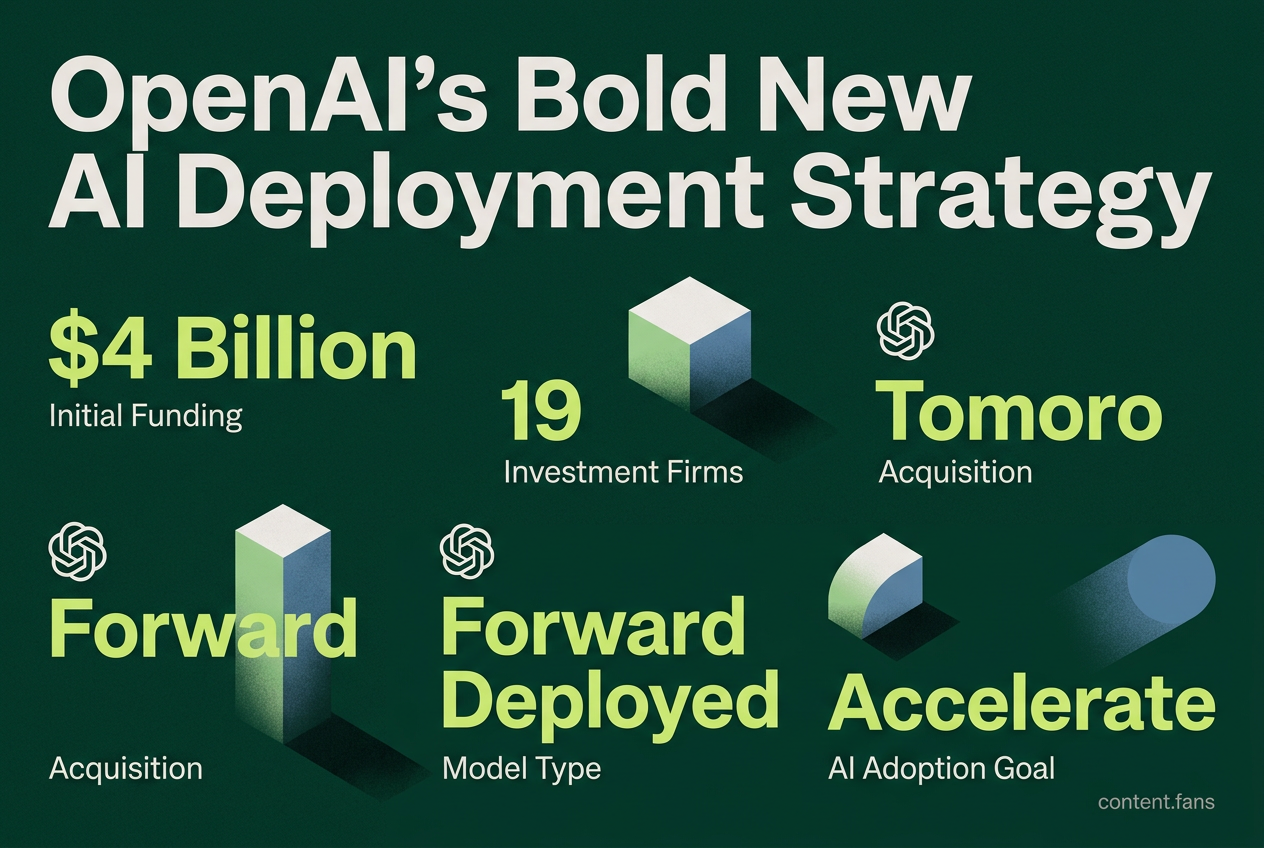
To build immediate field capacity, OpenAI has also agreed to acquire Tomoro, a London-based applied AI consultancy. The deal, pending regulatory approval, will bring a substantial team of engineers into the new subsidiary. According to industry reports, Tomoro has achieved notable successes in enterprise AI deployment, including developing and deploying in-game support solutions for large user bases.
How the Forward Deployed Model Works
The OpenAI Deployment Company is a new subsidiary focused on embedding 'Forward Deployed Engineers' into client companies. These specialists help integrate advanced AI models with legacy systems, manage data governance, and scale solutions from pilot programs to full production, accelerating enterprise AI adoption.
The new company's strategy is being compared to Palantir's successful 'Forward Deployed Engineer' model. This hands-on approach involves embedding engineering teams directly on-site with clients. These teams manage complex tasks like legacy system integration and data permissioning, iterating on solutions until a production-ready workflow is achieved. Experts note this model directly addresses bottlenecks that have historically delayed AI deployment projects by months or even years. This aligns with OpenAI's efforts to streamline development, such as its AgentKit toolkit, which has already reduced agent creation cycles from months to days.
Investor Network and Early Capacity
The 19 investment partners provide a powerful, built-in distribution channel, offering access to their collective portfolio of companies across various industries. This gives the new unit an immediate and extensive market to tap into. Key figures from initial filings and statements underscore the scale of the venture:
- Target Vehicle Size: According to industry reports, a substantial multi-billion dollar commitment
- Committed Capital: Over $4 billion
- Backing Partners: 19 investment and advisory firms
- Initial Headcount: A significant engineering team via the Tomoro acquisition
- Launch Valuation: Industry reports suggest a substantial valuation
Relation to Existing Alliances
This new venture complements OpenAI's existing 'Frontier Alliances,' which were formalized in February 2026 with partners like McKinsey, BCG, Accenture, and Capgemini. While the subsidiary will work alongside these partners, analysts cited by Constellation Research suggest OpenAI will retain direct control over the most critical and high-stakes integrations. This dual strategy points to a broader trend of vertical integration, with AI model developers increasingly seeking to own the end-to-end services and deployment layer.
Early Adoption Landscape
While the Deployment Company is new, OpenAI already serves one million business customers. Existing case studies demonstrate the potential impact of its technology: Cisco reduced code review times by 50%, and Carlyle analysts cut due-diligence timelines in half. These examples highlight the tangible results clients can expect as embedded engineers begin their work. As the company awaits regulatory approval for the Tomoro acquisition, trade outlets report that it is actively exploring further acquisitions using its earmarked capital.
What exactly is the OpenAI Deployment Company and how is it funded?
The OpenAI Deployment Company is a new, standalone subsidiary created to place Forward Deployed Engineers (FDEs) directly inside client organizations. It is structured as a substantial private-equity vehicle and is launching with more than $4 billion already committed from 19 investors. The cap table mixes Wall Street and consulting muscle: TPG, Advent, Bain Capital, Brookfield, Goldman Sachs, SoftBank, Capgemini and McKinsey are all backers. OpenAI keeps majority ownership, so the unit operates as an "extension of OpenAI" rather than an external vendor.
Why did OpenAI acquire Tomoro and what does the deal bring on day one?
OpenAI acquired UK-based Tomoro, an applied-AI consulting firm, to give the Deployment Company immediate execution capability. The deal adds a substantial team of Forward Deployed Engineers who already have live enterprise wins - for example, according to industry reports, successful deployment of in-game support solutions for large user bases. Terms were not disclosed, but the transaction is expected to close in the coming months pending regulatory approval.
How does the Deployment Company fit into OpenAI's broader partner ecosystem?
The new unit will work alongside OpenAI's Frontier Alliance partners (McKinsey, BCG, Accenture, Capgemini) formed in early 2026. The difference: instead of renting outside consultants, OpenAI now owns the integration layer. This vertical approach lets the same team that builds the models also redesign workflows, handle legacy hooks and meet regulatory requirements on site.
What real-world problems will the FDE teams tackle for clients?
Early briefings list three pain points the engineers are meant to solve:
- Legacy system integration - code bases that pre-date cloud or API standards
- Permission and governance maps - who can see what data inside a bank, insurer or retailer
- Scaling from pilot to production - moving an agent from demo to millions of daily queries
OpenAI cites Cisco as an existing customer that cut code-review time 50 % and shrunk project calendars from weeks to days once similar engineering support was in place.
Does the move signal a wider industry trend?
Yes. Private-equity AI deals jumped 49 % in H1 2025 versus the same period in 2024, but most capital went to "picks-and-shovels" plays such as data centers, not risky app start-ups. By pairing $4 billion in committed equity with an embedded-engineering model, OpenAI is following the money: investors want deployment certainty and enterprises want on-the-ground talent that can finish the last mile of AI roll-outs. Industry analysts suggest other labs may adopt similar approaches through acquisitions or joint ventures in the coming years.