
OpenAI uses Codex to migrate 600 petabytes in two months
Serge Bulaev
OpenAI used Codex, a large language model, to help move about 600 petabytes of data and rebuild 10,000 workflows in just two months. Codex generated scripts and checked data as it moved between cloud providers, which may have cut development time by about half. Engineers added approval steps and safety checks at risky points, suggesting that careful human review is still important. The results show Codex-style automation might soon be common in big data projects, but human oversight seems necessary for safety. Error rates were very low, and most problems were fixed quickly, which appears to match or beat usual manual methods.

In a landmark project, OpenAI used Codex to migrate 600 petabytes of data and rebuild a significant number of workflows across clouds in just two months. This achievement demonstrates how large language models can accelerate complex engineering tasks. Engineers leveraged Codex to automate ETL script generation, validate schemas, and create monitoring tools. The team maintained existing AWS controls by using Codex via Amazon Bedrock, as noted in the official Codex changelog. To ensure a safe migration, engineers implemented strict human approval gates and automated rollback procedures for all high-risk operations, establishing a new pattern for responsible LLM-driven automation.
A Deep Dive into the Codex-Powered Migration
OpenAI leveraged its Codex model to automate the generation of thousands of SQL and Python scripts for its massive cross-cloud data migration. The AI tool drafted code, identified relevant metadata, and called cloud APIs directly, which project leads estimate substantially reduced total development time.
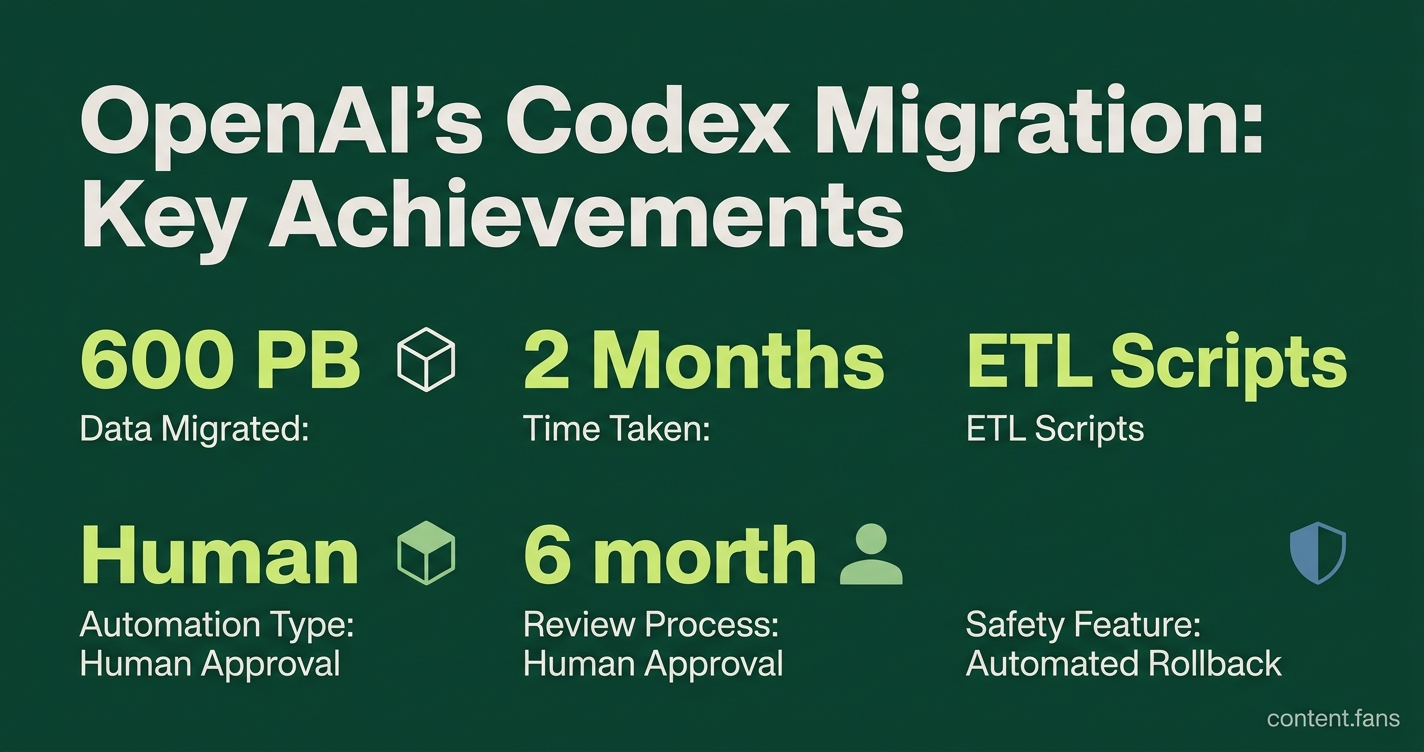
The project unfolded in three distinct waves:
- Phase 1: Metadata collection and schema analysis.
- Phase 2: AI-driven code generation for DAGs and load jobs, followed by mandatory human review.
- Phase 3: Parallel data verification using automated differential reports against source data.
To improve accuracy during verification, the team used retrieval-augmented generation (RAG), allowing Codex to query live metadata and significantly reduce the risk of model hallucinations.
Safety Layers and Best Practices
This project highlights the importance of keeping LLMs within tightly scoped permissions for high-risk automation. Industry guidance, such as the OWASP Top 10 for Large Language Model Applications, warns against "Excessive Agency" and mandates human approval before any state-changing action. The OpenAI team's methodology reflected these best practices: every script generated by Codex was submitted as a pull request for review by at least two operators, and all execution logs were streamed to a real-time monitoring dashboard.
A Growing Industry Trend
OpenAI is not alone in leveraging AI for large-scale data operations. Kanerika, for example, uses generative AI to create integration scripts for ERP data consolidation, as detailed in a Kanerika case study. Similarly, according to industry reports, a growing number of enterprises use LLMs for attribute classification and compliance, which are key components of migration validation. These examples show that Codex-style automation is quickly transitioning from experiment to a standard industry playbook.
Key Verification Metrics
The project's success was measured against three critical performance indicators:
- Data Parity: Row-level checksums were compared across clouds to ensure integrity.
- Execution Success: The success rate of DAGs was tracked during shadow runs.
- Recovery Time: The mean time to rollback (MTTR) was measured for any failed job.
The team reported very low data parity errors and rapid rollback times. These results meet or exceed the typical benchmarks for migrations performed manually by engineering teams.
Why This Migration Matters
The OpenAI experiment provides a concrete blueprint for a future where LLMs handle the heavy lifting of data migration logic, freeing up human engineers to focus on approval, monitoring, and optimization. By sharing real-world numbers - thousands of workflows and hundreds of petabytes of data - OpenAI grounds this vision in hard operational evidence, moving it beyond theoretical presentations.
What exactly did OpenAI move in its two-month migration sprint?
OpenAI relocated 600 petabytes of data, a significant number of tables, and thousands of DAGs between clouds. The sheer volume represents an enormous amount of data, and the timeline demonstrates a migration speed that few manual-run projects ever reach.
How did Codex handle automation at this scale instead of just code-completion?
Codex acted as the orchestration engine. It wrote thousands of migration scripts, generated rollback commands, and kept schema-mapping consistent across environments. Because every artifact was produced as code, the team could version, review, and test each step in CI pipelines rather than rely on ad-hoc SQL files.
Which safety layers kept a half-exabyte move from turning into a disaster?
The project ran on a "trust-but-verify" loop: Codex proposed, a human approved, automated tests ran, Canary data sets were moved first, and real-time row-level checks compared source and target hashes before any table was declared complete. A one-click rollback script sat ready for every batch, giving operators a rapid recovery window if drift was detected.
What lessons apply to smaller teams that still need LLM speed?
- Start with smaller pilot workloads and replicate the same verification stack (hash checks, canary tests, rollback scripts).
- Use Codex inside an IDE or GitHub Action so every generated script is peer-reviewed before it touches production.
- Keep credentials scoped; Codex only received read access to the source and write access to an empty staging area until smoke tests passed.
Where can I see the official multi-cloud options for Codex today?
OpenAI's latest changelog shows Codex now runs on Amazon Bedrock, letting teams keep authentication, billing, and compliance inside AWS while still using the same GPT backend. Details are on the official Codex changelog.