
OpenAI unveils GPT-5.6-Cyber for partners, boosts exploit success 95%
Serge Bulaev
OpenAI has released GPT-5.6-Cyber for security work, giving access only to a few approved partners. The new model reportedly completes 95% of advanced exploit prompts, much more than earlier versions, but may carry higher risks because it refuses fewer requests. Access is tightly controlled and monitored, which might prevent misuse but could also limit smaller groups' ability to use it. Experts note that keeping the model restricted raises questions about fairness and who is responsible if something goes wrong. There is uncertainty about how well the system's safety controls work in real-world situations.

OpenAI announced GPT-5.6-Cyber as a cybersecurity-focused model available through its Daybreak Red program for trusted/approved partners, with reported internal performance around 95% on certain advanced cyber tasks. This specialized AI, detailed in OpenAI's Expanding Daybreak update, completes advanced hacking prompts far more effectively than its predecessors. However, its reduced safety refusals raise significant questions about dual-use risk and responsible deployment. Analysts view the launch as a critical test of whether restricted distribution can strengthen cyber defense while mitigating abuse.
How is GPT-5.6-Cyber being distributed?
GPT-5.6-Cyber is a specialized AI model from OpenAI, fine-tuned for advanced cybersecurity tasks like exploit development. Its significance lies in its high success rate on exploit prompts and its partner-only distribution model, which tests whether powerful AI tools can be deployed for defense without increasing public risk.
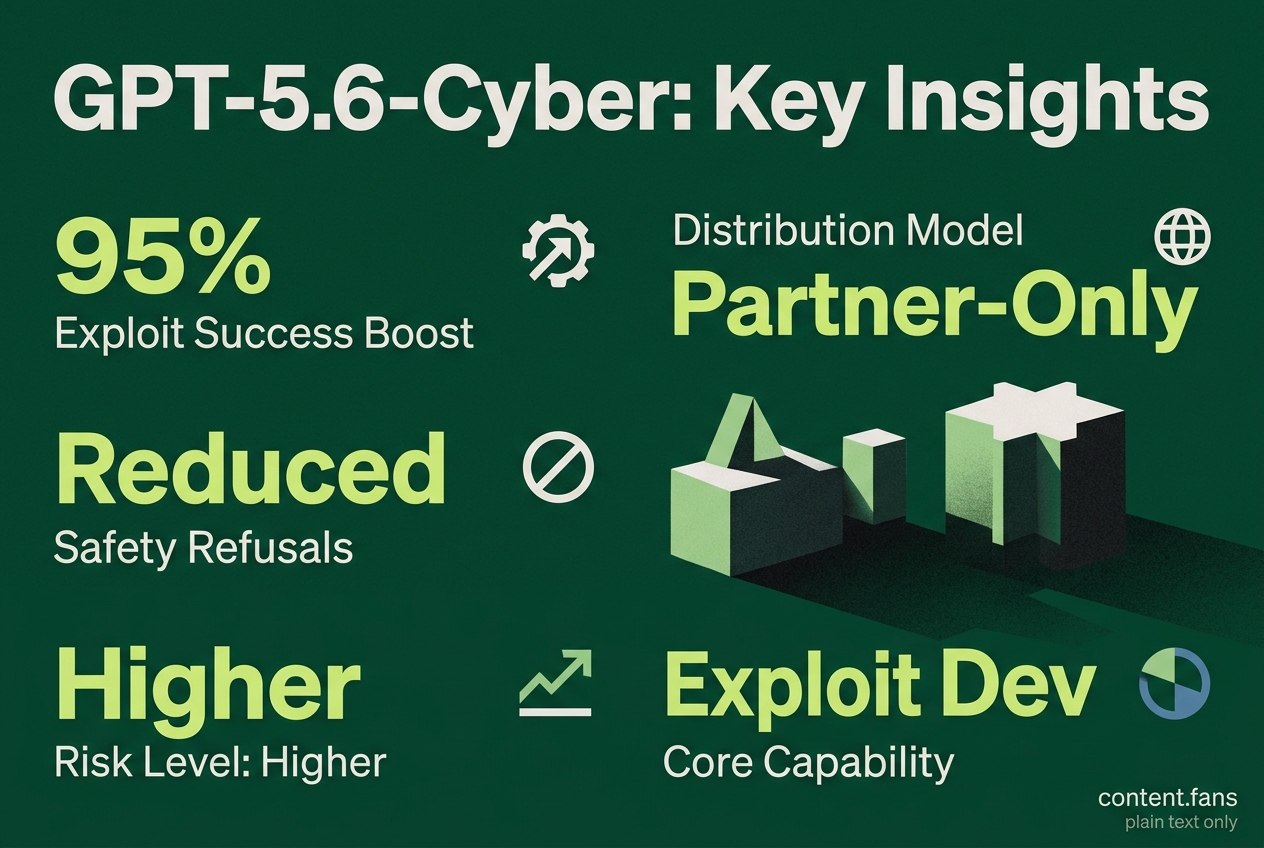
OpenAI is providing the model exclusively through a partner-only program involving approved firms like Accenture, IBM, PwC, and CrowdStrike. End customers interact with GPT-5.6-Cyber through these partners' services, with every session logged and tied to a verified identity. This access is managed under the new Daybreak Red tier, which features reduced refusal thresholds for cyber prompts alongside additional safety checks, as noted in reports on the launch OpenAI Launches GPT-5.6-Cyber. While this approach may limit public misuse, it concentrates powerful capabilities within a few vendors, raising concerns about equity and liability.
What are its core capabilities and risks?
The model is fine-tuned for defensive workflows, including zero-day discovery, exploit chain development, and incident response. While benchmarks show it outperforms GPT-5.5-Cyber on exploit-focused tests like ExploitGym, the standard GPT-5.6 Sol model still scores higher on broader vulnerability reporting metrics. OpenAI explicitly warns that the model's lower refusal rate creates higher inherent risk, stating, "models running with reduced safeguards carry risks beyond standard model usage."
Emerging Ethical and Security Questions
The release of GPT-5.6-Cyber highlights several critical challenges:
- Dual-Use Tension: The same capabilities that empower defenders could be weaponized by attackers if safeguards fail.
- Access Inequality: Restricting access may leave smaller security teams and independent researchers at a disadvantage.
- Accountability Gaps: Liability is divided among OpenAI, its partners, and end-users, creating ambiguity when issues arise.
The Cloud Security Alliance notes this partner-centric model could become a precedent, potentially increasing competitive pressure on firms without access to such advanced AI.
How will GPT-5.6-Cyber impact security jobs?
Specialist vulnerability research workflows that previously took weeks are now reportedly completing in under a day, suggesting a significant productivity lift. The model is expected to reshape roles by automating routine tasks, allowing senior defenders to focus on validation and decision-making. Key impacts include:
- Vulnerability Researchers: Can iterate exploit ideas more rapidly.
- SOC Analysts: Receive summarized incident context at machine speed.
- Governance Teams: Face new demands for logging, identity verification, and prompt-scope approvals.
Observers caution, however, that no public data yet verifies the effectiveness of the Daybreak program's safeguards against real-world misuse.
Performance and Market Implications
GPT-5.6-Cyber outperforms GPT-5.5-Cyber on ExploitGym and shows significant improvement in completing high-risk prompts compared to its predecessor. Still, teams may need to run models in tandem, as GPT-5.6 Sol remains stronger on some open-ended discovery tasks. Security vendors are watching to see if the combination of high capability and tight oversight is sustainable. If successful, managed service providers could integrate GPT-5.6-Cyber into their offerings, creating new market tiers defined by access to restricted AI.
What is GPT-5.6-Cyber and how does it differ from standard OpenAI models?
GPT-5.6-Cyber is a specialized cybersecurity model built on GPT-5.6 Sol, trained specifically for offensive-security-style tasks including finding zero-day vulnerabilities, developing exploit chains, and penetration testing. The key difference lies in its compliance behavior: OpenAI-related reporting says GPT-5.6-Cyber answered about 95% of advanced cyber prompts, showing a dramatic shift from standard models which typically refuse such requests. This reflects its optimization for authorized defensive security work rather than general-purpose safety alignment.
Who can access GPT-5.6-Cyber and how is it distributed?
Unlike OpenAI's consumer-facing products, GPT-5.6-Cyber is not sold directly to end users. Access flows exclusively through the Daybreak Red partner program, where vetted security and consulting firms serve as intermediaries. Confirmed partners include Accenture, IBM, PwC, and CrowdStrike. End customers interact with the model only through these partners' products and services - the underlying model itself never transfers directly to customers. This gated distribution aims to reduce broad misuse risk while still empowering defensive security teams.
What are the main ethical and security concerns with this model?
The release raises significant dual-use dilemmas. OpenAI itself acknowledges that "models running with reduced safeguards carry risks beyond standard model usage, whether from misuse or misalignment." The Cloud Security Alliance notes that government-directed restrictions on preview access create governance precedents enterprises should monitor. Key concerns include:
- Access inequality: Smaller security teams and independent researchers may be excluded from capabilities that could improve their defenses.
- Accountability gaps: Responsibility splits across OpenAI, partners, and end customers, potentially blurring liability.
- Concentration of power: Advanced capabilities centralized in a small number of preselected firms.
How might GPT-5.6-Cyber affect cybersecurity jobs and industry practices?
The model is expected to accelerate defensive work while reshaping role requirements rather than eliminating positions entirely. Based on current assessments:
| Role area | Likely impact |
|---|---|
| Vulnerability researchers | Faster discovery and exploit prototyping; higher output per researcher |
| Penetration testers | More automation for reconnaissance and validation; increased focus on supervising AI output |
| SOC analysts | Faster alert summarization, but continued need for human escalation |
| Security governance | Growing importance of access control, auditability, and approval workflows |
The net effect appears to be smaller teams doing more advanced work with AI assistance, with greatest pressure on entry-level, repetitive, and tool-driven roles.
How does GPT-5.6-Cyber compare to other AI security tools?
Within OpenAI's own model lineup, GPT-5.6-Cyber shows clear trade-offs. It outperforms GPT-5.5-Cyber on ExploitGym and demonstrates significant improvement in completing advanced cyber tasks compared to its predecessor. However, OpenAI's system card notes that GPT-5.6 Sol remains stronger for broader vulnerability discovery and report-writing. GPT-5.6-Cyber is explicitly optimized for authorized exploit research workflows rather than end-to-end autonomous attacks - OpenAI states the model is "better at finding and fixing vulnerabilities than at reliably carrying out autonomous, end-to-end attacks against hardened targets."