
How AI changes engineering teams, metrics, and burnout in 2026
Serge Bulaev
Rapid AI adoption is changing how engineering teams are organized, how their work is measured, and how burnout is addressed. By 2026, teams may have new roles focused on AI, such as AI Engineer or AI Governance Specialist, and new career paths are emerging from existing tech backgrounds. Leaders are encouraged to add job levels like "AI Architect" to keep senior staff engaged. Sources suggest that traditional metrics may not show new AI risks, so teams might use new ways to track code quality and safety. Studies also suggest that to prevent burnout, leaders could use practices like rotating review roles and having set times without AI tool use.
As AI reshapes software development, leaders must understand how AI changes engineering teams, metrics, and burnout. Proactive managers are redesigning roles, adopting new quality standards, and building resilient cultures to keep senior talent engaged and prevent developer fatigue.
This guide provides a strategic framework for engineering leaders to navigate this transition. It outlines emerging career paths, AI-native quality metrics for 2026, and cultural practices to mitigate the risk of "press enter" burnout.
Role redesign and career ladders
To retain senior talent, organizations are creating specialized AI career paths that reward architectural influence over raw output. These non-linear tracks, such as AI Architect and Head of AI, offer meaningful challenges in system design and governance, preventing experienced engineers from becoming stuck in simple review tasks.
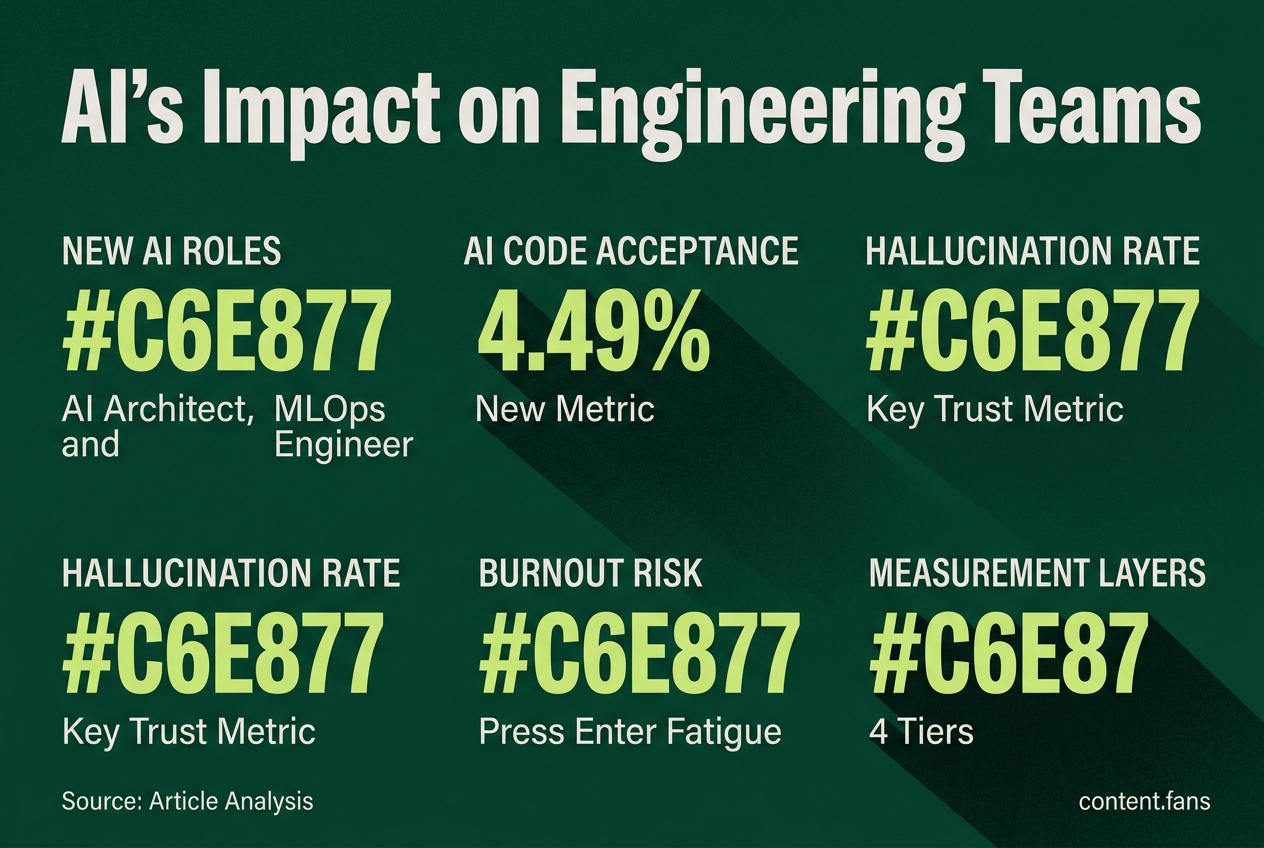
By 2026, engineering organizations are evolving to include specialized, AI-focused career tracks like AI/Generative AI Engineer, MLOps Engineer, and AI Governance Specialist. These roles build upon existing software, ML, DevOps, and product backgrounds, creating flexible career trajectories instead of a single, rigid ladder.
To challenge senior engineers, leading organizations are adding levels like "AI Architect" that prioritize system design and risk management over simple ticket velocity. Without such roles, teams risk seeing senior staff relegated to reviewing AI-generated pull requests while junior engineers tackle more innovative work.
Metrics, quality, and governance
While DORA metrics remain a baseline for delivery speed, they often conceal AI-specific risks and failure modes. Emerging best practices recommend supplementing DORA with new measures like AI-generated code acceptance rate, AI-attributed defect rate, and hallucination rate. These should be paired with compliance scorecards tracking policy coverage and control tests.
Leaders can adopt a four-layer measurement stack:
- Delivery: Deployment frequency and mean time to restore service (MTTR).
- Quality: Rework rate, review time, and maintainability index.
- Governance: Policy compliance score and approval-cycle time.
- Trust & Safety: Hallucination rate and guardrail trigger frequency.
This tiered approach clarifies whether AI-driven development is truly improving flow or simply degrading long-term reliability and compliance.
Preventing "press enter" burnout
Engineers who spend their days approving AI suggestions risk losing situational awareness and experiencing burnout. This phenomenon arises from the cognitive load of validating endless AI suggestions without a clear team strategy.
Proven interventions can restore engineer agency and prevent fatigue:
- Require a brief, human-written explanation before merging any AI-assisted change.
- Rotate the "deep-review" role each sprint to avoid creating a permanent "AI janitor."
- Schedule two-hour focus blocks where no AI tool interaction is expected.
- Designate AI-free lanes for critical architecture or security-sensitive code.
- Track team wellbeing with monthly pulse surveys alongside performance metrics.
These practices help leaders balance the productivity gains from AI agents with the human need for deep understanding and ownership.
By redesigning roles around AI specialties, adopting a multi-layered metrics scorecard, and actively tuning team culture, engineering managers can harness the power of AI. This strategic approach ensures that productivity gains do not come at the cost of quality, safety, or the well-being of their most valuable talent.
How are engineering roles evolving to keep senior engineers engaged in 2026?
Engineering organizations are redesigning career ladders around specialized AI tracks rather than forcing all senior talent toward management. The most visible paths include AI Engineer / Generative AI Engineer roles focused on LLM applications, MLOps / AI Platform Engineer positions productionizing AI systems, and AI Architect tracks for end-to-end technical strategy.
Critically, these paths are not linear ladders - organizations now recognize that senior engineers enter from software engineering, DevOps, data science, and product backgrounds. Forward-thinking companies are creating "AI-free zones" for architecture and critical systems work, ensuring senior engineers retain meaningful technical ownership rather than becoming passive reviewers of AI output.
The key retention pattern: rotate deep-review responsibilities so no single senior engineer becomes the permanent "AI janitor," and protect uninterrupted focus blocks for original thinking and system design.
What metrics should replace throughput-focused KPIs for AI-driven engineering?
The 2026 consensus is a layered scorecard combining four measurement dimensions:
| Layer | Key Metrics |
|---|---|
| Delivery | Deployment frequency, lead time for changes, change failure rate, mean time to restore |
| Quality | AI code acceptance rate, AI-attributed defect rate, rework rate, review time |
| Governance | Policy compliance score, control-test pass rate, approval cycle time, exception age |
| Trust/Safety | Hallucination rate, unsafe output rate, fallback rate, fairness metrics |
Research shows AI-generated code can introduce security vulnerabilities, making quality and governance metrics essential rather than optional. Organizations are specifically tracking rework rate - how much AI output needs complete rewriting - as a leading indicator of technical debt.
The critical shift: stop measuring raw AI usage and instead track whether AI improves or harms actual delivery performance, defect rates, and long-term maintainability.
What causes "press enter" burnout, and how can teams prevent it?
"Press enter" burnout emerges when engineers become operators of AI agents rather than problem-solvers - accepting suggestions quickly, losing situational understanding, and feeling drained by constant review work. Engineers describe this as challenging work where developers spend significant time reviewing AI output while working extended hours.
Effective prevention strategies include:
- Explanation requirement: Before any AI-generated code ships, the engineer must explain every significant decision without referencing the AI output
- Human-in-the-loop sign-off: No AI artifact ships without human review, understanding, and explicit ownership
- Protected focus blocks: Two-hour uninterrupted windows for architecture and original thinking
- AI-free work lanes: Reserve architecture, security, and critical systems for human-led design
The root cause is usually workflow design, not individual motivation - burnout spikes when management increases output pressure without adjusting review processes or protecting thinking time.
How should incident response and accountability change with AI agents?
Incident playbooks now require explicit attribution - whether incidents were caused by AI-generated code, human changes, or their interaction. Organizations are tracking mean time from AI incident to documentation update to ensure learning loops remain intact.
Key operational changes:
- Control-test pass rates verify that access, logging, and human-oversight controls actually function
- Exception volume and age metrics surface where governance gaps persist
- Vendor-review completion tracks whether third-party AI services received proper security assessment
The governance threshold in 2026: move from "we have a policy" to "we can prove the policy is enforced."
What cultural practices sustain engineering quality as AI adoption accelerates?
Sustainable cultures share three patterns:
1. Ownership without abstraction
Engineers retain explicit accountability for AI-assisted output. The practical standard: humans must own the reasoning, even when AI assists implementation.
2. Rotated cognitive load
Teams rotate who performs deep inspection of AI output, preventing any individual from becoming the permanent validator and reducing decision fatigue.
3. Measured wellbeing as organizational signal
Leading teams track pulse surveys and team-level fatigue metrics monthly, treating burnout data as workflow design feedback rather than individual performance issues.
The organizations succeeding in 2026 separate AI velocity metrics from AI wellness metrics - measuring business outcomes and code quality rather than raw AI tool activity.