
OpenAI revenue hits $25B, expands enterprise customers to 1M
Serge Bulaev
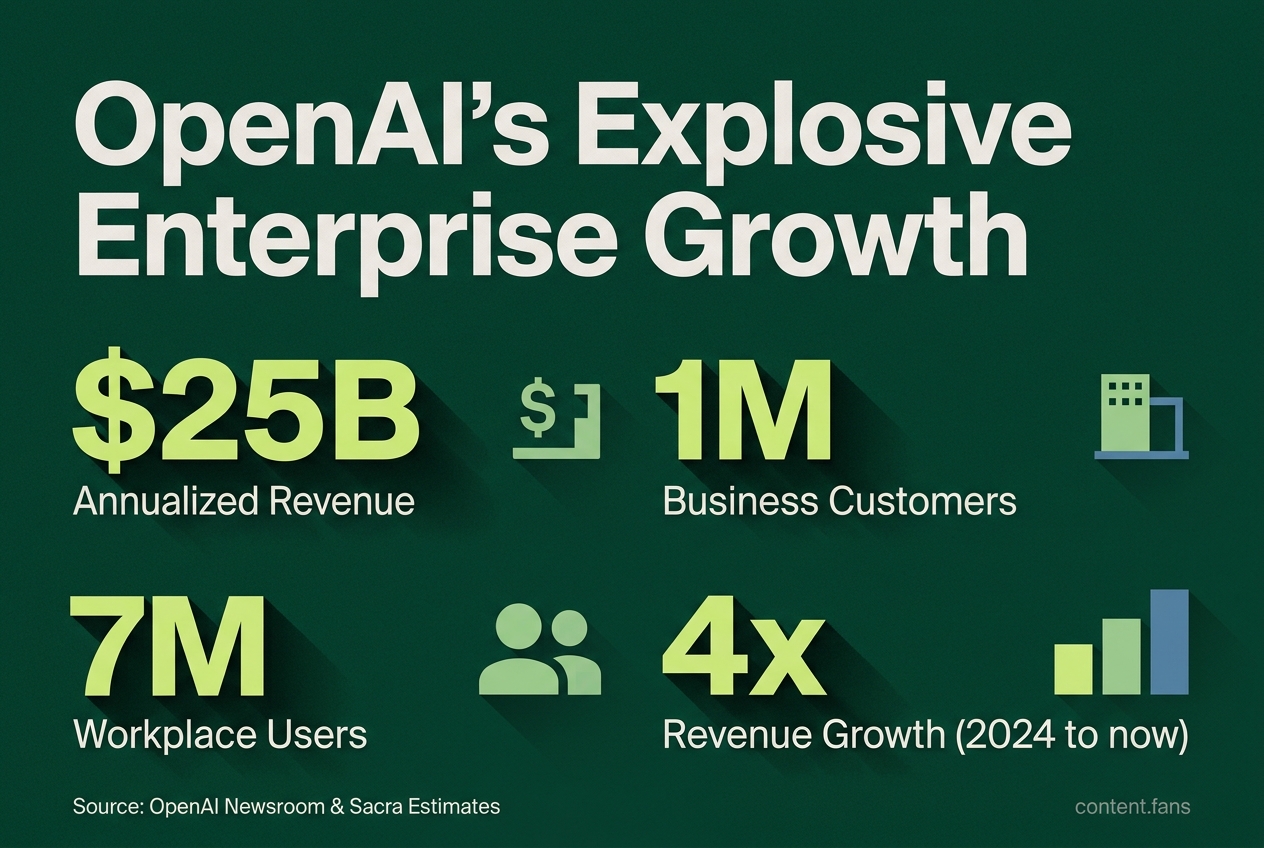
OpenAI now reports over 1 million business customers and more than 7 million workplace users, which may have helped its annualized revenue grow from about $6 billion in 2024 to $25 billion by early 2026. The company appears to be focusing on large corporate clients because these deals provide steady income and help cover high research costs. Usage is growing quickly across many industries and countries, though rivals like Anthropic and Google remain strong competitors. Organizations often request strong security, compliance, and support, and OpenAI is offering tools and services to meet those needs. These trends suggest that OpenAI's growth may be driven by its ability to win and grow enterprise contracts, though competition and customer requirements continue to shape the market.

Explosive enterprise adoption has catapulted OpenAI's revenue to an estimated $25 billion annualized run-rate, driven by significant growth in business customers and workplace users. OpenAI published a January 2026 post about reaching 1 million business customers and 7 million workplace users (OpenAI newsroom). This growth, up from roughly $6 billion in 2024 according to Sacra estimates, confirms why the enterprise market is central to OpenAI's strategy (Sacra revenue profile).
Why OpenAI Is Doubling Down on Enterprises
OpenAI is prioritizing enterprise contracts to create a predictable revenue stream that offsets the high costs of GPU infrastructure and frontier model research. Corporate subscriptions provide steady cash flow, while rapid adoption in business workflows drives significant, scalable growth in platform usage and recurring revenue.
According to industry reports, internal metrics reveal staggering growth: weekly enterprise message volume has surged substantially since late 2024, and API reasoning token usage per organization has climbed dramatically year-over-year. Even the slowest-adopting industry vertical more than doubled its usage.
This trend is global, with many international markets recording significant year-over-year growth in customer accounts. This suggests robust international demand that overcomes hurdles related to regional security standards and language diversity.
However, the market remains intensely competitive. According to industry reports, Anthropic holds a significant market share lead in enterprise LLM spending, compared to OpenAI and Google's substantial but smaller portions. Analysts suggest Anthropic's advantage stems from its strong coding tools, a top-ranked application for most executives.
Enterprise Buyers Ask for Governance and Dedicated Support
Before integrating AI into core workflows, large organizations demand robust security, compliance, and guaranteed uptime. To meet these "table stakes" requirements, buyers often align with a common stack of legal and technical governance frameworks:
- EU AI Act - risk tiering and mandatory documentation
- ISO-IEC 42001 - certifiable AI management system
- NIST AI Risk Management Framework - structured risk governance
- OWASP LLM Top 10 - application-level threat catalog
- MITRE ATLAS - adversarial attack mapping
OpenAI is addressing these needs with its ChatGPT Enterprise offering, which according to industry reports includes enterprise-grade security controls, dedicated support, and private deployment options designed to align with these frameworks. Key customer demands include identity-tied audit logs, automated redaction of sensitive data, and verifiable model versioning for all outputs.
Financial Signals and Usage Intensity
The estimated $25 billion annualized revenue suggests substantial compound annual growth since 2023, with enterprise contracts being the primary driver. According to industry reports, OpenAI has seen significant year-over-year increases in ChatGPT Enterprise seats, indicating that companies are not just testing the platform but rapidly scaling its use internally after adoption.
Deployment is also broadening across sectors. Industry reports note that the median customer sector increased usage substantially year-over-year. While technology, healthcare, and manufacturing lead adoption, even the slowest-growing sectors doubled their activity, diversifying OpenAI's revenue base and reducing dependency on any single industry.
The competitive landscape may shift as Microsoft leverages its significant share in AI platforms and Google integrates its Gemini models into Vertex AI. For now, OpenAI's enterprise success demonstrates a powerful formula: converting model leadership into recurring revenue through high-touch sales, robust compliance tools, and dedicated support.