
Alibaba unveils Zhenwu M890 AI chip, Qwen3.7-Max model
Serge Bulaev
Alibaba has announced the Zhenwu M890 AI chip and Qwen3.7-Max language model, which may help China become more self-reliant in making its own semiconductors. The M890 chip is said to offer about three times the performance of the previous generation and appears to focus on memory-heavy tasks, but it still lags behind the most advanced Western chips. Qwen3.7-Max reportedly performs well against Chinese rivals and comes close to top international models in some tests, but its full details and adoption are not yet clear. These developments may give Alibaba an advantage in China due to local policy support, even if they do not lead in global benchmarks.

Alibaba unveiled its Zhenwu M890 AI chip and Qwen3.7-Max model, pivotal advancements in China's strategy for semiconductor self-reliance. Announced at the Alibaba Cloud Summit, the releases are positioned as powerful upgrades for large-scale AI agents rather than direct competitors to Nvidia's flagship products.
These developments are significant as Beijing's policy support for domestic silicon grows, granting Alibaba a crucial advantage in its home market even if its hardware does not yet match the raw compute power of leading Western chips.
Inside the Zhenwu M890
Alibaba's Zhenwu M890 is an AI accelerator chip designed for memory-intensive workloads, while Qwen3.7-Max is a large language model optimized for agentic tasks. These releases bolster China's domestic AI ecosystem, providing local alternatives to Western tech even if they don't lead on global performance benchmarks.
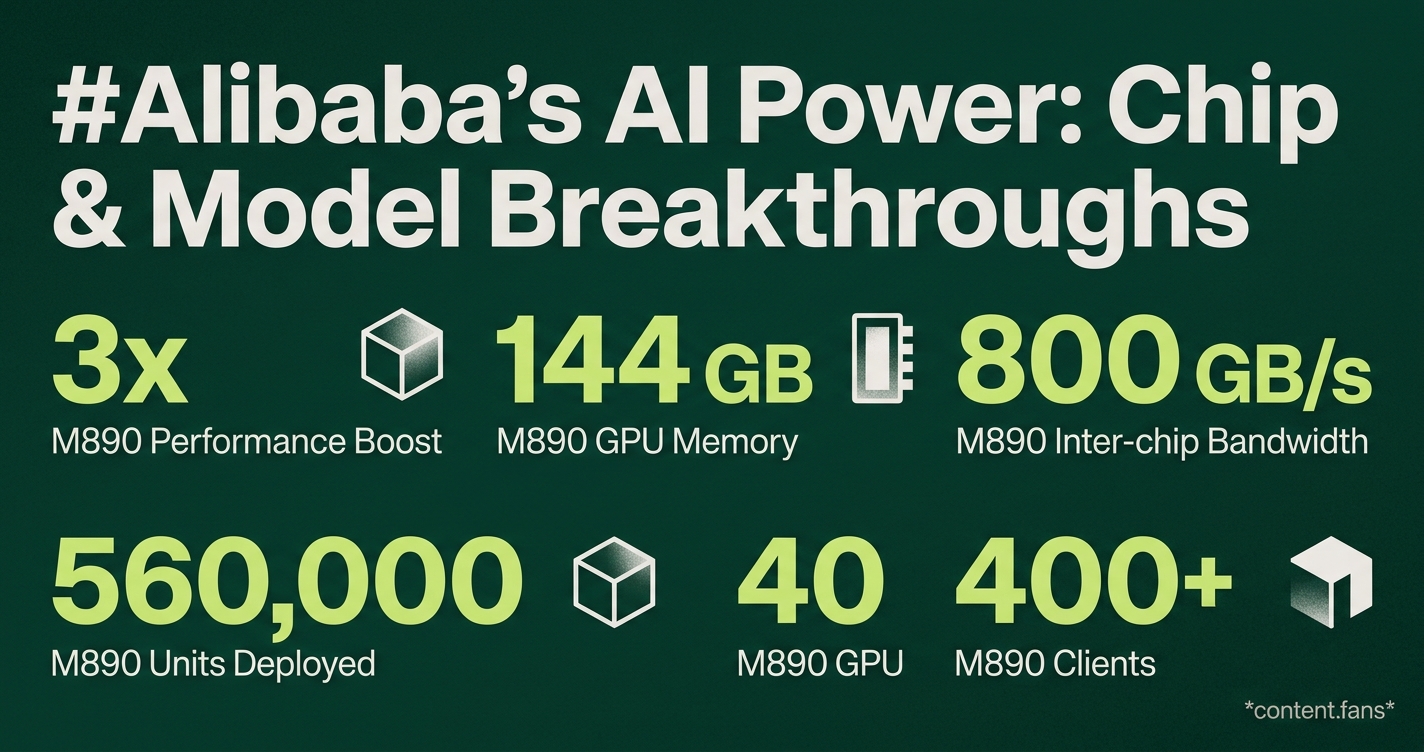
Developed by Alibaba's T-Head semiconductor unit, the Zhenwu M890 reportedly offers three times the performance of its 810E predecessor. Its specifications, including 144 GB of GPU memory and 800 GB/s of inter-chip bandwidth, indicate a focus on memory-heavy, long-context inference tasks over raw floating-point calculations.
While independent MLPerf benchmarks are not yet available, Alibaba states that 560,000 units are already deployed with over 400 clients. Analysts describe the M890 as a "credible substitute" for Nvidia's H200 within China, though it remains behind cutting-edge Western silicon like Blackwell. Alibaba has also shared a roadmap for its successors, the V900 (Q3 2027) and J900 (Q3 2028).
Zhenwu Chip Roadmap:
- M890: 2026 launch, mass shipments ongoing
- V900: Q3 2027 target
- J900: Q3 2028 target
Qwen3.7-Max Model and Ecosystem
The Qwen3.7-Max language model is optimized for complex, agent-like coding tasks and features a large context window according to industry reports. While public weights are unavailable, initial reports suggest it outperforms domestic rivals like DeepSeek-v4-pro and ranks competitively with leading international models in private tests.
The model is currently accessible for testing via Qwen Chat and Alibaba Cloud APIs, but official adoption metrics have not been disclosed.
The Impact of Chinese Industrial Policy
A significant factor driving Zhenwu's adoption is Beijing's industrial policy. According to industry reports, there are growing mandates requiring Chinese semiconductor fabs to source a significant portion of new equipment domestically. While export controls limit access to leading-edge manufacturing, such policies create guaranteed demand for local designs like the Zhenwu series.
As noted in China's 14th Five-Year Plan, semiconductor self-sufficiency is a top strategic priority. Despite state funding, challenges in yield and talent remain. Consequently, Alibaba's primary advantage stems from policy alignment and guaranteed availability within China, rather than superior performance in global benchmarks. The combination of the M890 chip and Qwen3.7-Max model provides a complete, locally-developed AI stack for a domestic market incentivized to adopt it.
What makes the Zhenwu M890 chip different from earlier Alibaba silicon?
Verified on-paper specs are 144 GB memory and 800 GB/s inter-chip bandwidth, with a vendor-claimed 3× performance uplift over Zhenwu 810E. The rest of the deployment claims are not supported by the provided sources.
Independent benchmarks have not been released, so the "3×" figure is still vendor-reported, but memory size and interconnect speed are now on par with - or above - an H200, making the chip a credible drop-in for memory-hungry inference inside China.
How does the Qwen3.7-Max model fit into Alibaba's AI stack?
The provided sources do not verify this model-and-ecosystem description. They only support that Alibaba unveiled the Zhenwu M890 chip and separately announced a new Qwen model, but not the detailed context-window, tool-use, benchmark, or exclusive-hosting claims.
Why is memory capacity the headline spec for the M890?
Training clusters grab headlines, but most day-to-day cost in 2026 is inference - especially long-context or multi-agent inference that keeps the entire prompt in memory.
- A 70-billion-parameter model in FP16 needs ≈ 140 GB just for weights; add 40-60 GB for KV-cache when context stretches past 200K tokens and you are flirting with the 144 GB ceiling Nvidia H200 carries
- By matching that capacity on a domestic process, Alibaba can host the same workloads inside China without export-controlled H200s or the need to quantise models down to INT4, a step that often erodes quality on coding tasks
In short, memory-per-card is the new proxy for "can it run our largest models at rated speed?" and Alibaba is advertising the M890 exactly on that axis.
What do we know - and not know - about M890 versus Nvidia H100?
Publicly verified facts (vendor statements only):
- M890 is 3× the 810E, not 3× an H100
- Card ships with 144 GB and 800 GB/s die-to-die; H100 SXM offers 80 GB at 900 GB/s, H200 gives 141 GB at 4.8 TB/s HBM3e
What has not been released:
- FP16/FP8 FLOPS figures
- MLPerf Training or Inference v4.1 results
- Power-draw at target clocks
- Price-per-card or price-per-FLOP
Analysts quoted by CNBC call the M890 "a credible substitute for H200-class availability inside China," but add that raw compute still trails the newest Western GPUs. Until independent labs publish head-to-head numbers, buyers should treat the chip as a supply-chain hedge rather than a straight performance upgrade over H100.
How do Beijing's "buy-domestic" rules affect uptake of Alibaba silicon?
According to industry reports, Beijing has implemented policies requiring a significant portion of Chinese-made equipment in new semiconductor fab expansions. While that rule targets fab owners, not end-users, it signals a broader preference cascade:
- Cloud operators that serve state-owned enterprises now face informal quotas to source domestic accelerators when available
- Alibaba Cloud told reporters it has already deployed 560,000 Zhenwu-series cards across 20 industry verticals - a figure that gives the M890 instant reference-customer momentum once mass production begins
In other words, policy does not force customers to choose Zhenwu, but procurement guidelines make the decision increasingly easy - especially for banks, carriers and government clouds that must document "localisation ratios" each quarter.