
AI Tollgates Force SaaS Vendors to Rethink Per-Seat Pricing
Serge Bulaev
AI agents that automate user tasks are causing SaaS vendors to question per-seat pricing. Research suggests that by 2030, up to 40 percent of SaaS spending may move to usage-, agent-, or outcome-based pricing. Analysts say this shift is happening because automation means fewer people need licenses, so vendors may start charging for what the AI does instead of who uses it. New models, like usage-based, outcome-based, and hybrid pricing, are appearing as companies experiment with ways to link price more closely to delivered value. These changes might lead to a future where SaaS pricing is based on measurable results, not just the number of users.

The emergence of AI tollgates - autonomous agents that execute user workflows - is compelling SaaS vendors to rethink the logic of per-seat pricing. With a single license potentially doing the work of many, the traditional model is under pressure. Deloitte Insights predicts that by 2030, approximately 40% of enterprise SaaS spending may shift to usage-, agent-, or outcome-based models. Echoing this, analysts at RSM US LLP argue that the per-user fee is "about to break," pushing vendors to charge for measurable results over simple access.
Why seat pricing loses traction
Per-seat pricing is built on the assumption that value scales directly with the number of users. AI agents shatter this assumption. They can resolve support tickets, draft documents, or manage databases independently, meaning one license can deliver the output of an entire team. This creates a value mismatch: as customers need fewer seats, vendors face revenue decline unless they adapt. Shifting to metrics based on usage or outcomes allows vendors to realign their pricing with the actual value delivered.
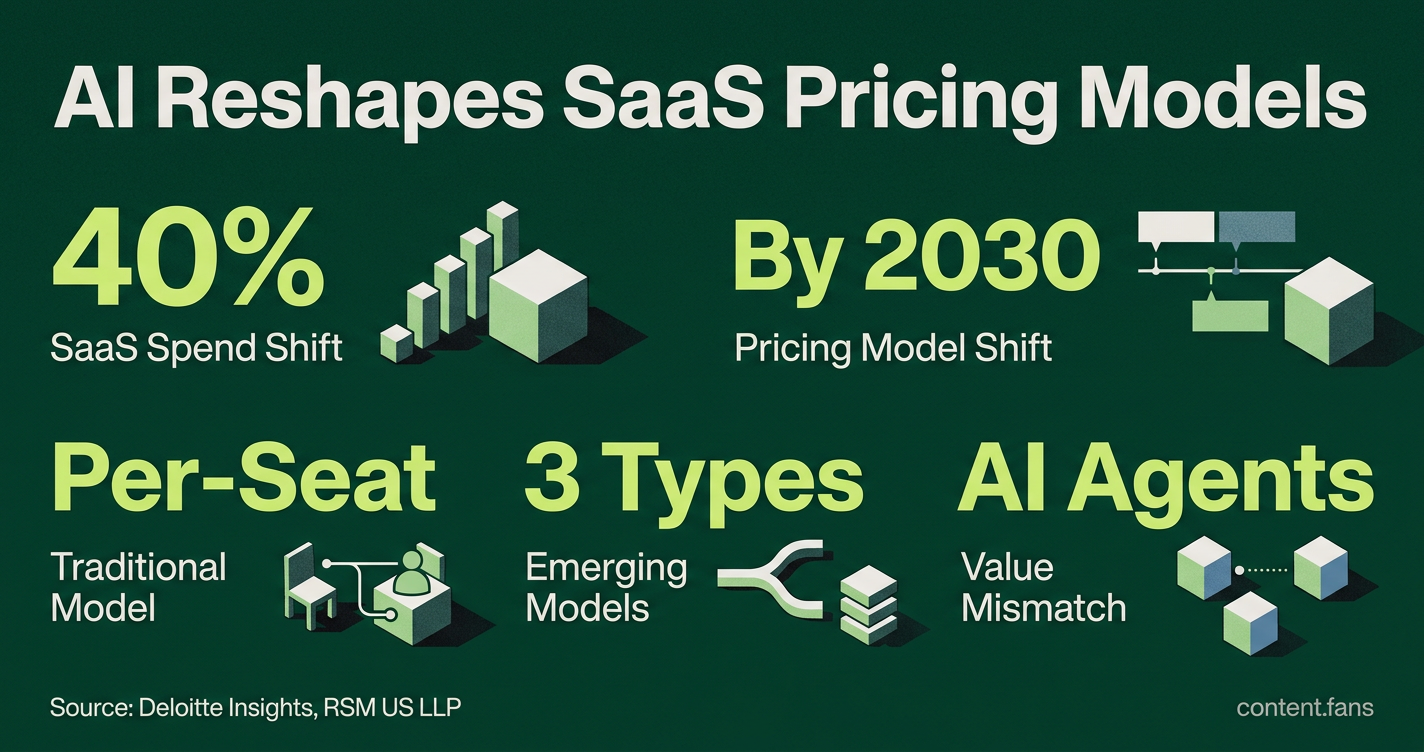
AI agents disrupt traditional SaaS models by enabling a single user license to perform the work of many, reducing the need for numerous seats. This decouples revenue from headcount, forcing vendors to explore new pricing strategies like usage- or outcome-based billing to capture the value of automation.
What the emerging models look like
In response, the market is shifting toward three primary pricing models that focus on performance rather than headcount:
- Usage-Based: This model charges for specific interactions, such as API calls or data processed. For example, Salesforce's Agentforce bills per AI-driven conversation.
- Outcome-Based: Billing is tied directly to successful business results. A prominent Intercom example shows the company charging a flat fee for each support issue its AI successfully resolves.
- Hybrid: This approach blends a fixed subscription fee with variable charges based on usage or outcomes, offering budget predictability for customers while allowing vendors to share in the upside of high-value automation.
AI tollgates and procurement
This new landscape presents challenges for procurement and finance teams, who must now manage variable, performance-based contracts. Key considerations include:
- Data Integrity: Poor data quality is a primary barrier to realizing AI's potential, as agents rely on clean information to function correctly.
- Precise Definitions: Contracts must contain unambiguous, auditable definitions of a successful "outcome" to prevent billing disputes.
- Governance and Trust: To ensure transparency, best practices include implementing clear escalation paths for human oversight and using technologies like append-only logs with cryptographic signatures for verifiable reconciliation.
Revenue implications for vendors
The financial implications for SaaS vendors are profound. Industry analysts are closely monitoring the decline in seat-based licenses against the growth in paid agent transactions. Industry reports suggest traditional subscription models may face significant pressure in the coming years, while outcome-based models are expected to experience substantial growth. This points to an inevitable future where SaaS monetization is built not on user counts, but on the measurable value the software delivers.