
OpenAI Restores ChatGPT to WhatsApp in Europe, Raises Privacy Concerns
Serge Bulaev
OpenAI has brought ChatGPT back to WhatsApp for users in the European Economic Area as of July 13, 2026, following a Meta antitrust order. This allows people to send texts, images, and voice messages, but some features are missing and usage is limited compared to the main app. There are concerns about privacy, as messages may be used to train OpenAI's models unless users opt out, and deleted chats might still be kept for training. Experts suggest that current data processing measures may not fully meet EU privacy laws, especially for business use. The upcoming EU AI Act might lead to stricter rules and closer checks on how ChatGPT is used in messaging apps.
OpenAI restores ChatGPT to WhatsApp in Europe, re-establishing a convenient channel for users in the European Economic Area (EEA) according to industry reports. The move, which followed a Meta antitrust order, allows direct access for text, image, and voice queries. However, this return renews significant GDPR privacy concerns over data training and lawful use for businesses.
What Does the Return of ChatGPT on WhatsApp Mean for EU Users?
According to industry reports, users in the European Economic Area can once again interact with ChatGPT directly through WhatsApp. The service allows for text, voice, and image messaging without an OpenAI account, though usage caps are lower and advanced features are missing compared to the main application.
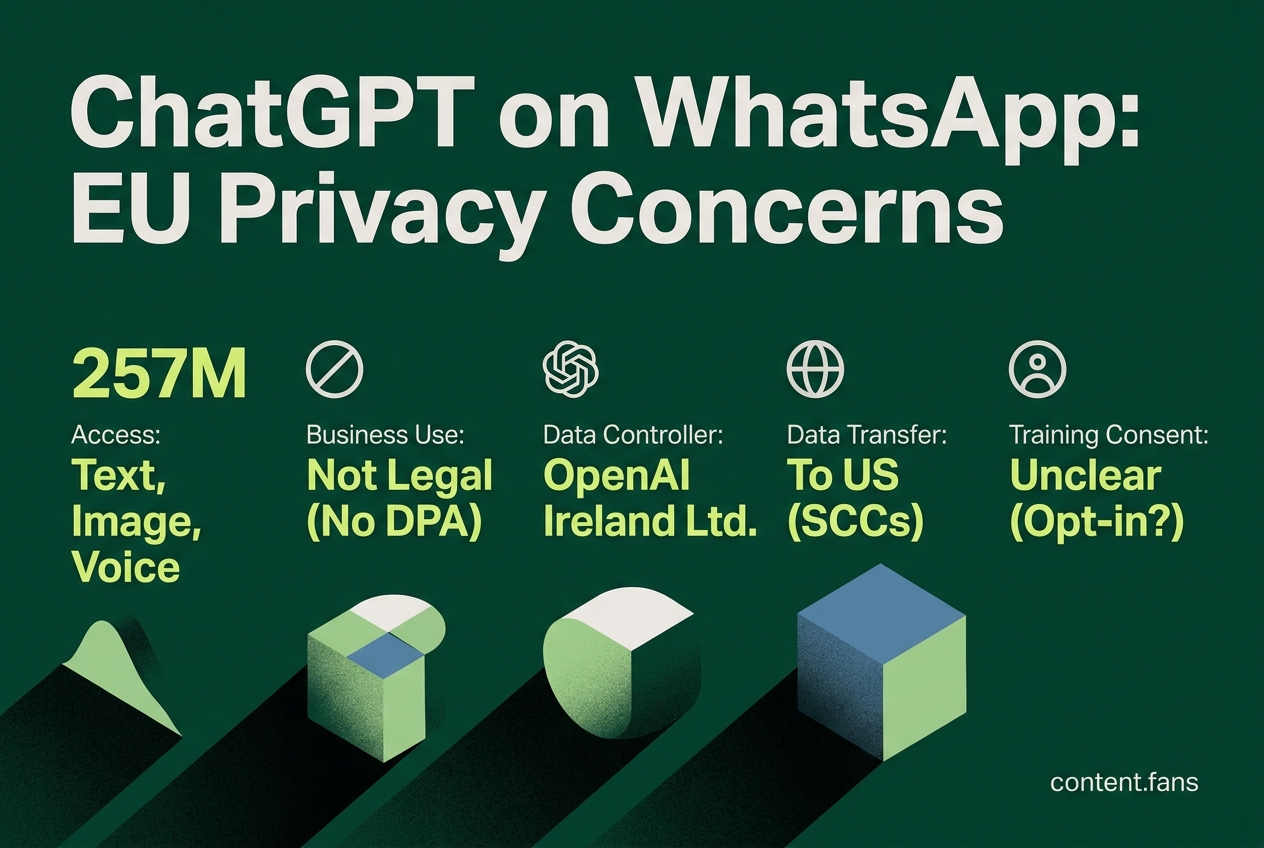
Following a global pause, the service is now exclusively reinstated for the EEA. Users can send photos for analysis, dictate voice notes, and get translations. However, the experience is more limited than the native app, with lower usage caps and the absence of advanced features like Agent mode.
Are Your WhatsApp Conversations Used for AI Training?
OpenAI's data usage for WhatsApp interactions is not confirmed in the sources to default to training; users likely must explicitly consent to data use for training under GDPR, rather than opting out. Privacy advocates at Is ChatGPT GDPR-Compliant? argue this default "opt-in" for data collection contradicts GDPR principles. Furthermore, there is no verified evidence in the sources that deleted WhatsApp conversations are retained for training; OpenAI's general data retention policies for WhatsApp are not explicitly stated.
Why Businesses Cannot Legally Use ChatGPT on WhatsApp
A major legal hurdle prevents business use: the lack of a Data Processing Addendum (DPA). While OpenAI provides DPAs for its paid tiers, according to industry reports no such agreement exists for the free WhatsApp service. Under GDPR, a DPA is typically required for a third party to process personal data. Without it, businesses in the EU have no lawful basis to send customer or internal data through this channel.
OpenAI Ireland Limited is the data controller for EEA users; OpenAI still transfers personal data to the US using mechanisms like Standard Contractual Clauses (SCCs), adding another layer of legal complexity.
Key GDPR Compliance Gaps
Analysts have highlighted several critical privacy shortcomings with the service:
- No Data Processing Agreement (DPA): The free WhatsApp channel lacks the legally required contract for business use.
- Data Training Consent: User conversations and consent mechanisms for model training remain unclear.
- Unclear Data Retention: Policies regarding how long conversation data is stored are opaque.
- Transatlantic Data Transfers: The reliance on Standard Contractual Clauses (SCCs) for EU-US data transfers remains under intense regulatory scrutiny.
EU-US Data Transfers Remain a Legal Minefield
The transfer of European user data to US servers is a persistent point of contention. OpenAI uses Standard Contractual Clauses (SCCs) as its legal basis, but multiple EU data protection authorities challenge whether this adequately protects data from US surveillance laws. According to industry reports, regulatory challenges continue regarding GDPR compliance, including transparency failures and lack of age verification.
The Upcoming EU AI Act: What's Next?
The regulatory landscape is set to become even stricter. The EU AI Act entered into force on August 1, 2024. Key obligations for general-purpose AI models apply from August 2025, and most provisions are fully enforceable by 2026, imposing new obligations on AI services integrated into platforms like WhatsApp. These include clear labeling and informed consent for data processing. Given the existing privacy concerns, experts anticipate that regulators will closely monitor the ChatGPT-WhatsApp integration for compliance. The prevailing advice for now is clear: businesses should use the secure Enterprise tier, and individuals should actively manage their privacy settings.
What changed and why does it matter?
According to industry reports, OpenAI quietly turned the WhatsApp number +1 800-CHATGPT back on for countries inside the European Economic Area.
No app download is required - users simply add the number to their contacts and start texting, talking or sending photos.
This represents a significant development for mainstream messaging app access to ChatGPT directly in Europe.
Is the service privacy-safe for Europeans?
Not completely.
OpenAI lists OpenAI Ireland Ltd. as the EEA data processor, but:
- There is no Data-Processing Agreement for the free WhatsApp channel
- Chat data usage and training consent mechanisms remain unclear under GDPR requirements
- Standard Contractual Clauses move some traffic to U.S. servers, a practice regulators keep questioning under the Schrems-II rulings
If you work in a company, avoid placing personal or client data in the WhatsApp thread; business use without a DPA can breach Article 28 of the GDPR.
How does WhatsApp ChatGPT compare to the standalone app?
| Feature | WhatsApp (EEA) | Stand-alone App / Web |
|---|---|---|
| Quick questions on the move | Excellent | Excellent |
| Voice notes | Yes | Yes |
| Long document comparison | Limited | Best |
| Agent mode (multi-step tasks) | Not offered | Full |
| Memory across sessions | No | Yes, if signed in |
Bottom line: WhatsApp is great for speed and convenience, but heavy work still belongs to the browser or desktop app.
Can businesses inside Europe legally plug ChatGPT into WhatsApp?
Only if you have a signed Data-Processing Addendum.
Today that document is offered only for ChatGPT Enterprise, Team and API seats. Using the public number for customer support, marketing or HR conversations exposes the company to GDPR fines because no DPA exists for that path.
Will ChatGPT stay on WhatsApp this time?
OpenAI has not published a sunset date, but history shows the integration depends on Meta's policy on generative bots.
If the current antitrust-driven access is reversed again:
- Export your history through Settings > Data Controls
- Keep an eye on regulatory news from Ireland's DPC; they oversee every major EU privacy decision about OpenAI
For step-by-step help on turning off model training or requesting Enterprise-level DPA, see OpenAI's EU privacy policy and the Data-Processing Addendum pages.