
Firms adopt AI ethics playbooks for employee skill cloning
Serge Bulaev
Firms are starting to use clear ethical rules, or playbooks, for AI systems that copy employee skills, but there are many rules about privacy, consent, and fairness. Current advice suggests companies should treat each AI skill clone with care, asking workers for clear permission and explaining how their data will be used and protected. Experts say it is important to track how the systems work, let humans double-check decisions, and spell out how workers will be rewarded or protected. The rules and best practices may keep changing as new laws and guidelines come out from groups like UNESCO and the OECD.

Developing AI ethics playbooks for employee skill cloning is rapidly shifting from a theoretical exercise to a critical compliance requirement. As pioneering firms like IBM and Wärtsilä prove the technical viability of converting employee expertise into reusable AI, they also highlight the urgent need to navigate complex rules around privacy, labor rights, and accountability.
Current international guidance advises treating each AI skill clone as a sensitive system. Key frameworks, like the UNESCO Recommendation on the Ethics of Artificial Intelligence and the OECD's paper on AI in the workplace, stress the importance of transparency, explainability, human rights, and system accountability. Integrating these principles from the outset is crucial for preventing future disputes over fairness and ownership.
Consent and purpose limitation
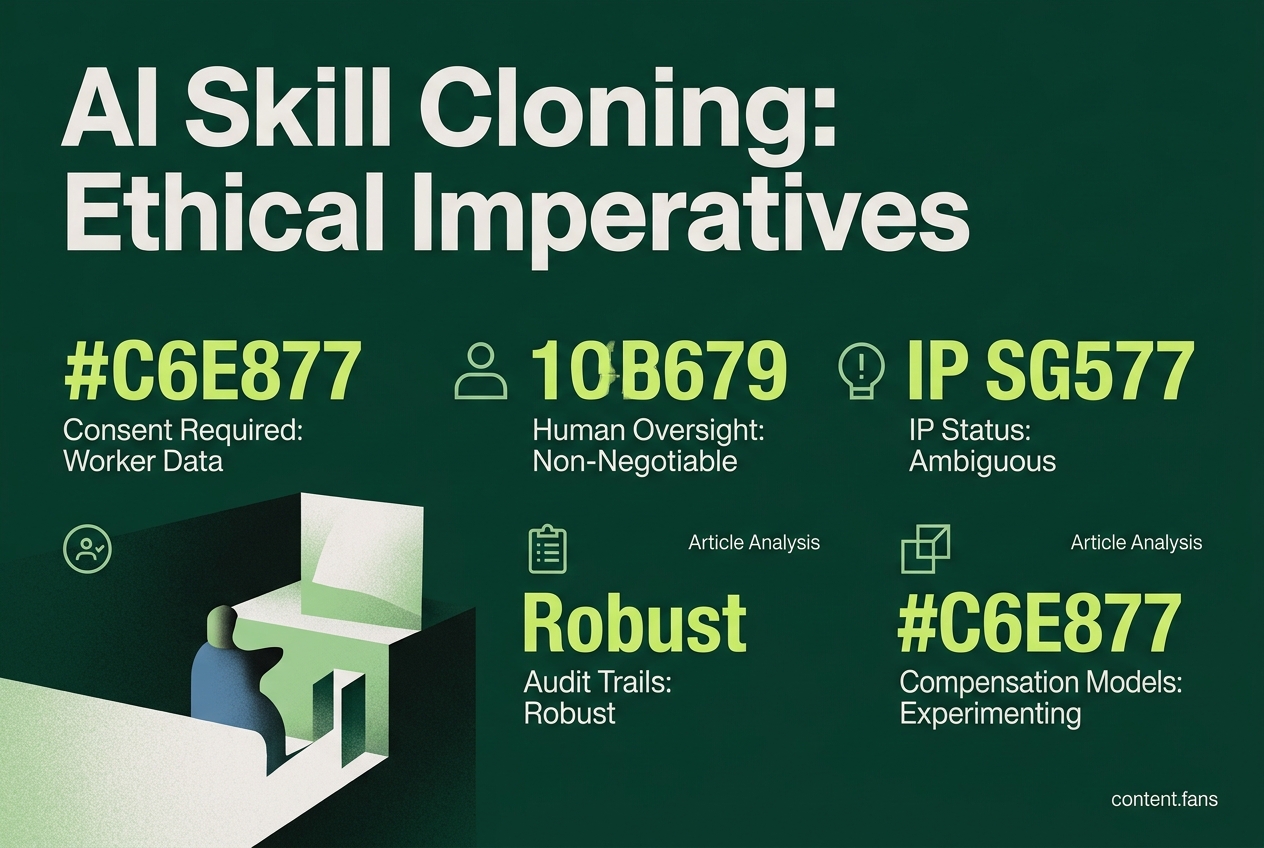
Organizations should provide notice and limit collection/use of worker data; informed, specific consent is required in some contexts, especially for disclosure outside the business or certain sensitive data uses. This involves clearly defining what data is used, its exact purpose, and its retention period, while also establishing processes for workers to revoke consent where legally permissible.
This aligns with the DOL's AI guidance, which urges notice, disclosure, and careful handling of worker data, with freely given, informed, and specific consent required for sharing worker data outside the business unless required by law. Furthermore, emerging international perspectives suggest that formal contractual agreements may become necessary to define ownership of the resulting AI-encoded skills. Every data-collection notice should specify what is gathered, its purpose, and its deletion date.
Auditability and human oversight
The OECD emphasizes that robust audit trails and meaningful human oversight are non-negotiable, especially when AI influences decisions on hiring, promotions, or discipline. Before any system rollout, comprehensive impact assessments must evaluate risks related to privacy, bias, and safety. A practical model, demonstrated by NASA JPL's knowledge-graph initiative, involves logging all transcripts and metadata to ensure any AI-generated recommendation can be fully reconstructed and reviewed by a person.
Compensation and IP questions
The legal and financial implications of AI skill cloning are still largely undefined. According to industry reports, the status of "AI-related skills" as intellectual property is ambiguous, forcing companies into contractual arrangements that may or may not include royalties. Echoing this uncertainty, UNESCO advises collaboration with labor unions to guarantee fair transitions for workers. Consequently, organizations are likely to experiment with various compensation models, including:
- One-time stipend for training data
- Ongoing royalty on revenues linked to the clone
- Recognition credits in internal performance reviews
- Access to reskilling programs funded by savings from the clone
- Sunset clause that retires or renegotiates the model after a fixed term
Building the Ethics Playbook for Cloning Coworkers
A practical ethics playbook should consolidate these recurring principles into a clear, actionable framework:
- Map data flows and tag any personal or sensitive elements.
- Collect explicit opt-in consent and allow revocation where feasible.
- Publish intended uses, limits, and human escalation paths.
- Log model inputs, updates, and decision outcomes for audit.
- Review compensation and IP clauses with both legal and workers' representatives.
The landscape of workplace AI is dynamic. While foundational regulatory texts from UNESCO and the OECD provide a strong starting point, sector-specific guidance is continuously being issued by regional authorities like Hong Kong's PCPD and the U.S. Department of Labor. Therefore, companies creating AI skill clones must treat their ethics playbooks as living documents, prepared to adapt as regulations and best practices mature.