
Douyin's 2026 animated dramas: 89% are AI-generated
Serge Bulaev
In 2026, 89% of the top animated dramas on Douyin were made using AI, and people keep watching these videos in huge numbers. Fast and cheap AI tools may have changed how many shows are made and how quickly they appear, but only a few become big hits. Legal protection for these AI-made works seems unclear, and studios are being asked to follow new rules about labeling and copyright. Costs for making animated dramas have dropped a lot, and many small teams or even single people can now produce shows. The industry appears to be facing questions about quality, jobs, and copyright as AI-generated content keeps growing.

The rise of AI-generated animated dramas on Douyin marks a significant shift in China's digital media landscape, with the platform's leaderboards now dominated by this new form of content. Analytics firm DataEye reported in May 2026 that 89 of the top 100 animated dramas on the app were machine-produced. This surge, fueled by affordable generative video models, is reshaping Chinese online storytelling while raising critical new questions about quality, labor, and copyright.
AI-powered video tools drive surge in AI-generated animated dramas in China
The production of AI-generated animated dramas has exploded, with Douyin adding a significant number of new titles monthly. While viewership is massive in aggregate, breakout hits are rare. This high-volume, low-hit-rate model is driven by rapid, low-cost AI tools that have dramatically widened the content pipeline.
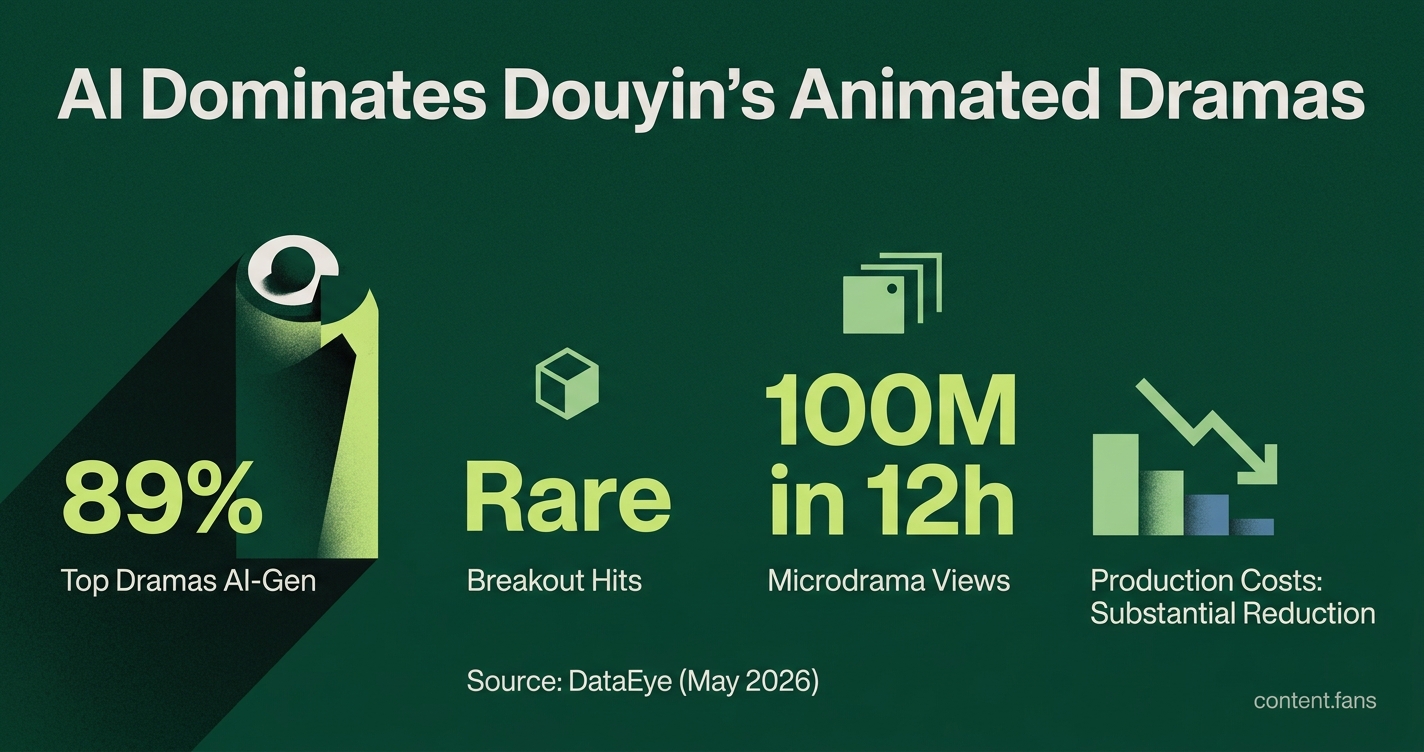
Douyin's content pipeline has expanded at an unprecedented rate. Reports indicate the platform has seen a massive increase in AI drama uploads compared to the previous year. Despite this flood of content - with industry reports suggesting substantial numbers of titles uploaded monthly - very few achieve breakout success. According to industry analysis, only a small fraction of active AI dramas surpass 100 million views. However, aggregate traffic remains high, with one hit microdrama reportedly reaching 100 million views in just 12 hours, according to Xinhua.
Legal and IP questions pile up
The legal framework surrounding AI-generated content in China is complex and evolving. Because Chinese law defines authorship as an inherently human act, the copyright protection for AI outputs remains uncertain. However, courts may grant copyright if a creator can document specific, individual choices made during production. A significant risk for producers is the lack of a text-and-data-mining exception, which exposes them to infringement claims if AI models are trained on copyrighted material. Furthermore, regulators now require producers to label AI content and submit scripts for review, adding to the compliance burden for studios.
Industry reports suggest studios commonly follow practices to reduce legal exposure:
- Secure licensed or original training data
- Record prompt, selection, and editing steps to show human creativity
- Obtain written consent for any real-person likeness or voice
- Apply platform labeling rules before upload
- Keep adaptation agreements for novels, games, or comics
Economics favor volume over hits
AI has significantly altered the economics of animation, with industry reports suggesting substantial reductions in production costs and timelines. This has democratized production, enabling smaller studios to enter the market. Revenue models are built on volume, relying on episode unlocks, advertising, and platform incentives. While industry sources suggest top-performing AI series can generate substantial monthly revenue, most content generates low margins until promoted by platform algorithms.
The labor market is adapting to this new reality, with increased pressure on traditional live-action crews as studios pivot to smaller, AI-focused teams. New business models are emerging, such as 'portrait-rental' services that allow creators to legally license real human faces for synthetic characters. This trend suggests the industry is building a new supply chain optimized for cost efficiency over traditional production values and star power.
For now, Douyin's metrics confirm that generative video can effectively capture user attention, but the industry must navigate significant challenges, including extremely low hit rates, an uncertain and evolving legal landscape for IP, and an intense race to the bottom on costs.
The surge of AI-generated animated dramas on Douyin represents one of the most dramatic transformations in digital entertainment. With 89 of Douyin's top 100 animated dramas in May being AI-generated, the industry is grappling with unprecedented scale, shifting economics, and complex questions about quality and rights.
Below are answers to five critical questions about this phenomenon, based on current research and industry reporting.
How many AI-generated animated dramas are being produced on Douyin?
The volume has exploded beyond anything seen in traditional animation. According to DataEye research reported by AI Weekly, Douyin has seen a massive increase in AI drama uploads compared to the previous year. The New York Times reported that a significant number of AI-generated microdramas were uploaded in March 2026 alone. This represents a substantial daily upload volume of new titles.
What does user engagement look like for this AI content?
Despite the massive volume, audience consumption remains extraordinarily high. CNN reported that in the first half of 2026, a large number of new AI-generated microdramas accumulated substantial viewership on Douyin. However, the hit rate is extremely low: only a small percentage of titles crossed the 100 million view threshold. When breakout success does occur, it can be explosive - Xinhua noted one AI microdrama reached 100 million views in just 12 hours.
How has AI changed production costs and timelines?
The economic disruption is severe. According to industry reports, production costs for animated dramas have seen substantial reductions. Production timelines have compressed significantly, with some studios able to produce content much faster than traditional methods. This cost structure has enabled smaller production companies to compete with traditional studios, fundamentally restructuring the labor market.
What copyright and IP challenges does AI-generated animation face?
Chinese law currently presents a split but evolving picture. Under the Copyright Law of the PRC, AI systems cannot be authors - authorship is limited to natural persons and legal entities. However, courts have increasingly recognized copyright protection for AI-assisted works when creators can demonstrate documented human creative input through prompt engineering, output selection, and editing. Critical unresolved risks include:
- No text-and-data-mining exception for training AI on copyrighted content
- Rising disputes over unauthorized adaptation of literary works into AI-generated formats
- Strict enforcement against unauthorized use of portraits, voices, and likenesses
- New labeling and filing requirements imposed by regulators and platforms
How are studios actually making money from AI-generated dramas?
Profitability depends on high-volume distribution rather than blockbuster hits. Revenue streams include:
- Micro-transactions and episode unlocks (industry reports suggest top AI dramas can generate substantial monthly revenue)
- Subscription tiers and platform advertising
- Platform subsidies and state support (live-action subsidies were reduced, pushing producers toward AI)
- IP licensing from original stories and novels
- Face-rental markets where individuals license their likeness for fees per episode
The sector is described as generating "stable profits" for established players, though profit margins face pressure from intense competition and platform commission structures.