
HBR: Empathetic Leadership Makes or Breaks AI Adoption
Serge Bulaev
The article suggests that empathetic leadership may be essential for successful AI adoption, as employees experience new technology changes both socially and technically. Machines cannot fully replace the trust and empathy that humans build at work, especially in leadership situations like mentoring or complex decisions. While some research finds AI might lower burnout and raise productivity, there may also be a growing sense of disconnection among teams. Experts recommend that companies create spaces for personal connection and carefully measure both productivity and team well-being. Overall, the evidence appears to show that workplaces are more likely to thrive with AI when human connections are protected and valued.
Successful AI adoption hinges on empathetic leadership. While artificial intelligence can accelerate repetitive tasks, a Harvard Business Review analysis argues that leadership empathy can "make or break AI adoption," as employees experience new tools as social, not just technical, changes. This analysis explains why cultivating human connection is vital and how companies can design workflows that protect judgment, focus, and care.
Why Trust and Empathy Resist Automation
Machines cannot replicate the subtle signals that build credibility between colleagues or take final responsibility for high-stakes decisions. These human-centric limits are most apparent in leadership roles involving mentoring, conflict resolution, or strategic judgment. When executives rush AI deployments, teams may seem to comply but withhold discretionary effort, undermining promised productivity gains.
Empathetic leadership is crucial for AI adoption because technology rollouts are social and emotional processes, not just technical ones. Leaders must guide teams through the uncertainty, building the psychological safety needed for employees to adapt and embrace new tools without fear of being devalued or replaced.
The Impact of AI on Burnout and the "Connection Deficit"
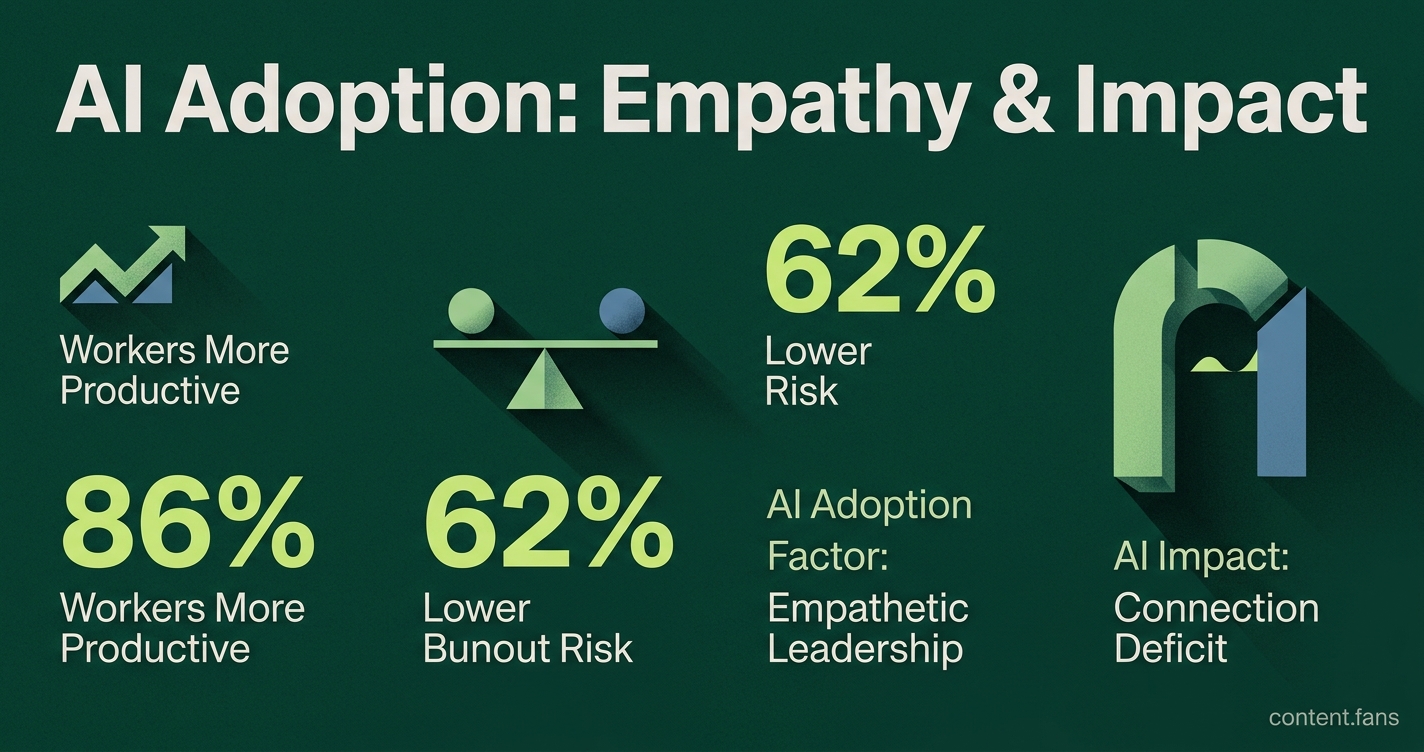
Research on AI's impact reveals a mixed picture. A global survey from Workday research found 86% of workers felt more productive and 62% reported lower burnout risk. However, the report also warned that automation can deepen a "connection deficit" as teams meet less. Industry reports suggest that focused work sessions may decline after AI rollouts, indicating potential cognitive drain from task-switching.
Vital Leadership Actions for Human-Centered AI Workplaces
Experts recommend deliberate design choices to protect interpersonal moments. Deloitte labels these cultural routines "softwiring." Key actions include:
- Scheduling recurring AI-free huddles for brainstorming.
- Holding office hours for employees to discuss use cases in person.
- Maintaining a human-in-the-loop for coaching, feedback, and mediation.
- Surveying loneliness and psychological safety alongside productivity metrics.
Designing Workflows to Protect Deep Focus
Studies suggest sustained attention shrinks when AI assistants are a click away. To combat this, organizations are adopting "pause before generate" norms. This requires employees to outline a problem and potential approaches first, guarding against passive acceptance of imperfect AI drafts and creating space for original insight.
Measuring What Truly Matters: Connection and Engagement
Connection can be overlooked because it is invisible on financial dashboards. Researchers advise pairing AI productivity metrics with indicators like peer recognition frequency or voluntary mentoring. This transparent reporting helps leaders see if efficiency gains are masking rising turnover intentions or declining morale.
Firms that approach AI as a tool for augmenting, rather than substituting, human bonds are more likely to maintain engagement. The evidence points to a core premise: people trust people, and technology performs best when this truth guides its implementation.
Why is empathetic leadership critical for AI adoption success?
While AI can automate tasks and boost productivity, it cannot replicate trust, loyalty, or empathy - elements that remain fundamentally human. Research from Harvard Business Review shows that empathetic leadership can make or break AI adoption, with employees often experiencing AI rollout more anxiously than executives assume. Organizations that treat human connection as a strategic organizational asset rather than a nice-to-have will better navigate the transition. As management consultant Marc Cugnon emphasizes in his SmartBrief piece "Why genuine connection still matters in the age of AI," intentional cultivation of these human elements must accompany - not be displaced by - technological advancement.
How does AI adoption impact employee burnout and engagement?
The 2026 research presents a mixed but cautionary picture. On one hand, Workday's global research found that 62% of employees reported decreased stress or burnout risk after using AI, and 86% felt more productive. However, other studies reveal concerning trends: industry analysis suggests that after AI adoption, deep-focus work sessions may decline significantly, multitasking increased, and workloads often intensified rather than decreased. UC Berkeley researchers warned that AI can create implicit pressure and blurred work boundaries leading to cognitive fatigue. Research indicates that transparency in AI integration correlates with higher engagement and stronger employee commitment.
What practical strategies help leaders balance AI efficiency with human connection?
Effective organizations deliberately design work so AI supports rather than replaces trust-building and reflection. Key strategies include:
- Establishing clear boundaries for when work must stay human - particularly mentoring, coaching, conflict resolution, and team building
- Creating intentional rituals such as AI-free meetings for brainstorming and original thinking
- Holding "AI office hours" where employees share use cases and ask questions in person, fostering collaborative learning
- Training leaders to model presence - listening without multitasking and encouraging reflection over immediate answers
- Measuring cultural health alongside productivity metrics, including surveys on loneliness, cohesion, and psychological safety
Deloitte's 2026 framework distinguishes between "hardwiring" (formal roles and protocols) and "softwiring" (culture, leadership behavior, and psychological safety) - both essential for sustainable AI integration.
Why should leaders prioritize deep thinking and focus time over pure speed?
AI's promise of efficiency can inadvertently erode the cognitive conditions needed for judgment and innovation. Research shows that constant task-switching and AI-assisted output pressure reduce opportunities for the sustained concentration that produces quality decisions. McKinsey emphasizes that curiosity, adaptability, responsibility, and human-centered thinking are foundational mindsets for 2026's workplace - all requiring protected time to develop. Leaders who create space for focus help employees maintain the discernment to question AI outputs and the capacity for sense-making that machines cannot replicate. This investment pays off in better decision quality and reduced error rates downstream.
How can organizations prevent a "connection deficit" as they scale AI?
The risk is real: Workday's research explicitly warned that AI may be deepening a connection deficit at work even as it eases individual burnout. Prevention requires intentional design:
- Use AI to coordinate relationship-building (suggesting peer learning pairs, prompting follow-ups) rather than substituting for it
- Audit workflows specifically to identify lost human touchpoints and reintroduce small rituals
- Implement "pause before generate" norms for high-stakes work, requiring verification and reflection
- Reward connection as well as output in performance systems
- Establish human-in-the-loop mandates for sensitive interpersonal functions
Organizations that embed these practices from the start of AI adoption report stronger long-term engagement and more sustainable performance gains.