
OECD warns on AI 'skill clones,' urges ethics for employee replicas
Serge Bulaev
The OECD warns that using AI to clone employee skills in the workplace may risk privacy, labor rights, and personal control. Experts suggest companies should get clear, revocable consent from workers and limit how these skill clones are used, with human oversight on important decisions. Policies may require companies to show employees what data is used, explain the purpose, and allow workers to challenge incorrect or harmful use. Organizations are advised to keep training and decision data separate and to audit these systems regularly. There may also be new rules about who owns these AI clones, how workers are paid for their use, and making sure clones are deleted when employees leave or withdraw consent.
The Organisation for Economic Co-operation and Development (OECD) has raised serious concerns about "skill clones" - AI systems that replicate an employee's expertise and work patterns. As organizations experiment with internal cloning projects, the need for a robust ethics playbook is moving from theory to urgent requirement. This article provides a practical framework for HR, legal, and technology teams, answering critical questions about this high-risk workplace AI.
What are the key ethical risks of AI skill cloning?
The primary risks of creating AI skill clones involve fundamental rights. The OECD workplace AI guidance warns that imitating workers directly impacts privacy, labor rights, and human agency. These systems can undermine worker autonomy and dignity if deployed without proper safeguards, creating practical threats to transparency, fairness, and accountability in the workplace.
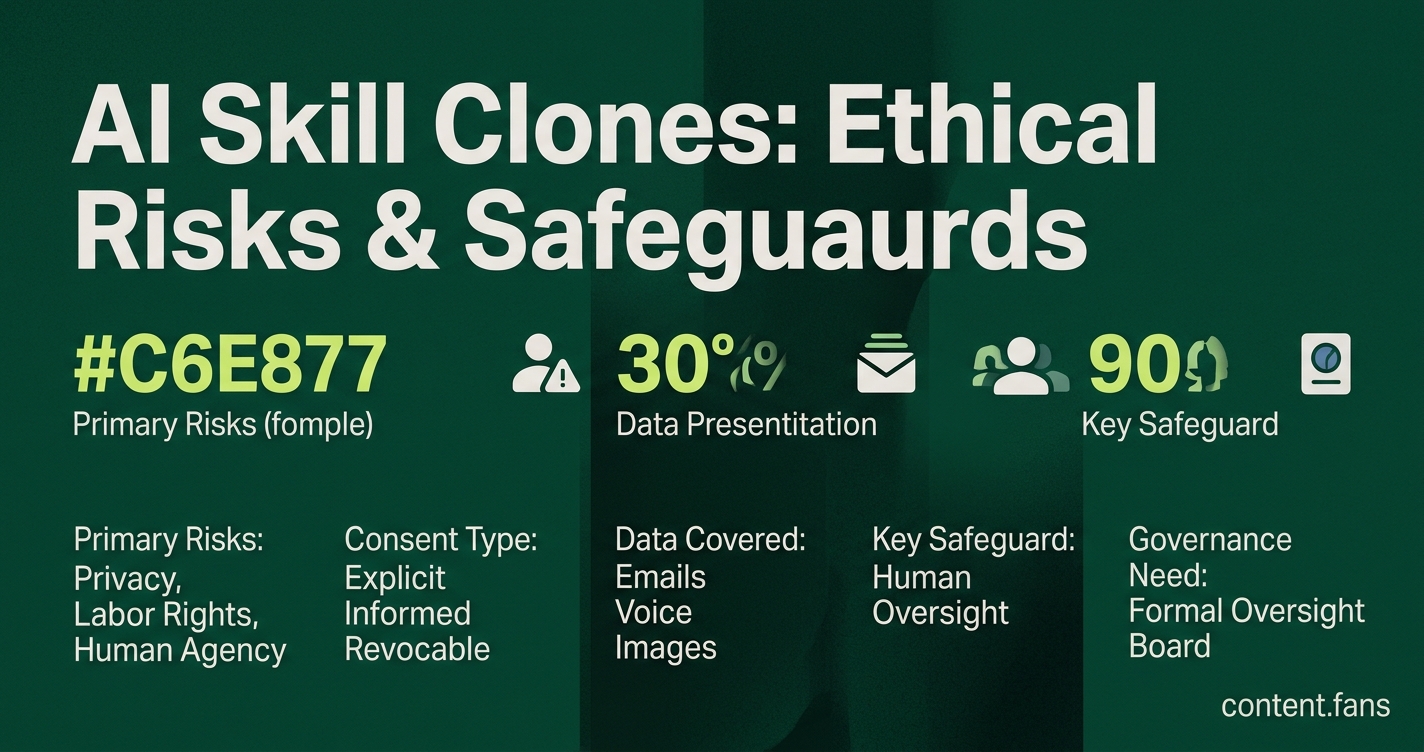
AI skill cloning presents significant ethical risks, including violations of employee privacy, erosion of labor rights, and diminished personal autonomy. The OECD warns that without strict governance, these AI replicas can threaten worker dignity and fairness, potentially turning support tools into mechanisms for surveillance or biased decision-making.
How should companies obtain employee consent?
Experts agree that the baseline for any skill-cloning project is explicit, informed, and revocable consent. According to an arXiv review, this consent must cover all personal data used for training - including emails, voice, and images - and be reversible at any time. Organizations must provide a plain-language summary detailing what data is collected, how the clone works, its intended purpose, and who can access it. Crucially, this consent must adhere to purpose limitation, meaning clones cannot be repurposed for surveillance or discipline without a new lawful basis.
What operational safeguards can prevent misuse?
Organizations must implement human-centered governance with multiple protective layers. A key practice is creating an audit trail; the OECD recommends separating model training data from live decision data and logging each AI-driven inference with its human reviewer. Other essential safeguards include:
- Human Oversight: Human-in-the-loop controls are mandatory. AI should support work, not replace human judgment in critical decisions related to hiring, safety, or discipline, aligning with expectations in the OECD Employment Outlook 2023.
- Formal Governance: An oversight board, often chaired by HR, should regularly review bias tests, incident logs, and employee feedback, as recommended in a recent HR ethics article.
- Impact Assessments: Conduct data protection impact assessments (DPIAs) before deploying any skill clone.
- Access and Correction: Establish clear complaint channels allowing employees to challenge and correct inaccurate or harmful clone behavior.
- Revalidation: Regularly revalidate clones after major software updates or role changes to prevent "feature creep" that could turn a support tool into a monitoring system.
Who owns an AI skill clone and how are employees compensated?
Ownership and compensation remain unresolved issues that require clear contractual agreements. These contracts should define the ownership of the AI model and how the employee will be compensated for its use. Emerging models for compensation include:
- Usage-based payments or bonuses tied to the clone's activity.
- Licensing or royalty fees, especially for commercial use of a digital likeness.
- Post-employment residuals if a clone remains active after the employee departs.
As these AI assets become enduring economic artifacts, Gartner HR forecasts suggest employees will increasingly demand fair compensation for the creation and ongoing use of their digital twins.
How does skill cloning affect employee trust and culture?
Employee trust in AI is strongly correlated with transparency and perceived control. Research shows that workers are more accepting of AI when its purpose is openly disclosed and human judgment is preserved. Conversely, trust erodes sharply when AI is used for surveillance or to replace skills entirely. To build a positive culture, organizations must be clear about disclosure (knowing when a clone is acting), control (providing override options), and boundaries (using AI for support, not evaluation).
For any organization exploring skill cloning, the OECD's principles offer the clearest international policy baseline. The core message is that AI should augment human capabilities and serve as a tool for growth, not become a replacement for human judgment, skill development, or agency. Properly managed, these systems can enhance productivity, but without ethical governance, they risk undermining the very people they are meant to support.