
OpenAI GPT-Live Expands Voice AI With Full-Duplex Talk
Serge Bulaev
OpenAI's GPT-Live uses full-duplex voice AI, which means it can listen and speak at the same time. This may help make conversations smoother in different languages and learning situations, as it removes long pauses and allows people to talk more naturally. Research suggests that full-duplex models can reduce misunderstandings and may work almost as fast as human interpreters, though strong accents or noisy places can still cause problems. Other companies, like NVIDIA and Alibaba, are also making similar systems, but GPT-Live still seems to lead in some areas. Experts believe the voice AI market might grow a lot, but which system people use most could depend on how well it handles real conversations.

OpenAI's GPT-Live is revolutionizing voice AI with its full-duplex capabilities, allowing it to listen and speak simultaneously. This listen-and-speak loop is especially transformative for multilingual conversations and language tutoring, where even minor delays can disrupt understanding. GPT-Live positions conversational AI as an always-on interpreter, moving beyond the turn-based, "baton-passing" model of older systems.
Why full-duplex matters in live translation
Full-duplex voice AI allows a system to process user speech while simultaneously generating and speaking its own response. This eliminates the awkward pauses common in traditional voice assistants, enabling natural, overlapping conversation and real-time interruption, much like a human dialogue, which significantly improves user experience.
Traditional speech translation follows a slow, cascaded process: transcribe, translate, then synthesize audio. Industry reports highlight that this pipeline introduces significant delays per turn. Full-duplex models eliminate these stages by translating speech-to-speech in a single, efficient pass, allowing speakers to interject or self-correct naturally. An OpenAI report notes this can significantly reduce misunderstandings for use cases like travel and customer support.
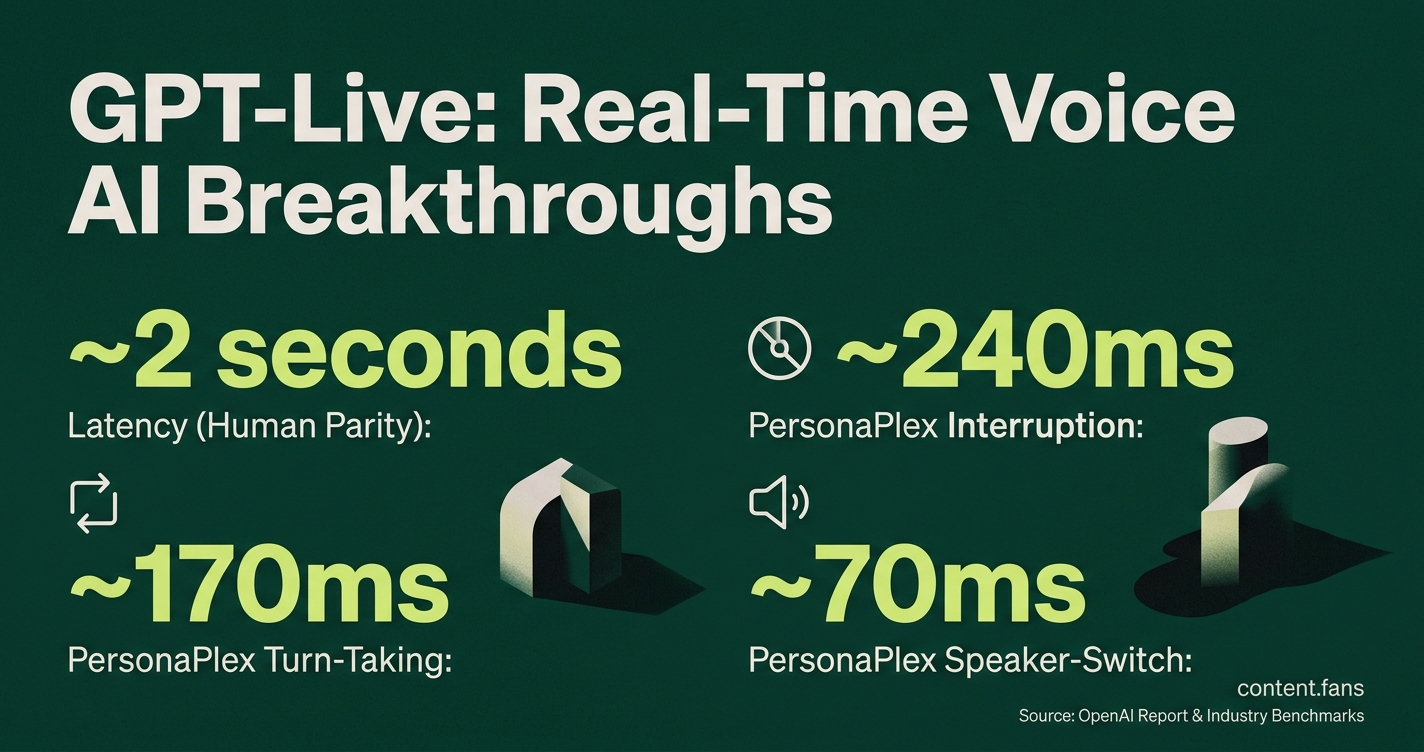
A recent survey of such end-to-end systems confirms they are achieving near-parity with human interpreters on latency, with benchmarks around two seconds in controlled tests. However, experts caution that accuracy can still decrease with strong accents or in noisy environments, making sensitive medical or legal exchanges cautious use cases for now.
Language learning gets conversational
Educators testing GPT-Live report a significant reduction in the "awkward pause" that often discourages students during voice practice. Because the model is always listening, a learner can hesitate, restart, or use filler words without breaking the conversational flow. Key benefits noted by educators include:
- Immediate pronunciation feedback delivered in a natural voice
- Context-aware corrections that reference earlier dialogue
- Role-play scenarios (job interviews, travel check-ins) launched on demand
- Support for backchannel cues such as "uh-huh" or "right" to practice real turn-taking
These features transform language practice from a rigid exercise into a dynamic chat with a fluent partner.
Rising competition and architectural choices
OpenAI is not the only company developing overlapping audio stream technology. PersonaPlex-7B-v1 was released January 15 - 20, 2026, as an open 7B full-duplex speech-to-speech model. Key latency metrics: interruption response ~240ms, turn-taking ~170ms, speaker-switch ~70ms. Other organizations like Thinking Machines Lab, Covo, and Alibaba's Fun-Audio-Chat have also presented models with simultaneous listen-and-speak functionality, though most do not yet match GPT-Live's advanced reasoning capabilities.
Analysts now categorize voice AI systems by three main architectures: pure speech-to-speech (like GPT-Live), dualplex setups that balance latency with voice quality, and L1 hybrids that stream audio but rarely overlap. According to industry reports, the voice AI sector is experiencing significant growth. While estimates differ, the key competitive battleground may be conversational flow - how gracefully a system handles interruptions and cross-talk - which will likely determine its adoption in daily workflows.
What is GPT-Live and how does full-duplex voice work?
GPT-Live represents a fundamental shift in voice AI architecture, enabling continuous two-way voice interactions where the model can listen while speaking. Unlike traditional turn-based systems that force users to wait for the AI to finish before responding, full-duplex technology processes incoming audio simultaneously with output generation. This creates conversations that feel "as natural as talking to another person" - eliminating the mechanical pauses that previously broke conversational flow.
How does full-duplex improve real-time translation compared to older systems?
The transformation is substantial. Traditional translation relied on cascaded pipelines (speech-to-text → translation → text-to-speech) with significant delays and rigid turn-taking. GPT-Live's single-pass end-to-end speech-to-speech translation architecture reduces latency to near-human levels while allowing users to interrupt, interject, or correct mid-sentence without restarting the exchange. Two people speaking different languages can now converse with preserved conversational context and voice characteristics - a capability that makes cross-language communication genuinely interactive rather than sequential.
What are the most promising use cases for GPT-Live beyond basic conversation?
Language education and tutoring stand out as particularly transformative applications. Full-duplex AI creates interactive, low-stakes practice environments where learners receive immediate natural-sounding corrections without dialogue-breaking pauses. The ability to interrupt or backchannel (saying "uh-huh" or "oh") lets learners practice authentic conversational dynamics - skills nearly impossible to master with rigid turn-based systems. Combined with role-playing capabilities, this supports scenario-based practice for job interviews, travel situations, and professional communication.
Live brainstorming and collaborative workflows benefit similarly, with the AI able to process contributions while articulating its own thoughts - enabling genuine real-time ideation rather than structured Q&A.
How does GPT-Live compare to competing full-duplex voice technologies?
The competitive landscape has intensified rapidly. While OpenAI's GPT-Live powers ChatGPT Voice, alternatives have emerged with distinct technical approaches:
- PersonaPlex: Open 7B full-duplex model with ~70ms speaker-switch latency and ~240ms interruption latency
- Industry developments: Multiple organizations are exploring various architectural patterns including pure speech-to-speech, dualplex hybrid systems, and full-duplex approaches
Notably, conversational flow (turn-taking, interruption handling, pause management) has become an increasingly important competitive differentiator - with natural interaction quality emerging as a key metric for voice AI adoption.
What limitations should users understand about full-duplex voice AI?
Despite significant advances, several constraints remain relevant:
| Challenge | Impact |
|---|---|
| Strong accents | Variable translation accuracy |
| Background noise | Degraded recognition performance |
| Less common languages | Reduced model capability |
| Critical domains | Legal/medical discussions require caution |
The technology excels at fluid multilingual exchanges and natural turn-taking, but users should maintain appropriate skepticism for high-stakes communications. Current deployments may still experience latency variations based on connectivity and processing location.
Hardware note: OpenAI's collaboration with Jony Ive on dedicated voice AI hardware signals industry commitment to reducing these limitations through specialized edge computing.