
Oban International updates B2B marketing for AI-driven buyer journeys
Serge Bulaev
Oban International's new guide says that paid ads, organic content, brand messages, and AI now all mix together in a single buyer journey. This shift, called a "converged decision environment," means buyers may see everything at once, such as search results and chatbot answers. Oban suggests that August is a good time for B2B teams to check how well their content works in this new world. The guide notes that truly local content and clear, repeated key ideas may help brands stand out, while using only English or overlapping topics might weaken results. Some studies suggest AI chatbots and smarter lead scoring can boost qualified leads, though Oban does not guarantee these results.

Oban International's guide for B2B marketing in an AI-driven buyer journey introduces the concept of a "same decision environment," a new reality where paid ads, organic content, brand assets, and AI-generated answers all appear together. This model compresses the path to purchase, as buyers evaluate options side-by-side in search results and chatbot windows. Oban suggests the August slowdown provides a critical window for B2B marketing teams to audit and adapt their content for this new landscape.
Why the Same Decision Environment Matters
This environment blends paid, organic, and brand content within AI-powered interfaces like search and chatbots. It compresses the buyer's journey by presenting information from multiple channels at once, forcing brands to compete for authority in a single, consolidated view without expecting a website click.
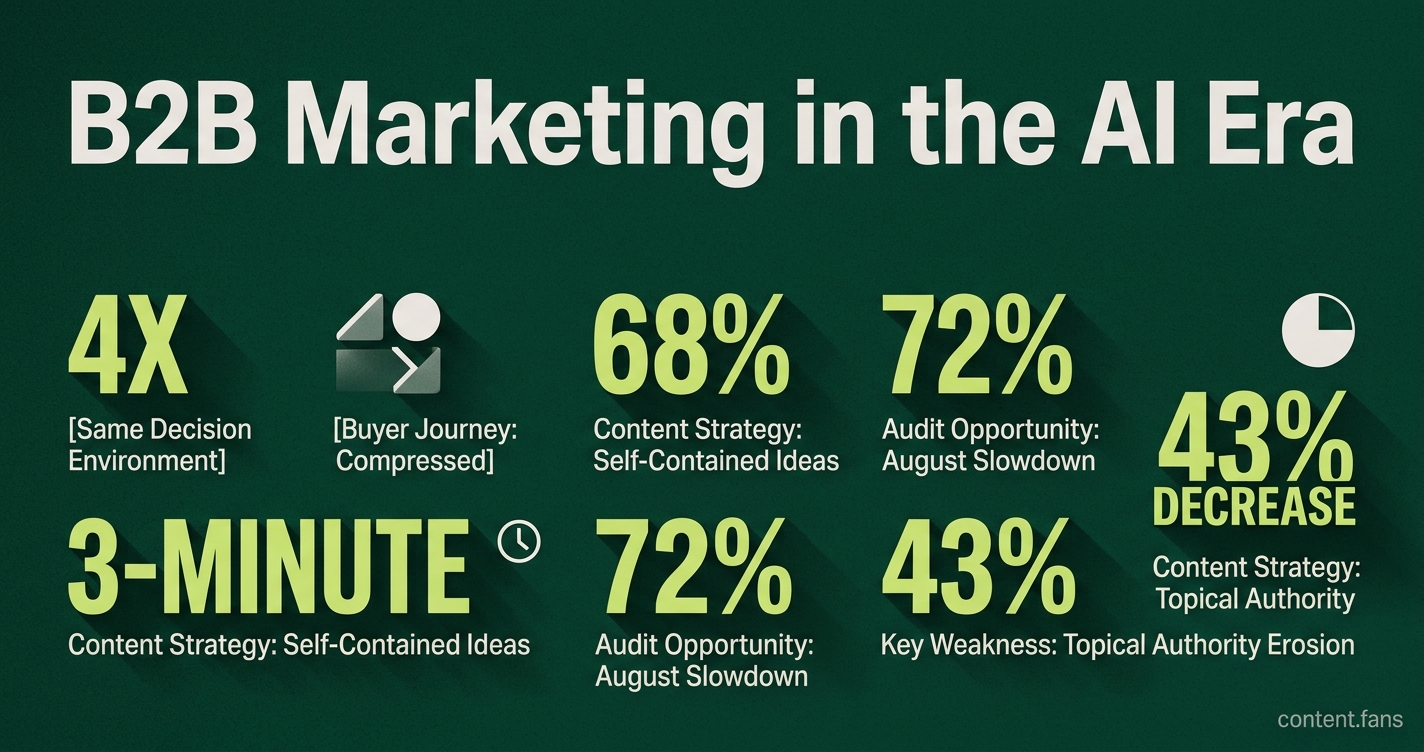
Industry analysis explains that content is increasingly "summarized, recombined and surfaced inside AI responses" without a click. For B2B marketers, this means a prospect asking an AI assistant a question could see brand messages, paid links, and organic results all at once. This trend suggests that siloed channel strategies are becoming less effective, as AI prioritizes the most coherent and authoritative information available. Oban advises making core ideas self-contained and using consistent terminology to improve how AI systems extract and present your brand's message.
External analysis reinforces this pressure. ZoomInfo is mentioned as a platform for intent modeling, highlighting that multi-channel campaigns increasingly succeed based on intent signals, not just form fills. This implies the competition for a buyer's attention starts long before they ever visit a brand's website.
Preparing in August: Key Audit Questions
Oban frames August as an ideal time for a strategic content audit. The guide identifies common weaknesses found in international marketing programs that harm visibility in this new environment:
- Topical Authority Erosion: Overlapping content on different regional sites confuses search engines and dilutes authority.
- Ineffective Localisation: Keyword lists are directly translated instead of reflecting authentic local search terms and buyer language.
- Attribution Blind Spots: Analytics fail to show which content assets truly influence the sales pipeline in smaller markets.
- Content Over-Reliance: Dependence on a few high-traffic articles creates significant risk from algorithm updates.
The guide urges teams to test content variations during the summer slowdown, as lower traffic can make performance anomalies easier to identify and analyze.
The Critical Role of ABM and Localisation
Echoing industry calls for "genuinely local" Account-Based Marketing (ABM), Oban emphasizes the need for distinct topical clusters for each country. When regional sites in Spain or Germany simply mirror the UK site's navigation and content, AI systems may flag them as duplicates, damaging brand authority. The solution is to develop locally nuanced content clusters that align with a global strategic theme. This approach signals relevance to both local buyers and AI without fragmenting the core brand identity.
What the Data Implies for Performance
While Oban does not guarantee specific results, its recommendations align with broader industry trends. Research shows that businesses using AI chatbots report up to a 67% increase in qualified leads, with some studies indicating 35-40% more qualified leads than static forms. These metrics suggest a significant payoff when paid, organic, and AI strategies work in concert. Oban's guidance to establish expertise early in the AI-driven journey is consistent with achieving these benchmarks.
Ultimately, this new decision environment rewards brands that design every piece of content to serve as zero-click proof of their expertise. The slower pace of August offers a valuable opportunity to audit pages, refine localisation, and ensure authority signals are clear to both buyers and bots.
What is the "same decision environment" Oban International describes?
It is the point where paid ads, organic pages, brand assets and AI-generated answers appear inside one shared search or chat interface. Because large-language-model engines now summarize, re-order and re-publish content without sending a click, your copy must be self-contained, stat-rich and authority-signed or it simply never reaches the buyer.
Why does the guide call traditional lead creation "obsolete"?
Forms, gated PDFs and linear funnels assume a human visitor lands on your domain. In the new environment the AI speaks first; many buyers now short-list vendors entirely inside chat, then visit only one site. If your ideas are not structured for zero-click extraction they are invisible to that process.
Which on-page changes give content the best chance of being quoted by AI?
- Put the core claim in the first 50 words.
- Add numeric proof (percentages, time saved, revenue gained).
- State authorship, date and source in the same paragraph.
- Repeat the primary entity exactly the same way across pages to build topical authority.
- Keep paragraphs under 45 words so summarizers can lift them intact.
How can marketers use the August slowdown wisely?
Oban recommends a five-point international audit:
- Does each country roll-up reinforce the others or compete for keywords?
- Are local pages built from translated keyword sets or from how buyers actually describe pain?
- Is expertise scattered in PDFs or surfaced in public, linkable HTML?
- Do high-performing assets rely on one market, creating risk if spend pauses?
- Can variations be A/B tested quietly before Q4 budget unlocks?
What measurable gains do teams see when AI-driven intent replaces MQL volume?
Industry reports show significant improvements in lead quality and conversion rates. The most cited tactic is visitor-deanonymization plus real-time chat, which compresses speed-to-lead from hours to under 30 seconds and can lift conversion rates substantially.