
Quora's AI Moderation Fails to Combat Misinformation on Short-Form Video
Serge Bulaev
Quora appears to still use its old AI moderation system, which mainly checks text for spam or AI-written content, not for factual accuracy in short-form videos. There is no official announcement or proof that Quora has released a tool called Quora Shorts or any new fact-checking features for video. Reports suggest the moderation system sometimes makes mistakes, like flagging real people as bots or sarcasm as harassment. Experts say AI is good at catching obvious rule breaks, but may struggle with complex issues like misinformation, especially in videos. Overall, current evidence suggests Quora's AI focuses on spam and synthetic text, not on real-time fact checking for short-form videos.

Recent reports suggest Quora's AI moderation fails to combat misinformation on short-form video because Quora is a text-based platform and does not host short-form videos, so video fact-checking is not part of its functionality. Despite viral claims about a new "Quora Shorts" tool, the company has not issued any official announcement, product demo, or policy update to support them. All available evidence indicates Quora's existing AI moderation stack remains focused on text analysis.
The platform's current priority is identifying synthetic text, not verifying factual claims. To this end, Quora contracts with detection services for large-scale identification of AI-generated answers. According to industry reports, detection systems show significant improvements over earlier methods, reinforcing Quora's focus on text authenticity over truthfulness.
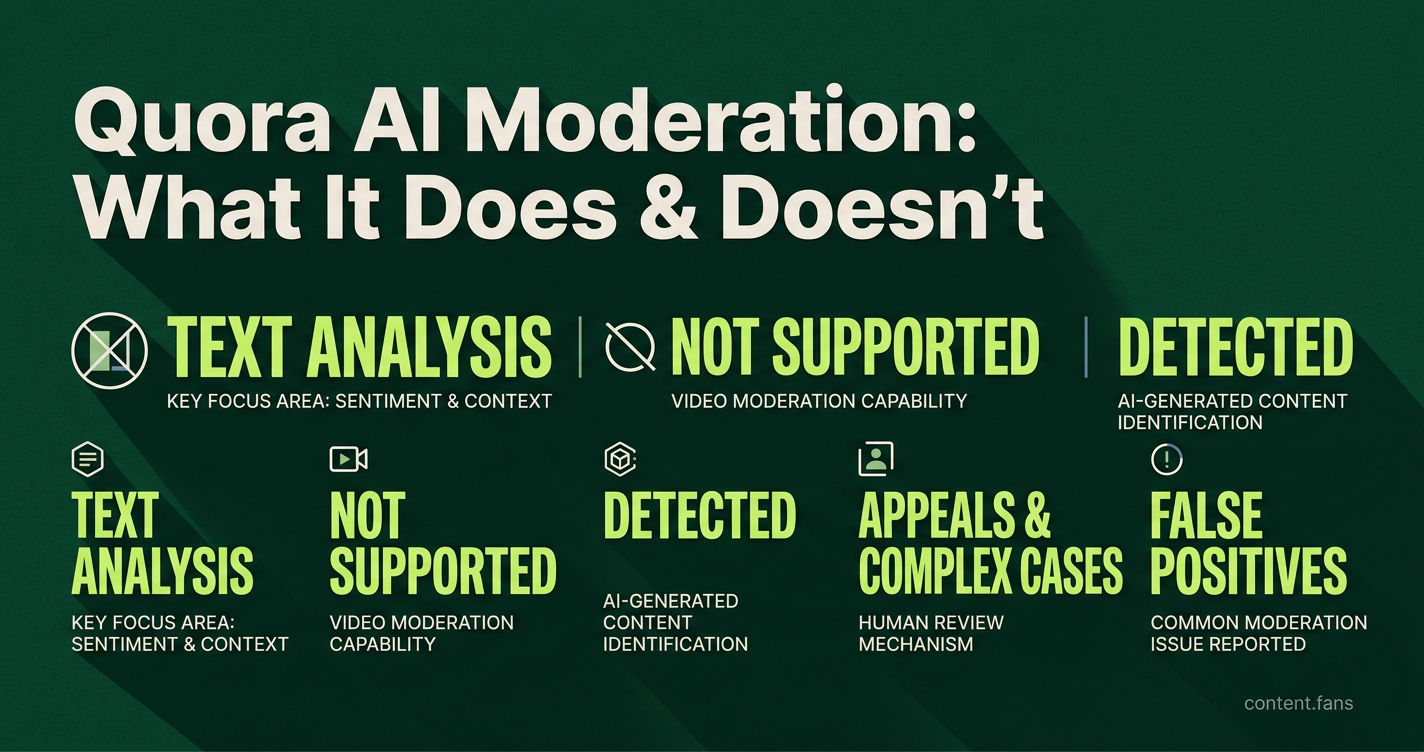
What Quora's AI Moderation Actually Does
Quora uses AI systems to detect patterns (e.g., spam, AI-generated content, artificial engagement) and flag content for review. Human moderators handle appeals, complex cases, and escalated issues. Moderation is not performed by a single AI reviewing nearly every answer and comment. Quora is a text-based platform and does not process video or speech; its moderation system focuses on text analysis using NLP and machine learning.
The AI classifier automatically screens incoming answers and comments, flagging machine-generated content for down-ranking or removal by safety bots. While users and community volunteers can appeal decisions, the initial moderation is largely automated. User reports indicate this system frequently makes errors, leading to significant issues:
- Long-time human contributors are misclassified as bots.
- Sarcasm is incorrectly flagged as harassment by sentiment analysis.
- Account suspensions become permanent if users do not appeal.
- Factual accuracy in videos or images is not a moderation focus.
- Recent rules engine updates have reportedly affected false positive rates according to user reports.
User accounts on Reddit describe the moderation pipeline as "buggy" and "harsh," citing mass deletions of legitimate content. These reports highlight a common challenge for algorithmic filters: they operate effectively at scale but often fail to understand crucial context.
The Missing Quora Shorts Layer
There is no credible evidence that a product called "Quora Shorts" exists; the claim likely confuses names or hallucinates a product. The feature is absent from Quora's public roadmap, developer documentation, and ad policies. No regulatory filings, conference presentations, or media reports confirm its launch. While other platforms and academic projects like Duke University's LiveFC are developing real-time video fact-checking, these tools are not associated with Quora.
Experts in automated moderation note a significant performance gap. While AI models achieve high precision on clear violations like nudity, their accuracy drops for context-dependent issues like misinformation and hate speech. A growing number of moderation APIs confirm that hybrid human-AI workflows outperform purely automated systems. This analysis highlights that short-form video is especially challenging, as it requires real-time parsing of speech, text, and visuals.
Industry Benchmarks Provide Context
Industry benchmarks provide further context. Automated systems detect significant portions of harmful content; human review handles many edge cases. However, deepfake detection and cultural nuance remain significant unsolved problems. Although regulatory bodies are pushing for clearer labeling of synthetic media, no Quora-specific rule changes are found in FTC or EU Digital Services Act records.
The lack of official announcements or product documentation strongly suggests that widespread rumors about "Quora Shorts" are unfounded. They likely confuse broader industry trends in video moderation with Quora's actual, narrower focus on text-based spam and AI detection. Until Quora provides new documentation, its AI moderation should be understood as a system for scoring text, not for verifying facts in a hypothetical video product.
What exactly did Quora announce for its short-form video product?
Quora has not launched a short-form video product called Quora Shorts.
No announcement exists for real-time fact-checking overlays or new sponsored-content rules as of July 2026. The rumour appears to stem from a misunderstanding of Quora's existing AI spam-detection partnerships, which target AI-generated text, not video.
If Quora has no Shorts, why are users seeing AI moderation failures?
Quora uses AI systems to detect patterns and flag content for review, with human moderators handling appeals and complex cases.
- The model was trained to spot AI-written text, not to validate facts.
- It misclassifies sarcasm, idioms, or academic wording as toxic or machine-written, triggering bans unless the user appeals.
- Limited human review occurs unless an appeal is filed, so legitimate creators often stay suspended.
How accurate are today's AI moderation tools on short-form video in general?
Across the industry, top-tier systems reach high accuracy on clear violations like nudity, but accuracy drops once the harm is subjective (hate speech, misinformation).
- On TikTok, Instagram and YouTube, a significant portion of removals are already automated.
- Deepfakes and synthetic audio remain the biggest blind spot; detectors lag weeks to months behind the latest generative models.
Could Quora repurpose its existing AI to fight misinformation if it ever released Shorts?
Not without a major redesign.
- Current engines flag writing patterns, not factual claims.
- Quora would need multimodal models that fuse speech, OCR and vision, plus a human review pipeline for context. Current evidence shows Quora has no such stack ready for video.
What proven tools could Quora copy if it wanted real-time fact-checking on a future video product?
Peer-reviewed demos already show it is feasible:
- LiveFC transcribes live audio and overlays True / False ratings within seconds (source).
- ShortCheck spots check-worthy clips in multiple languages on TikTok-scale data.
- Instacheck browser plug-in already labels Instagram Reels in real time.
All are open-source or licensable, but none are integrated into any Quora product today.