
Marketers use AI, 3 tiers to boost pipeline 2-3X
Serge Bulaev
Marketers are using AI and three levels of personalization to increase engagement and sales pipeline, sometimes by two to three times. These levels include basic account details, adapting messages based on behavior, and using real-time intent signals to trigger campaigns. AI tools are helping teams respond faster and coordinate actions across different channels, and many companies may adopt these tools soon. However, success can depend on good data and teamwork, and some challenges like data quality and quickly making personalized content still remain. Results suggest that more personalized and focused content might lead to higher engagement and bigger deals, though individual outcomes may vary.

Marketers are using AI with a three-tiered personalization model to deliver significant revenue gains according to industry reports. By layering account-level data, behavioral signals, and real-time buying intent, leading firms achieve substantial lifts in engagement, pipeline value, and deal size. This guide outlines the specific tactics, AI technology, and a phased roadmap that top performers use to win and retain high-value accounts.
Tiered Personalization Lifts Pipeline
This strategy layers three distinct personalization levels to compound pipeline growth. It begins with account-level firmographics, progresses to content adapted for behavioral cues, and culminates in campaigns triggered by real-time intent signals. This targeted approach delivers increasingly relevant experiences that maximize engagement and conversion.
Programs layering all three personalization levels demonstrate the highest returns. For example, Prospeo case studies show a cloud provider achieved significant engagement improvements and substantial increases in successful contacts by targeting accounts with a 1:few strategy. Abmatic.ai reports that firms combining all three tiers - account basics, behavioral cues, and intent-based triggers - generate substantially more pipeline per campaign. Further data from Revenue Memo indicates top programs achieve significantly higher ROI compared to average programs, linking deeper personalization directly to greater efficiency.
AI-Powered Journey Tools Reshape Delivery
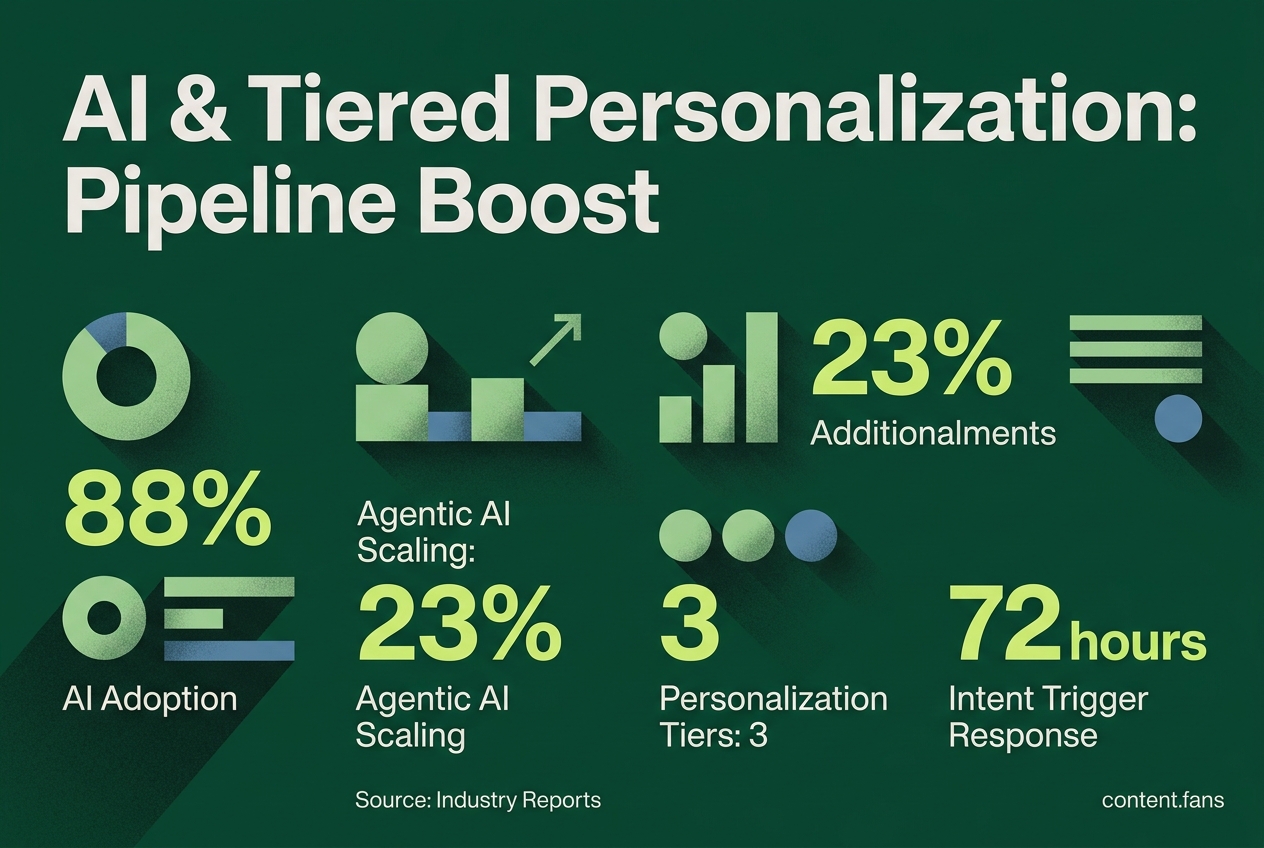
The delivery of personalized campaigns is shifting from static journey maps to dynamic AI orchestration platforms. According to Forrester, modern Customer Journey Management systems analyze intent and behavior data in real time to coordinate actions across channels without manual intervention. McKinsey's 2025 State of AI reports 88% of organizations use AI in at least one business function, with only 23% scaling agentic AI, showing the technology is quickly becoming a standard. These platforms use predictive analytics to forecast next steps and identify friction points, while research from Monday.com shows AI can autonomously manage tasks like attribution and content selection, allowing teams to reduce the lag between insight and execution.
Month-by-Month Rollout
A phased rollout helps teams implement this strategy effectively while managing data and governance risks.
- Month 1 - Deploy account-level basics: personalize subject lines and landing pages with firmographic fields.
- Month 2 - Add role-based email sequences: route three nurtures by decision-maker, influencer, and user.
- Month 3 - Launch web variants: serve page modules based on account ID or industry tag.
- Month 4 - Activate intent triggers: connect intent data to automation rules that fire within 72 hours of a buying signal.
The benefits of this approach are clear: industry reports indicate that personalized landing pages (Month 1 & 3) can significantly lift conversions. Furthermore, aligning content with industry pain points (Month 2) contributes to larger average deal sizes according to industry studies. These results underscore the potential gains but require reliable data and disciplined testing.
Data and Alignment Remain Hurdles
Despite the power of AI, significant hurdles remain. Industry research finds that a substantial portion of B2B marketers identify data accuracy as their top challenge, and many struggle with sales and marketing alignment. Without clean data and shared metrics, even sophisticated AI tools will fail. The emerging best practice is "human-first, AI-fast," where practitioners guide strategy and software accelerates execution. Another key bottleneck is content production; teams often cannot create personalized landing pages at scale. GenPage AI suggests dedicated template libraries can solve this by reducing design time. The impact of overcoming these challenges is immense: industry studies show that highly tailored, sector-specific content drives significant engagement increases and substantial rises in qualified leads.