
Ukraine adopts AI policy for local model control, builds sovereign LLM
Serge Bulaev
Ukraine has announced a new policy to run artificial intelligence (AI) models locally on its own infrastructure, instead of relying on foreign cloud services that may be restricted. Officials say this move may help protect national security and keep services running during the war. Ukraine is also building its own language model based on open-source technology, with testing planned for 2026 and gradual release to public and private groups. There are challenges, such as the need for strong hardware, steady electricity, and skilled workers, and it appears that running these systems might be costly unless used at large scale. Some popular foreign AI models may be allowed in the future if providers let Ukraine fully control and host them, but no such deals have been made yet.

Ukraine's new AI policy prioritizes local model control, a wartime strategy to ensure critical AI systems run on sovereign servers. This strategic shift, announced by Kyiv officials, moves state agencies and the armed forces away from foreign cloud services that providers can suspend, aiming to bolster national security and service continuity.
Ministry Chief AI Officer Roman Kyslyi emphasized that the primary requirement is that the vendor provides the model to run on Ukraine's on-premise infrastructure, regardless of the model's origin. Officials have indicated there are no restrictions as long as vendors can meet this deployment requirement.
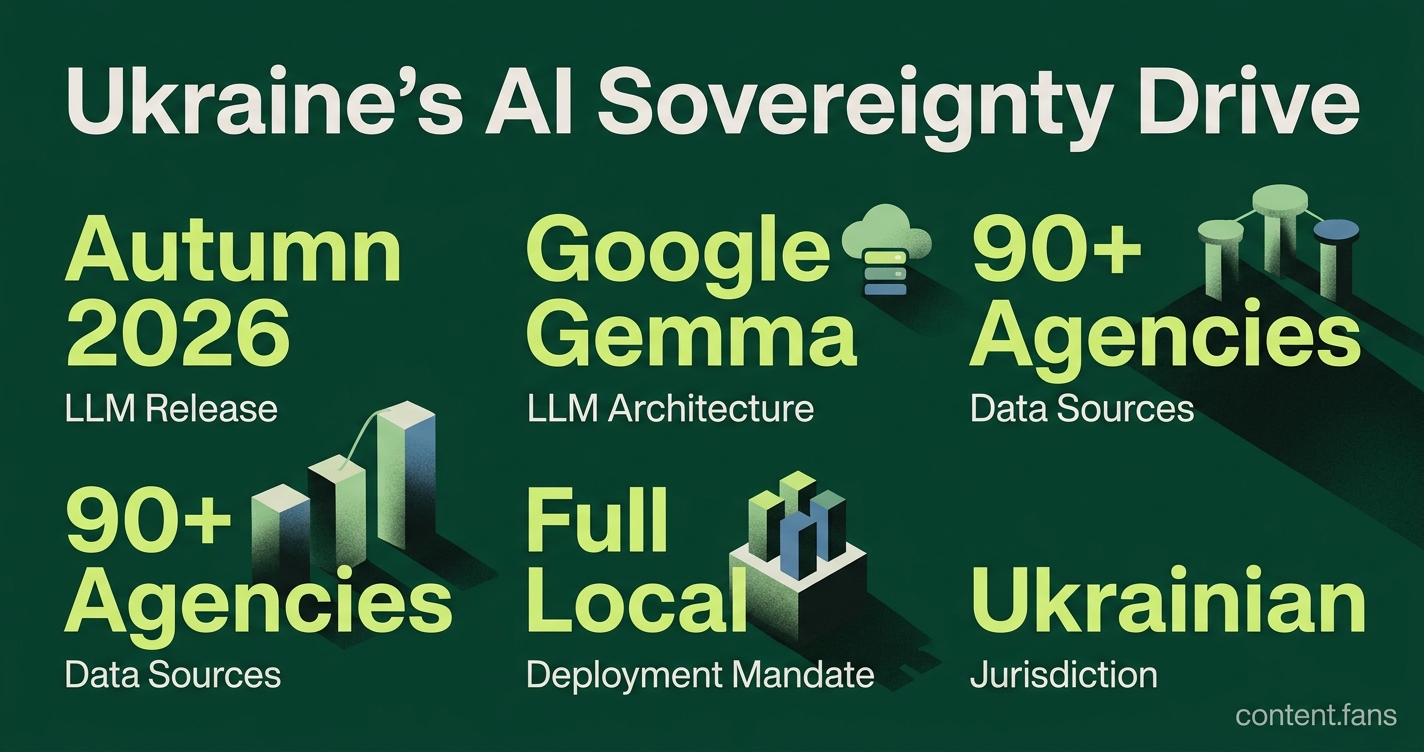
Securing Digital Sovereignty Through On-Premise AI
Kyiv's policy is a direct response to the risks of relying on foreign technology during wartime, where access to essential AI tools can be limited or revoked. By mandating local hosting, Ukraine gains full operational control, technical autonomy, and protection from external regulations and service disruptions.
The policy stems from experiences where foreign providers reportedly restricted access to vital systems. By keeping AI workloads within its borders, Ukraine ensures technical autonomy, enables clearer audit trails, and avoids foreign legal frameworks like the US CLOUD Act. The Ministry of Digital Transformation has published key criteria for acceptable AI systems:
- Full local deployment, including model weights and inference stack.
- No compulsory calls to external application-programming interfaces.
- Vendor agrees to Ukrainian jurisdiction for updates and security patches.
- Compatibility with preventive cyber-security tooling already in government data centres.
Developing Ukraine's National Language Model
In parallel with its procurement rules, Ukraine is developing a sovereign large language model (LLM). According to government sources, the project is based on Google's open-weight Gemma architecture and financed by telecom operator Kyivstar, which will transfer the final model to the state. The sovereign LLM is due to be released in autumn 2026, using a training corpus that includes historical sources, cultural references, linguistic structure, domain-specific data for public administration, education, and security, plus materials from over 90 government agencies including court registries, educational publishers, regional archives, and documents on Russia's invasion actions. The model will be released first to public institutions before being open-sourced for private sector use.
Overcoming Implementation and Regulatory Challenges
Despite the strategic benefits, the policy faces significant hurdles. Operating large-scale models on-premise requires substantial investment in specialized hardware, skilled engineers, and a stable power supply. Data centers are preparing for possible cyberattacks and considering measures against prompt injection (malicious instructions in queries). Analysts caution that costs may be high until usage scales significantly.
On the regulatory front, a draft risk framework modeled on EU rules is progressing through parliament. While aligning with the EU AI Act could increase compliance burdens, it would also create clearer standards for foreign investment and partnership.
Excluded Models and Project Roadmap
Under the new policy, remote-only AI services like OpenAI's GPT series and Anthropic's Claude are excluded from government use, as are Chinese-developed LLMs, because they cannot be hosted locally. However, officials remain open to future partnerships if these providers agree to a full, on-premise deployment. The project continues to progress with planned milestones for improved Ukrainian language processing capabilities and safety benchmarks for accrediting the model across government, military, and private entities.