
Nvidia reorganizes reporting, spotlights enterprise AI and edge computing
Serge Bulaev
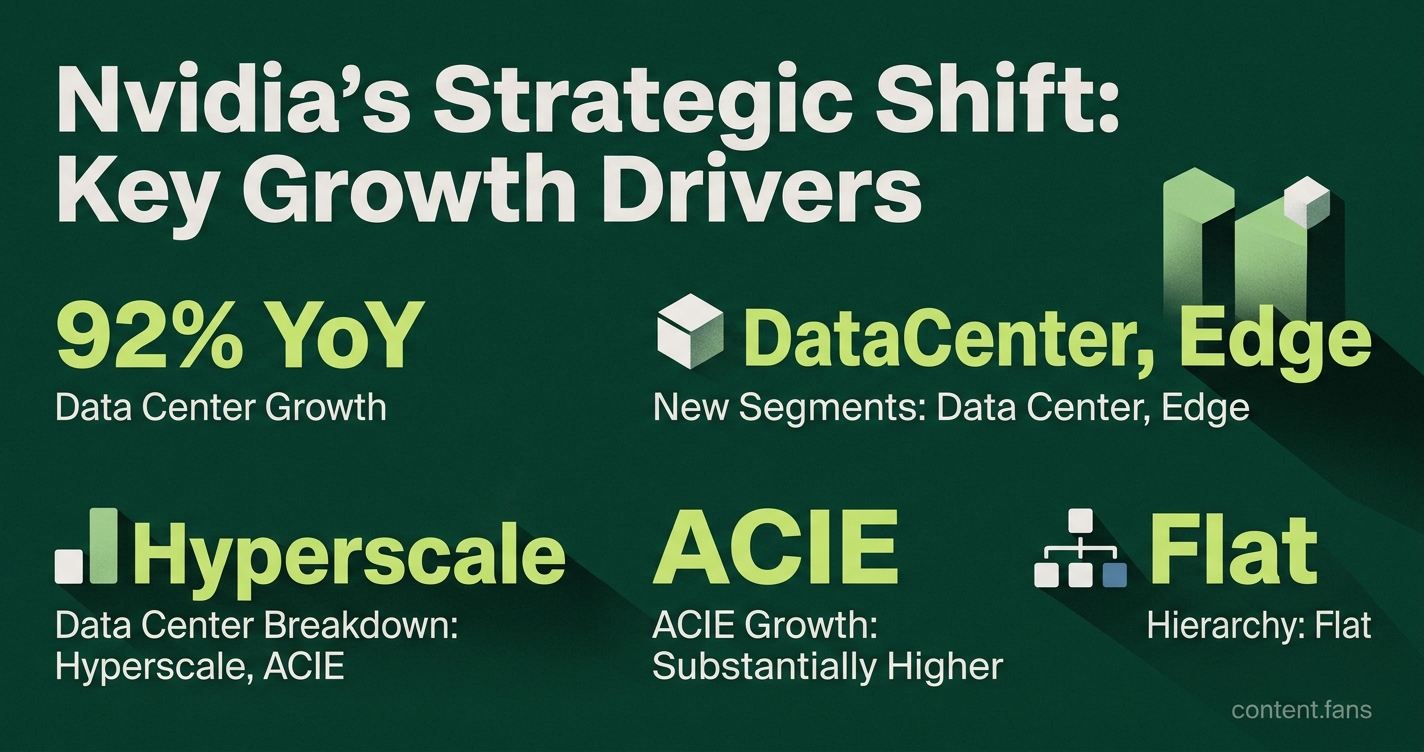
Nvidia changed how it reports earnings in fiscal 2026, splitting results into Data Center and Edge Computing. Inside Data Center, it now separates revenue from Hyperscale and ACIE (AI clouds, industrial, and enterprise customers), with ACIE growing much faster than Hyperscale. This new setup may help investors see where demand is rising most quickly, especially as enterprise and industrial clients might be scaling AI projects faster than big cloud companies. Edge Computing is now reported on its own, possibly highlighting its growing importance for tasks that need very low delays. The company's strong overall results suggest these areas could keep driving growth, but future changes in reporting rules could affect how numbers are compared.

As part of a strategic shift, Nvidia has reorganized its reporting to provide greater transparency into its fastest-growing segments. The company's disclosures are now split into two main categories: Data Center and Edge Computing. Within Data Center, Nvidia has created distinct reporting lines for its Hyperscale clients and the rapidly expanding ACIE (AI Clouds, Industrial, and Enterprise) group. Recent earnings data highlights the significance of this change, with industry reports indicating strong growth momentum in the ACIE segment as detailed in a Sergey Substack review. This new structure allows investors to pinpoint demand momentum beyond traditional server sales.
This strategic pivot is enabled by Nvidia's agile corporate structure. A 2024 Fortune profile noted CEO Jensen Huang's flat hierarchy designed for rapid decision-making. The reorganization equips analysts to better evaluate performance across three key growth pillars: hyperscale AI, enterprise and industrial AI, and edge computing.
Inside the Data Center Bucket
Nvidia updated its financial reporting to give a clearer view of its diverse customer base. The new structure separates large-scale cloud providers (Hyperscale) from the rapidly growing segment of enterprise, industrial, and specialized AI cloud customers (ACIE), highlighting distinct growth trends within its primary Data Center business.
While Hyperscale clients still represent a significant portion of all Data Center revenue, industry reports suggest the ACIE segment is experiencing substantially higher growth rates. Together, the segments propelled total Data Center revenue to an impressive 92 percent year-over-year increase, cementing its role as Nvidia's main growth engine.
Why the ACIE Segment Is a Key Growth Indicator
- Diversified Customer Base: The ACIE category highlights a reduced dependency on a handful of major cloud companies, showcasing a broader market adoption.
- Software-Driven Stickiness: Company leadership emphasized that its software stack "increases platform durability," which suggests a strategy for locking in customers and sustaining higher margins.
- Efficient Capital Strategy: The company employs an R&D-focused spending model aimed at reducing the cost per token and boosting the throughput of AI factories, maximizing customer value.
External data supports this focus on enterprise expansion. Industry reports indicate that a growing number of organizations plan to increase their AI budgets, with many intending to invest directly in AI infrastructure. These trends signal a robust pipeline of enterprise demand likely to benefit the ACIE segment.
Edge Computing: A New Standalone Focus
Nvidia has elevated Edge Computing to its own reporting segment to underscore its importance for latency-sensitive applications where cloud processing is not feasible. While market researchers note that hyperscalers like AWS and Microsoft command a significant portion of the edge infrastructure market, Nvidia's role in hardware is crucial. Industry analysts indicate that hardware, where Nvidia's GPUs and networking are key components, constitutes a substantial share of the edge market.
Record Performance and Future Outlook
This strategic reorganization is set against a backdrop of record-breaking financial performance. According to its official results release, NVIDIA's fiscal Q4 2026 total revenue was $68.1 billion, while Data Center revenue was $62.3 billion and up 75% year over year, fueled by AI and accelerated computing. Industry reports suggest that evolving disclosure requirements may impact future year-over-year comparisons.
Key Takeaways from the New Reporting Structure
- Accelerated Enterprise Growth: The primary signal is that enterprise and industrial AI adoption is growing at a faster percentage rate than in the hyperscale sector.
- The Strategic Importance of Edge: Elevating Edge Computing confirms that demand for low-latency, localized processing is significant enough to warrant a dedicated focus.
- Future Growth Scrutiny: Investors will be closely monitoring the ACIE segment to see if its explosive growth can be sustained as future quarterly and annual comparisons become more challenging.
Why did Nvidia split its Data Center segment into "Hyperscale" and "ACIE"?
The change lets investors see how much growth is coming from giant cloud titans versus everyone else. Industry reports suggest ACIE revenue is experiencing strong growth, significantly outpacing Hyperscale. Management wants Wall-Street to notice that enterprise, industrial and sovereign AI clouds are becoming a second engine instead of a sideshow.
What exactly falls inside the new ACIE bucket?
AI Clouds - think Core-Weave, Lambda, Yotta and other GPU-first providers
Industrial - on-prem clusters for robotics, energy, medical imaging, autonomous machines
Enterprise - banks, retailers, telcos and governments renting or buying DGX, HGX and Omniverse gear
Together these groups already deliver a significant portion of Data-Center revenue and are projected to out-grow Hyperscale in the coming years.
How big could the ACIE opportunity become?
Industry reports point to a substantial AI infrastructure market opportunity by 2030. With ACIE taking an early lead in vertical-specific silicon (Grace, Blackwell) and software (CUDA, AI Enterprise suite), Nvidia is positioning itself to capture a rising share of spend that sits outside the five big hyperscalers.
Why was Edge Computing promoted to its own reporting line?
Edge revenue is still smaller than Data Center, but verticals such as retail, factory floors and smart cities are adopting GPU-based inference boxes at a blistering pace. By isolating the number, Nvidia can:
- highlight strong growth in Jetson, EGX and IGX shipments
- court ISVs and OEM partners with clearer ROI data
- signal to telecoms that 5G + AI fleets are a strategic priority, not an experiment.
Does the new structure mask any risks for investors?
The flip-side of customer diversification is lower volume visibility. Hyperscalers issue rolling 12-month forecasts; factories and hospitals buy in smaller chunks. Greater mix from ACIE and Edge could increase quarterly lumpiness, so analysts will need to track book-to-bill and purchase-commitment disclosures rather than relying on single-customer run-rates.