
NIQ: AI Agents Will Discover, Evaluate, and Purchase Products by 2026
Serge Bulaev
The report says that for brands to stay competitive, they need to make their product data easy for AI to read and update it in real time.

According to new research from NIQ, AI agents are beginning to find, compare, and in some cases purchase products on consumers' behalf, representing an emerging trend that could reshape commerce by 2026. This shift signals a potential move toward an AI-mediated commerce ecosystem where intelligent systems handle everything from discovery and recommendation to checkout and fulfillment. Industry reports suggest that these agents are starting to "autonomously discover, evaluate, and purchase products on consumers' behalf," a development driving the creation of the NIQ Commerce Lab to build the necessary data infrastructure.
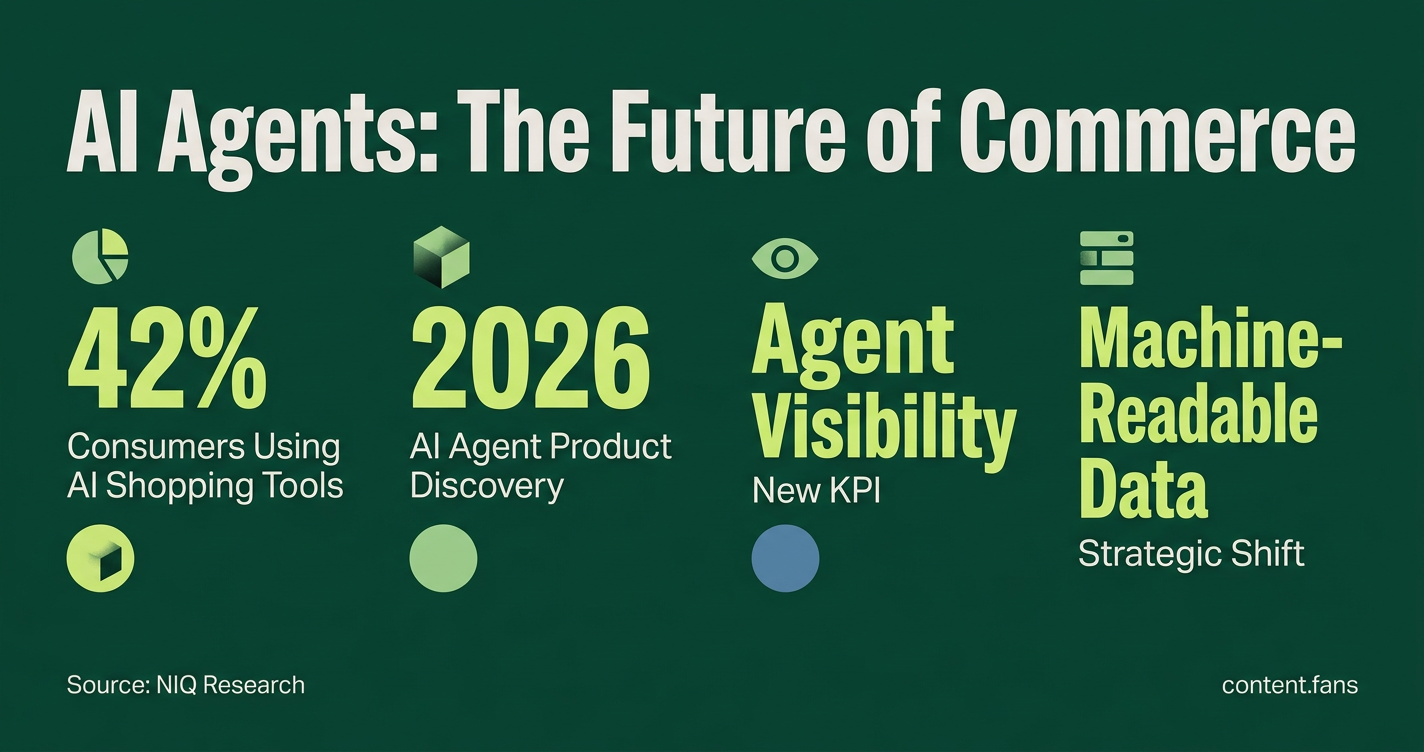
Analysts observe the traditional marketing funnel collapsing as recommendation engines present products proactively, often before a shopper even searches. NIQ attributes this compression to the growing adoption of AI shopping tools, noting that 42% of consumers used at least one AI tool to shop in the past month, and that AI is helping consumers compare options, evaluate value, and narrow choices. For brands, this trend means that a search-centric strategy risks total invisibility as algorithms increasingly control product discovery.
Data strategy and measurement in an agent-first era
To prepare, brands must optimize their product data for machine readability. This involves structuring catalogs with precise attributes like dimensions and certifications, exposing live inventory and pricing through APIs, and testing the end-to-end transactional path to ensure reliability for AI-driven purchasing systems.
The primary strategic shift for brands is to ensure their data is legible to machines. To effectively evaluate offers, AI agents need structured product attributes, real-time inventory levels, and immediate pricing data, as highlighted by industry analysts. A practical readiness roadmap from Digital Applied outlines three critical steps:
- Enrich product catalogs with machine-readable data such as dimensions, compatibility, and certifications.
- Expose real-time inventory, pricing, and fulfillment status via authenticated APIs with well-defined rate limits.
- Stress-test the end-to-end agent transaction process to proactively identify and resolve potential breakpoints.
Failing to take these steps makes it impossible for CMOs to compete for what NIQ terms "agent visibility" - a new share-of-voice KPI measuring how often a brand appears in algorithmic recommendations. Other crucial metrics for this new era include AI-mediated lifetime value and advanced cross-platform attribution to distinguish between agent-driven sales and human-initiated conversions.
Rise of a Unified, Continuously Optimizing Commerce Ecosystem: Organizational Demands
Legacy organizational structures built around separate channels will create significant friction in an AI-driven ecosystem. According to Skai's retail-media forecast, high-performing teams are aligning around unified planning and shared incrementality, moving from siloed budgets to coordinated strategies. This alignment requires a single measurement layer that can ingest data across retail media, social commerce, CRM, and site behavior to apply sophisticated attribution models, a strategy endorsed by Improvado's AI-CMO guidance.
Consequently, marketing operations leaders must prioritize two core technical capabilities: universal data connectivity and a standardized event taxonomy that includes agent context. As Improvado warns, without consistent event definitions across platforms, attribution models will deliver unreliable insights by "comparing apples to oranges."
Ethical and governance guardrails for agent-driven retail
Governance frameworks must evolve to keep pace with the speed of algorithmic commerce. An ethical AI primer for ecommerce from Salsify identifies transparency, accountability, and bias mitigation as non-negotiable principles. A three-layer governance model, based on insights from Robotic Marketer and the University of Virginia Darden School, proposes the following structure:
- Policy Owners: Define acceptable AI use cases and establish thresholds for required human approval.
- Operational Stewards: Document all model inputs, maintain testing logs, and manage customer feedback.
- Assurance Teams: Conduct regular bias audits, perform privacy reviews, and monitor real-time model performance.
For checkout flows managed by AI agents, additional controls are essential. These include bounded autonomy rules, which prevent irreversible actions without human confirmation, and detailed action logging to ensure clear audit trails for dispute resolution.
Competitive visibility: early signals from emerging trends
Industry projections suggest that agentic commerce will continue evolving through 2026 and beyond, with standards potentially emerging in the following years. In parallel, the online grocery market is expected to experience significant growth, with AI-powered personalization dramatically narrowing the digital shelf. This creates a new competitive landscape where feed quality, availability signals, and dynamic pricing will determine if an AI assistant even considers a product.
To keep up with the quick-commerce trends emerging in APAC, where a significant portion of consumers already use social and quick-commerce platforms, retailers are expanding their assortments in a marketplace model to increase match opportunities. Simultaneously, brands are refining product content to allow algorithms to automatically parse key attributes like sustainability, allergens, and usage context.
Ultimately, the competitive edge in this new era will belong to brands that invest in making their commerce data fully interoperable, optimized for AI agents, and continuously measurable across all touchpoints.
What exactly is NIQ predicting will change by 2026?
Industry research suggests that 2026 represents a potential tipping point when AI agents may start to more autonomously discover, evaluate, and purchase products on behalf of consumers. Instead of shoppers typing keywords into search bars, the AI layer will surface relevant items inside social feeds, live streams, quick-commerce apps and super-apps before the user asks. Industry analysts suggest the entire commerce stack - discovery, pricing, checkout, fulfillment and measurement - may increasingly be mediated by AI, collapsing the traditional funnel into a single, continuously optimizing ecosystem.
Key numbers to keep in mind
- A significant portion of APAC consumers already shop through social and quick-commerce channels.
- Online grocery is expected to experience substantial growth, with AI narrowing the digital shelf for every shopper.
- 42% of global consumers have already tried generative AI tools and use them most often for research and recommendations.
How should brands prepare product data so AI agents can "see" and pick them?
Treat AI agents as a new customer segment that never reads persuasive copy but does need precise, machine-readable facts. A proven 90-day agent-readiness roadmap looks like this:
- Structured product data - feed fields for dimensions, certifications, SKUs, UPC codes, allergens and compatibility.
- Real-time inventory and pricing APIs - any latency here lowers ranking.
- Delivery and returns webhooks - agents favor sources that return exact shipping windows and return policies in milliseconds.
Retailers who expose these capabilities through secure APIs and keep them ≥99.5% reliable will outrank competitors inside agentic recommendation engines.
What new KPIs replace classic marketing metrics in an agent-first world?
By next year, leadership dashboards will pivot from impression and click-through rates to three AI-native indicators:
- Agent visibility index - share of product mentions across major AI ecosystems.
- Agent-mediated lifetime value - revenue from repeat purchases made through AI delegation.
- Cross-platform attribution clarity - ability to trace an order back to every AI touchpoint from first recommendation through checkout.
Success will hinge on unified data models that connect CRM, retail media, social commerce and fulfillment events into one analytics layer.
What governance guard-rails do I need before agents start spending my budget?
Deploy a risk-tiered, 3-layer policy that scales as agent autonomy grows:
- Policy layer - define which decisions agents can make alone versus those that require human sign-off.
- Operational layer - log every agent action including order size, discount applied and data source used.
- Assurance layer - quarterly bias audits and continuous drift monitoring to catch pricing or recommendation errors before they scale.
Remember, your organization remains liable for any agent mistake, so naming a single accountable owner for each AI workflow is non-negotiable.
How will the C-suite org chart need to evolve?
Break down the old channel silos. Forward-thinking companies are exploring "Commerce Intelligence" teams that report directly to the CMO and CIO. Its charter:
- own unified data pipelines
- tune product feeds for AI readability
- manage agent visibility and cross-platform attribution
- enforce ethical governance across all agentic touchpoints
This team sits between marketing ops, retail media and supply-chain IT, aligning budgets and KPIs around the new intelligence layer instead of traditional search or store banners.