
New Data Project Aims to Standardize AI Token Usage Metrics
Serge Bulaev
A new Data Project aims to help companies measure how many AI tokens are creating real economic value. The project suggests collecting anonymized data on token usage and product outcomes across different firms. This may allow leaders to compare their AI investments and spot trends in adoption and productivity. Early benchmark data suggests AI referrals might convert at higher rates than traditional search, but direct links between tokens and value are still unclear. The project hopes to create shared metrics that let companies track and compare their AI impact more accurately.

A new data project is being launched to standardize AI token usage metrics, helping companies finally measure how many tokens generate real economic value. As firms integrate large language models (LLMs) into their products, they lack a clear method to connect token consumption with tangible business outcomes. The proposed "Aggregate Token Usage vs Shipped Product Across Firms" initiative aims to replace guesswork with hard data, mapping inputs to measurable results.
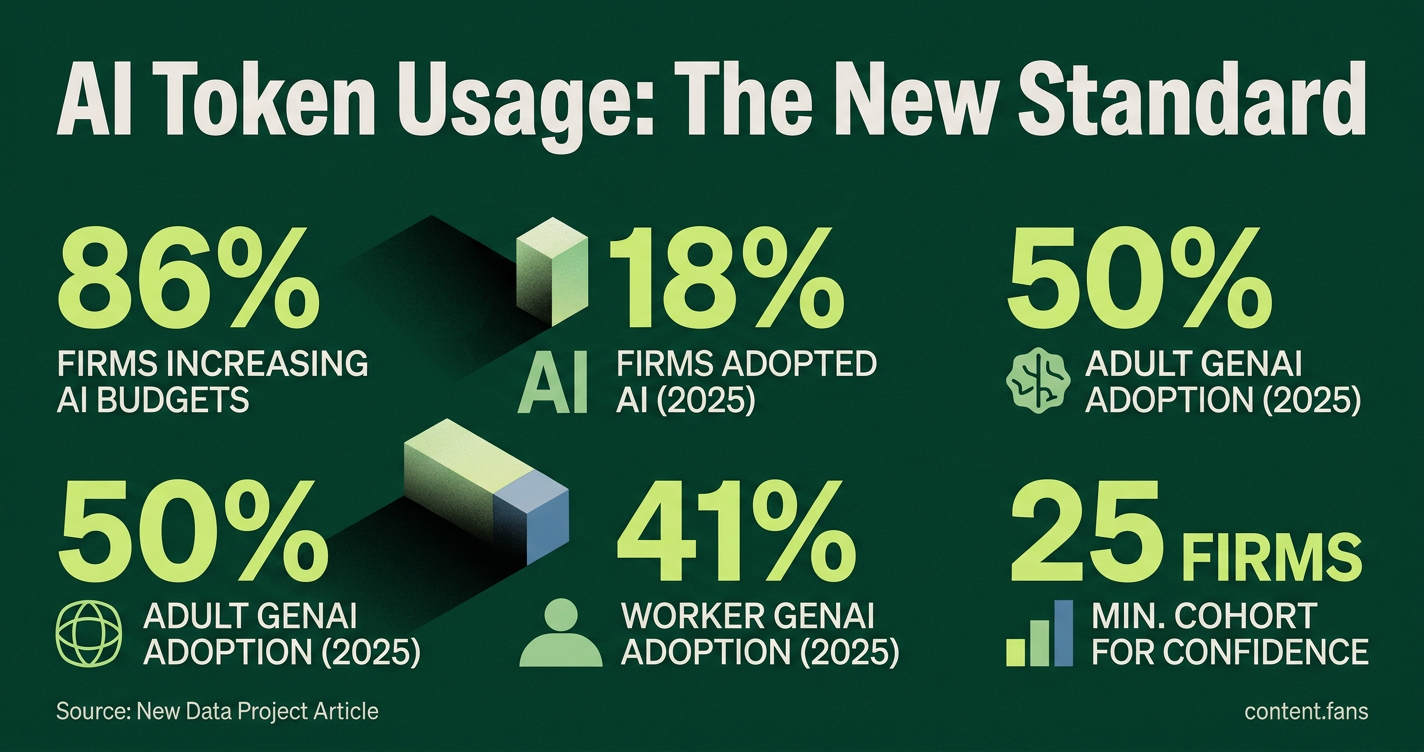
The demand for credible usage metrics is surging among executives, investors, and policymakers. While productivity and adoption figures often conflict, the financial commitment to AI is clear: approximately 86% of organizations surveyed in early 2026 reported increasing their AI budgets compared with the previous year. Furthermore, AI adoption is already widespread, with the Federal Reserve indicating that about 18% of firms had adopted AI by year-end 2025, while adult/worker GenAI adoption was roughly 50%/41% in late 2025.
The Executive Need for AI Token Telemetry
Standardized token telemetry provides objective data for critical business functions. It enables CFOs to accurately benchmark ROI and negotiate cloud contracts, gives investors clear signals of future margin growth, and helps policymakers anticipate labor market shifts that may necessitate new reskilling programs.
Senior leaders consistently rank operational efficiency and employee productivity as their primary goals for AI. Without standard ratios linking token expenditure to shipped features, CFOs cannot benchmark ROI or confidently negotiate cloud commitments. Investors view AI penetration as a key indicator of future margin expansion, while policymakers monitor these trends to prepare for labor-market shifts and potential reskilling initiatives.
How the Data Project Works
The project will operate by collecting anonymized logs from participating companies. Each LLM API request will be tagged with context like its product stage, feature type, and any resulting user action. Core design elements include:
- An opt-in SDK that hashes user and firm identifiers to ensure anonymity
- Daily exports of token counts, model tier, and latency
- Event hooks for release events, feature adoption, and revenue attribution
- Statistical controls to account for seasonality and traffic shocks
- Quarterly peer benchmarks delivered back to participants
A minimum viable cohort of just 25 B2B SaaS and ecommerce firms could establish confidence intervals sufficient to identify outliers in conversion efficiency.
Early Benchmarks: AI Referral Conversion Rates
While direct token-to-product metrics are not yet publicly available, AI referral conversion rates serve as a powerful early proxy. Industry reports suggest that AI search traffic shows improved conversion rates compared to traditional organic search, though specific metrics vary significantly across sources and methodologies.
Early industry analysis indicates that traffic from different AI platforms shows varying conversion performance, with some sources suggesting that AI-generated referrals may outperform traditional search baselines. However, comprehensive standardized measurement across platforms remains limited.
These emerging trends suggest that when AI output serves as the entry point for a user journey, the user's intent is often more qualified from the start.
Establishing Credible Economic Value Metrics
To build robust metrics, the project will follow methodologies recommended by the American Economic Association, pairing firm-level productivity analysis with consistent AI input measures. Techniques like A/B testing, before-and-after baselines, and process mining will isolate the incremental value generated by AI.
The focus will extend beyond simple model accuracy to real-world outcomes. For waste-oriented use cases, ReFED advises measuring tons diverted or contamination reduced. Similarly, the World Economic Forum highlights real-time vision systems where success is measured by sorting purity, recovery yield, and avoided disposal costs.
By connecting telemetry with business outcomes, the project will illuminate a standardized value chain: Tokens → Engineered Feature → User Adoption → Revenue or Cost Impact. Shared dashboards will allow participants to benchmark performance against anonymized peers, protecting proprietary data while fostering collective improvement.