
MiniMax M3 Unveils 1M-Token Context for Enterprise AI Agents
Serge Bulaev
MiniMax M3 is an open AI model that may help enterprises handle large and complex tasks, like coding and video analysis, by supporting up to 1 million tokens of context. Benchmarks suggest it performs well on long and multi-step tasks, possibly matching top closed models on some measures. Companies appear to be choosing open models like M3 for lower costs and more control, especially where data privacy or custom tuning is needed. However, some uncertainty remains, as closed models may still lead in special features and reliability. The market now seems to focus on which models can handle long contexts, different data types, and complex agent work.

The release of the MiniMax M3 model, with its groundbreaking 1M-token context window, signals a major market shift toward using open-weight AI for sophisticated enterprise agents. This development challenges the dominance of closed APIs for workflows requiring long-context reasoning, multimodality, and advanced tool use. As a result, the measure of AI quality is moving beyond simple benchmarks to focus on sustained, multi-step task execution.
Open-Weight Models Target Complex Agentic Workflows
MiniMax M3 features a massive 1M-token context window, with a guaranteed 512K tokens on its API, enabling tasks like repository-scale code analysis and long-form video processing (MiniMax spec). Its training pipeline was built for native multimodal inputs, including text, image, and video, avoiding the limitations of retrofitted models (Ollama library). Performance benchmarks now prioritize agentic capabilities, with evaluations tracking task chains and planning depth over static language scores.
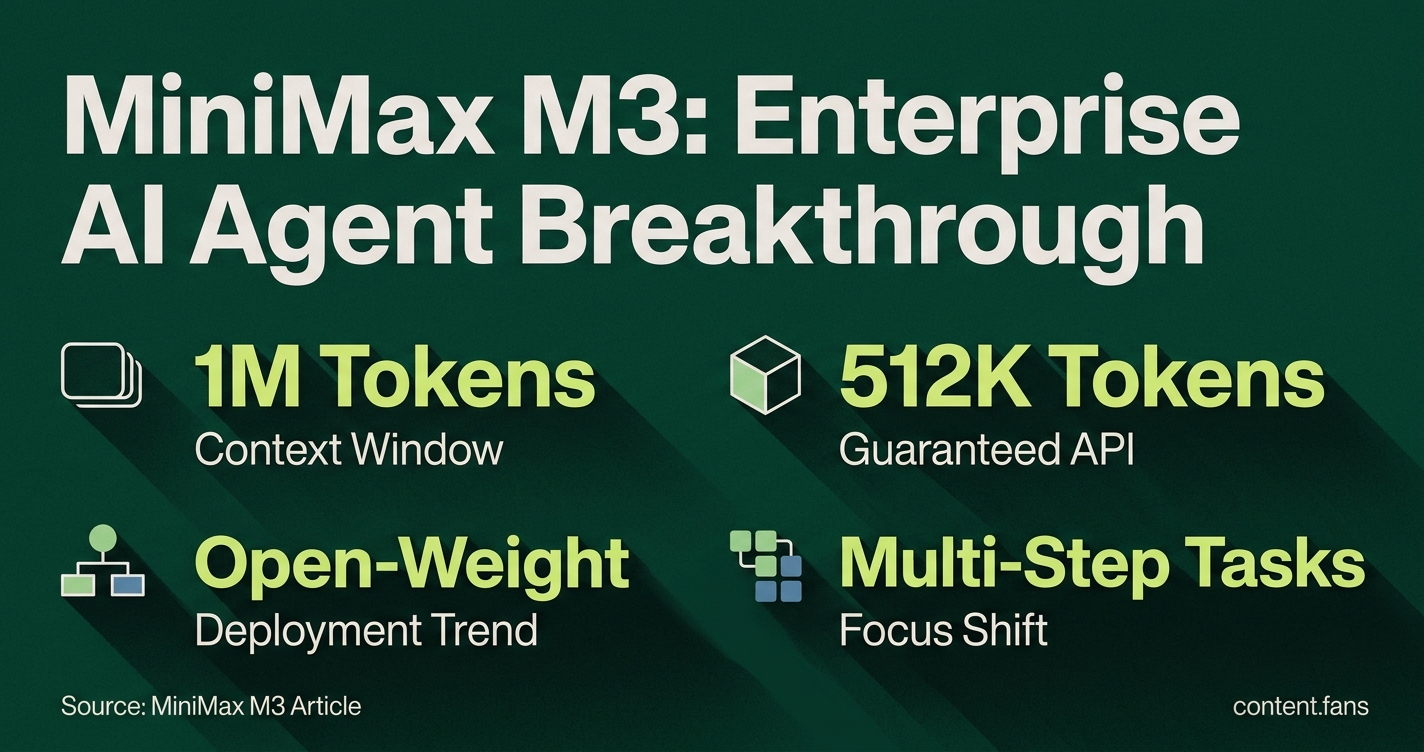
MiniMax M3 is an open-weight AI model designed for enterprise agentic workflows. Its primary advantage is a massive 1-million-token context window that allows it to process entire codebases, extensive legal documents, or long videos in a single pass, enabling more complex and reliable automation tasks.
Key Drivers for Enterprise Adoption and Governance
Enterprises are increasingly drawn to open-weight models for improved deployment efficiency and agent readiness. This trend is fueled by the need for data sovereignty, particularly in regulated industries like telecom and banking where on-premise inference is critical for compliance. According to industry reports, high-volume agentic workloads are increasingly defaulting to open-weight deployment as the cost per successful task has fallen dramatically.
A short list of enterprise factors shaping adoption:
- Private deployment for regulated data and audit trails
- Custom fine-tuning on proprietary corpora
- Cost control for token-intensive agent loops
- Ability to mix models through multi-vendor routing
- Need for policy, approval, and monitoring hooks around autonomous actions
While open models handle volume, closed vendors are shifting to premium features like ultra-long context and managed reliability to protect margins.
Market Dynamics and the New Competitive Landscape
The open-weight ecosystem is expanding rapidly. Industry data shows that derivatives of open models account for a significant portion of new Hugging Face uploads, highlighting their fast adoption. However, BentoML notes the core trade-off remains operational convenience versus control, as teams must manage their own GPUs, tuning pipelines, and safeguards.
The competitive landscape now revolves around key axes including context length, multimodal coverage, and agentic tool use. MiniMax M3 scores high on all three, positioning it as a strong foundation for production agents. Closed-model providers continue to command premium budgets for frontier reasoning and turnkey compliance, while the open ecosystem monetizes hosting, evaluation, and guardrails.
What exactly is MiniMax M3's 1M-token context window good for?
MiniMax M3 offers substantial context capabilities on the production API, scaling up to significant token limits. This means an enterprise AI agent can read an entire 500-page legal contract bundle, ingest the full git history of a multi-million-line codebase, or watch a two-hour technical training video in one pass without truncating or chunking the input. Early users on OpenRouter report that context length is the decisive factor for long-horizon coding tasks and browser automation chains that previously required human hand-offs.
How does MiniMax position M3 against closed "frontier" models?
MiniMax markets M3 as bringing advanced capabilities to the open-weight ecosystem. Industry benchmarks show M3 performing competitively against leading closed models on tasks that reward multi-step reasoning and tool use. The company positions the model not on chat scores but on its ability to act as a production agent backbone: sustained workflows, desktop "computer use," and long-context reasoning.
What are the enterprise adoption drivers for an open-weight agentic model?
Cost at scale and data sovereignty lead the list. Industry surveys indicate that for high-volume use cases, open-weight deployment is becoming increasingly popular because token-intensive agent loops become prohibitively expensive under closed-model API pricing. Regulated sectors such as finance and telecom prefer on-premise or private-cloud installs to retain full control over proprietary source code and customer data, something closed APIs cannot legally guarantee.
What operational hurdles still slow enterprise rollout?
Even when the weights are open, enterprises cite governance, reliability, and integration as the top blockers. Stanford HAI notes failures can stem from tool timeouts, prompt drift, or external APIs rather than the model itself. Industry reports indicate that for many teams the gap between a successful pilot and a governed, monitored production service requires significant engineering work.
How will this shift affect the closed-model business model?
Expect tiered pricing and managed services to become the closed-model response. Industry analysts forecast that closed providers will defend margin by reserving their steepest fees for premium capabilities - ultra-long context, frontier reasoning, or enterprise-grade SLAs - while open-weight models absorb the high-volume, lower-margin agentic workloads. The immediate signpost: buyers are already moving toward multi-model routing rather than locking into a single vendor API.