
Australia Unveils New AI Office, Binding Data Center Standards
Serge Bulaev
Australia announced new rules for AI, including strict standards for data centers and the creation of an Office of AI. The rules may require data centers to use more clean energy, pay for their own grid connections, and use less water. There are also new copyright rules, meaning AI companies must get permission from creators to use their work, but payment systems are still being discussed. Some experts suggest these rules could make Australia a top market for clean data centers, though others warn they might slow down new projects. The final laws may change and still need to pass through more government steps.
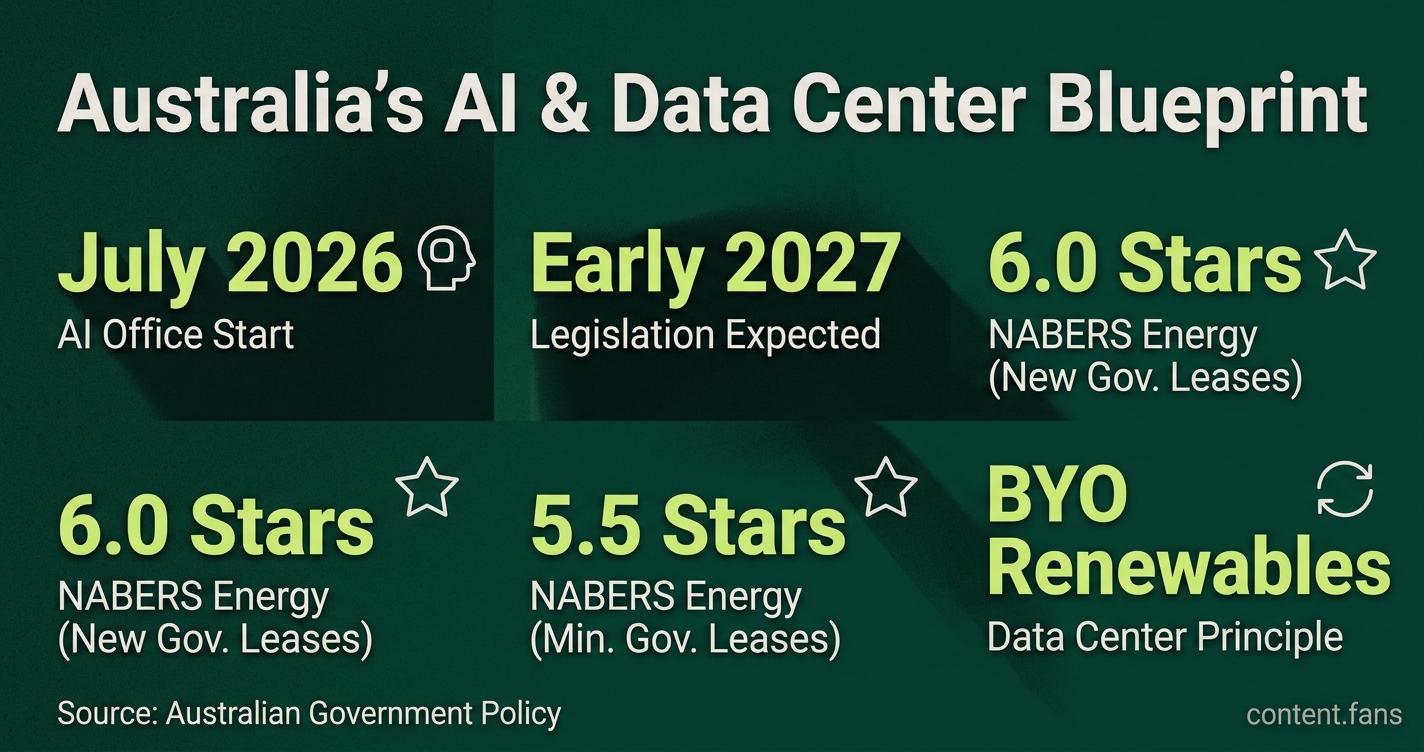
The Australian government has officially unveiled a new AI policy, with the Office of AI created effective July 15, 2026, and binding AI standards and data center legislation expected in early 2027. Prime Minister Albanese presented these measures as crucial tools to "seize and shape" Australia's AI future while protecting households from rising energy costs.
The government's strategy proceeds on two fronts: establishing a permanent Office of AI within the Department of the Prime Minister and Cabinet, and developing a legislative roadmap imposing strict energy and water usage requirements on hyperscale data center investors.
Key Pillars of Australia's New AI Framework
The policy establishes a national Office of AI and introduces binding standards for data centers, focusing on renewable energy, water efficiency, and grid stability. It also introduces a licensing framework requiring AI companies to secure permission and potentially pay for using copyrighted material in model training.
- Energy & Grid Stability: Large AI data centers will be mandated to fund new clean power generation, cover their full grid connection costs, and reduce their energy consumption during peak demand periods.
- Efficiency Standards: From July 2026, all new government office leases must achieve 6.0 NABERS Energy stars and be all-electric; the 5.5-star minimum applies from July 2025.
- Copyright & Licensing: A new licensing system will be created, allowing creators to control the use of their work for AI model training. The specifics of payment systems are currently under consultation.
Protecting Household Bills with Strict Data Center Standards
A national framework outlined minimum standards for energy, water, and grid resilience. While final legislation is still being developed, the core "BYO Renewables" principle is confirmed to remain. This requires operators to source their own new clean energy instead of taxing the public grid, a measure intended to prevent data center demand from increasing residential electricity prices (Morningstar). Water usage policies are also being strengthened, with a draft roadmap promoting the use of non-potable or recycled water and targeting improved water efficiency standards.
Industry experts suggest these robust energy regulations could establish Australia as a premium market for operators committed to net-zero goals. Conversely, tech industry lobbyists express concern that the requirements could hinder deployment, as developers would need to secure large-scale renewable energy projects before beginning construction.
Copyright Policy Sparks Investment Debate
Minister for Communications Michelle Rowland (not Attorney-General) rejected the broad TDM exemption, requiring AI companies to negotiate licenses with rights holders. This decision means AI companies must now negotiate licenses directly with rights holders for training data, unless a collective licensing model is established. This has drawn criticism from industry leaders like Atlassian's Scott Farquhar, who claims the policy could render large-scale model training "probably illegal" in Australia, potentially driving investment to other countries.
In contrast, creative industry groups have praised the government's stance. They point to recent commercial agreements between major international publishers and AI companies as proof that paid licensing is a viable, scalable model. According to industry reports, a collecting-society framework, similar to those used in radio broadcasting, is being considered, with consultations ongoing.
Legislative Timeline and Next Steps
According to industry reports, the Office of AI is expected to present its draft standards to the National Cabinet in the coming months. Following endorsement, a legislative bill could be introduced to Parliament by early 2027 to formally enact the energy, water, and copyright mandates. However, industry observers note this timeline could face delays due to ongoing negotiations over creator compensation or if further technical reviews on grid impact are required.
Interim Requirements for Data Center Developers
Companies planning to build data centers in Australia must now adhere to a clear set of interim requirements. These include meeting enhanced energy standards, budgeting for the full cost of transmission lines, securing a dedicated renewable power source, and designing cooling systems that use recycled water. Industry analysts suggest these compliance measures could increase upfront capital costs significantly, although long-term savings from clean energy contracts might offset some of this initial investment. This evolving policy demonstrates Canberra's commitment to fostering AI growth on terms that align with its climate objectives and support the creative sector.