
Partnered Health Reports Major Cyberattack, Exposing Thousands of Patient Records
Serge Bulaev
Partnered Health reports that a cyberattack led to the theft of medical records from 21 clinics across five Australian states, possibly exposing thousands of patients to identity fraud. The breach was discovered on 23 June 2026, but public confirmation came 22 days later. Stolen information includes names, dates of birth, addresses, Medicare numbers, insurance details, and clinical notes. Experts suggest this data may increase the risk of phishing and other scams. It remains uncertain if current steps, like legal action and system improvements, will prevent further misuse of the stolen data.
Partnered Health reports a major cyberattack that led to the theft of medical records from 21 clinics, exposing thousands of Australian patients to potential identity fraud. The incident, detected on June 23, 2026, but only confirmed publicly 22 days later, underscores the growing threat to healthcare data and the critical need for rapid, transparent incident response.
Partnered Health Cyberattack: Timeline and Scope
The cyberattack on Partnered Health was detected on June 23, 2026, but publicly confirmed on July 15. The breach affected 21 GP and skin-cancer clinics across five states, with stolen data including patient names, Medicare numbers, and private clinical notes, impacting thousands of individuals.
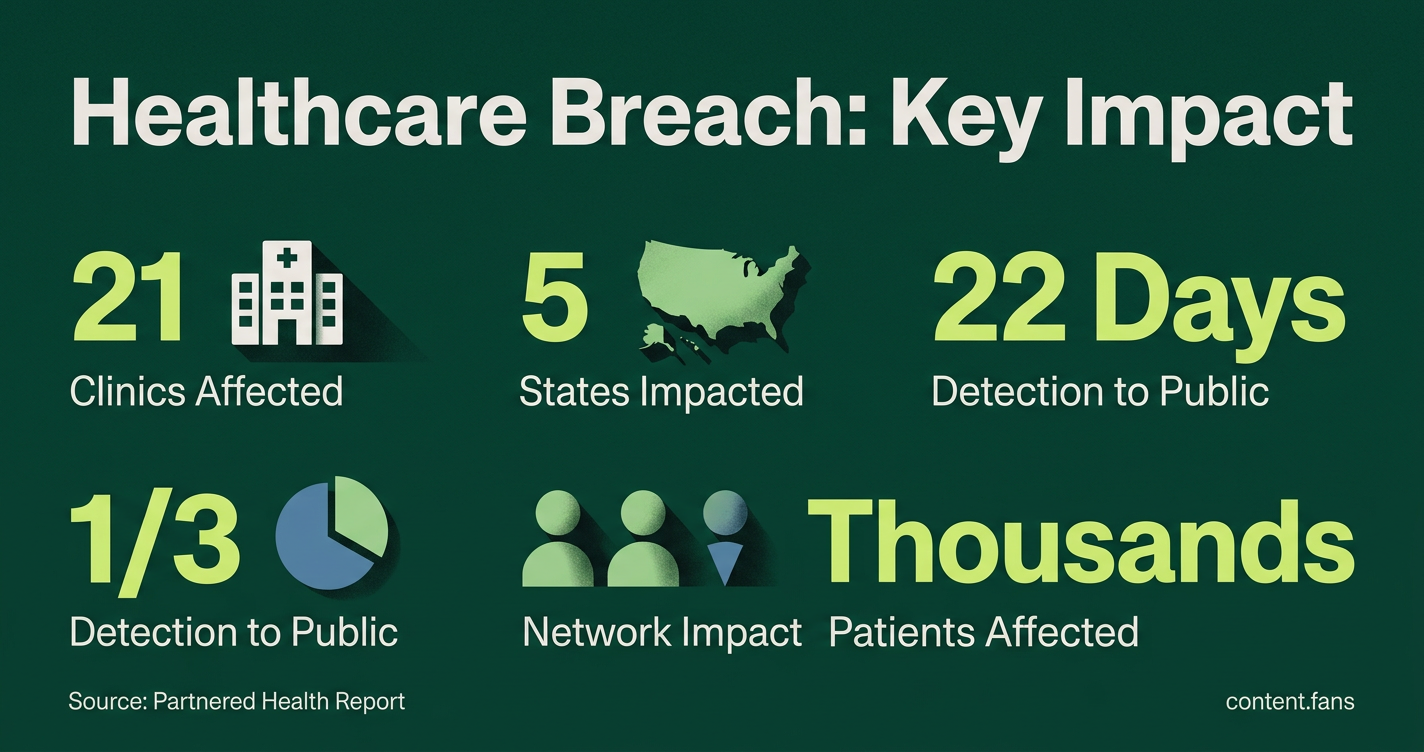
According to company disclosures, the incident was first detected on June 23, 2026. However, public confirmation was delayed until July 15, following internal investigations. This 22-day gap drew criticism for a lack of transparency, as highlighted in legal analysis on Peter A Clarke's privacy law blog.
Key facts emerging from the breach include:
- Affected Clinics: The attack impacted 21 general practice and skin-cancer clinics across NSW, VIC, QLD, WA, and the ACT, representing approximately one-third of the company's network.
- Compromised Data: Stolen information is extensive, including patient names, birth dates, addresses, Medicare numbers, private health insurance details, and highly sensitive clinical notes.
- Legal Action: The company obtained a Supreme Court injunction in NSW to block the publication or use of the stolen data, although the practical enforcement of such an order is limited.
The Significance of Stolen Healthcare Data
The stolen healthcare records are uniquely dangerous because they combine permanent identity data with private clinical histories. Security experts warn that this combination allows attackers to create highly convincing and personalized phishing and social engineering scams. A report from the cybersecurity newsletter Bushletter confirms the breach affects "thousands" of patients, although Partnered Health has yet to release a precise figure.
In response, Partnered Health launched a dedicated support page and started notifying affected individuals on July 15. The company has not yet offered identity theft monitoring services, but this may be considered by regulators as their investigations proceed.
Regulatory and Compliance Obligations
Australian healthcare providers are bound by strict data breach regulations. The federal Privacy Act's Notifiable Data Breaches (NDB) scheme mandates that organizations notify affected individuals "as soon as practicable" if serious harm is likely. Furthermore, as a provider of critical infrastructure, Partnered Health is subject to a 72-hour incident reporting deadline under the Cyber Security Act 2024. The company has fulfilled its initial duties by reporting the breach to the Australian Cyber Security Centre (ACSC) and the Office of the Australian Information Commissioner (OAIC).
While Partnered Health has stated the breach did not compromise the national My Health Record system, further investigation is ongoing. Any connection to this system would trigger additional, stringent reporting obligations.
Healthcare: A Prime Target for Cyberattacks
This incident reflects a dangerous trend. Healthcare organizations face significant cybersecurity challenges, with the sector experiencing numerous data breaches and being frequently targeted by cybercriminals. Common vulnerabilities exploited by attackers include outdated software, poor multi-factor authentication (MFA) implementation, and compromised third-party vendors.
Although authorities have warned of state-linked actors targeting Australian industries, Partnered Health has not attributed the attack, referring only to a "malicious actor." It remains unknown whether the perpetrators are financially motivated cybercriminals or a state-sponsored espionage group.
How Affected Patients Can Mitigate Risks
Regulators and cybersecurity experts advise patients of the affected clinics to take immediate protective measures:
- Be vigilant: Scrutinize all emails, text messages, and phone calls that request personal information like Medicare or insurance details.
- Monitor accounts: Regularly check your Medicare and health insurance statements for any fraudulent or unrecognized claims.
- Update passwords: Change the passwords for any online accounts that might use the same login credentials or personal information shared with the clinics.
Partnered Health has stated it is actively working to strengthen its security systems, improve monitoring, and cooperate with law enforcement. However, the effectiveness of these measures and the court injunction in preventing the future misuse of stolen patient data is yet to be seen and remains a key concern for privacy advocates.
The Partnered Health cyber incident serves as a stark reminder of the escalating threats facing Australian healthcare providers. Below are answers to critical questions about the breach, its impact, and what it means for patient data security.
What exactly happened in the Partnered Health cyberattack?
Partnered Health, an Australian operator of GP and skin-cancer clinics, confirmed that a "malicious actor" exfiltrated sensitive patient data from 21 clinics across New South Wales, Victoria, Queensland, Western Australia, and the ACT. The breach was discovered on June 23, 2026, though the company delayed public disclosure for 22 days, confirming the attack only on July 15, 2026. The stolen data includes names, dates of birth, addresses, Medicare numbers, private health insurance details, DVA cards, and detailed medical records including consultation notes and pathology results. The company secured a Supreme Court injunction to prevent publication of the stolen data and established a dedicated support page for affected patients.
How many patients were affected, and what risks do they face?
While an exact patient count hasn't been disclosed, the breach involves thousands of patients across the 21 affected clinics. The risk profile is particularly severe because attackers obtained both government identifiers and detailed clinical records - a combination that creates heightened potential for identity fraud and targeted phishing attacks. Experts note this is more dangerous than standard financial data breaches because medical records cannot be easily changed like credit card numbers, and the information can be exploited for years. Affected patients in Sydney, Melbourne, Canberra, Gold Coast, Sunshine Coast, and Coffs Harbour were contacted directly beginning July 15, 2026.
What does this incident reveal about broader healthcare cybersecurity trends?
The Partnered Health breach fits a concerning pattern of increasing cyberattacks against healthcare organizations. Healthcare remains a frequently targeted sector for cyber incidents, with organizations experiencing significant challenges in defending against sophisticated attacks. Attackers increasingly exploit third-party vendors, legacy systems, inconsistent patching, and compromised credentials as common attack vectors.
What legal obligations do Australian healthcare providers have when breaches occur?
Healthcare providers operate under a complex regulatory framework. Critical infrastructure entities must report cyber incidents within 72 hours of discovery under the Cyber Security Act 2024. For My Health Record breaches, providers must follow specific notification steps: contain, assess, manage notifications, and continue investigation - notifying the Australian Digital Health Agency, the Office of the Australian Information Commissioner, and all affected healthcare recipients. Additionally, healthcare organizations must comply with various cybersecurity standards and regulations designed to protect patient data and critical infrastructure.
What should healthcare organizations prioritize to prevent similar incidents?
Effective protection requires comprehensive cyber-hardening across multiple layers:
| Priority Area | Key Actions |
|---|---|
| Identity & Access | Implement multi-factor authentication organization-wide; restrict administrative privileges with privileged access management tools |
| Technical Defenses | Deploy Endpoint Detection and Response (EDR) across IT systems; ensure secure, regularly tested backups |
| Monitoring & Response | Establish robust security operations with data egress monitoring; address inadequate logging as a critical weakness |
| Human Factors | Conduct regular cyber education including simulated phishing; train staff to recognize social engineering attempts |
| Third-Party Risk | Strengthen vendor risk management - a common attack entry point that can amplify breach impact across organizations |
The healthcare sector must move beyond compliance paperwork to active, continuous monitoring. With ransomware and cyber threats now considered a persistent challenge, organizations that delay security investments face significantly higher costs and patient trust erosion when incidents occur.