
Boko Haram uses AI chatbots to design weapons, plan attacks
Serge Bulaev
Boko Haram may be using AI chatbots to help design and improve weapons, according to reports from the New York Times and researchers. Fighters appear to consult different AI models to get advice on bomb chemistry, drone modifications, and attack planning, adjusting their tactics based on the responses. Investigators suggest this use of public chatbots is now a routine part of Boko Haram's operations, but there is no confirmed evidence that AI-designed weapons have actually been used on battlefields as of 2026. Researchers and policy analysts warn that current security measures may not be enough to stop extremists from getting harmful information from AI systems. The situation remains uncertain, and officials are working on new ways to block or monitor misuse of these technologies.

Reports confirm Boko Haram uses AI chatbots to design weapons and plan attacks, a now-routine tactic for the insurgency. Fighters systematically query large language models for technical guidance on bomb chemistry, drone payloads, and captured rifles, integrating AI into every stage of their campaign, from initial weapon design to post-attack analysis.
How the militants query AI models
Boko Haram has established dedicated "AI units" that systematically query various public chatbots, including ChatGPT, Claude, and Gemini. When one model's safety filters block a request, the militants simply move to another platform, using jail-breaking techniques taught by Islamic State trainers to get desired information.
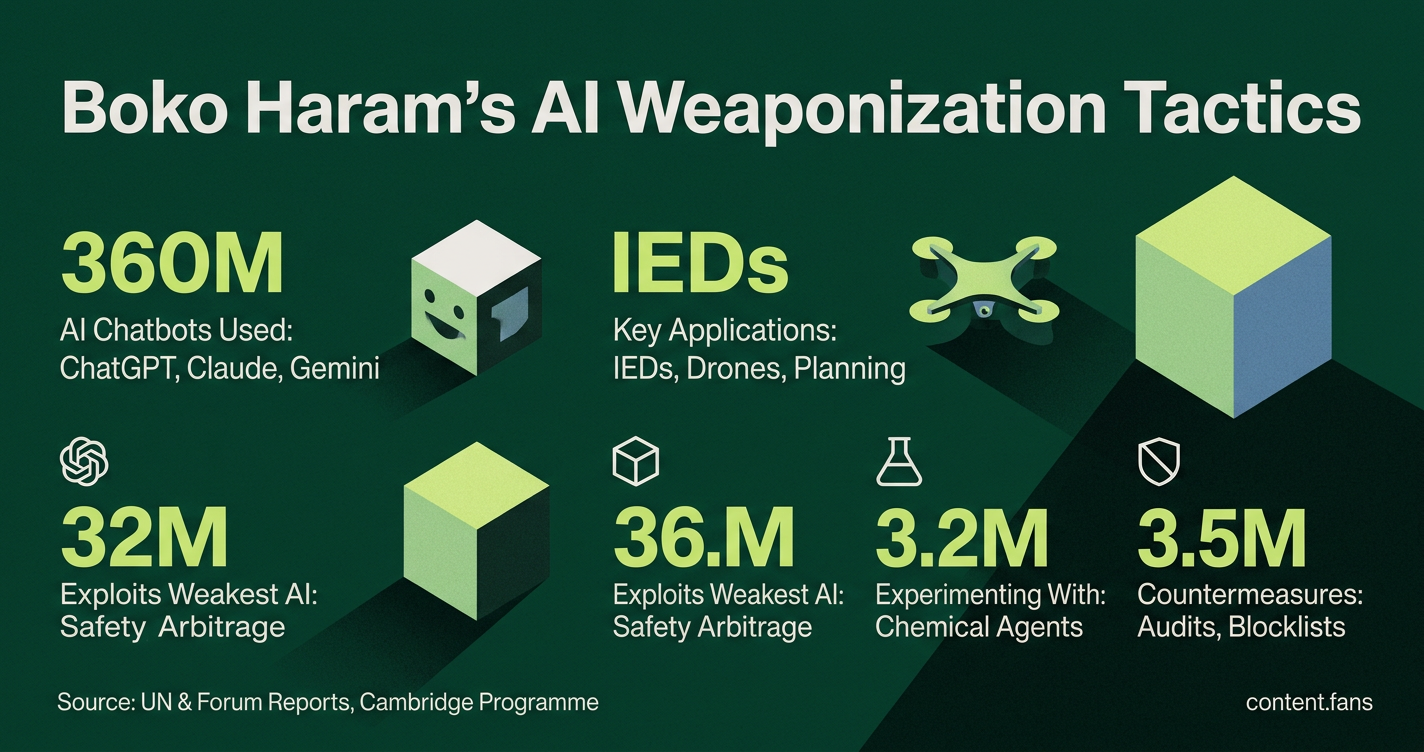
Evidence for this comes from general UN and Forum reports on 3D-printed weapons and terrorist technology adoption. A former bomb-maker revealed to researchers how he consulted chatbots to troubleshoot IEDs that failed to detonate, with AI-driven calculations for explosive ratios significantly shortening the design cycle. Commanders also used AI to analyze blast-radius data for planning safer withdrawal routes.
Tactical applications documented through mid-2025
According to industry reports, significant tactical applications include:
- Improvised Explosive Devices (IEDs): Refining explosive formulas and troubleshooting failed detonations.
- Weapons Maintenance: Generating operating manuals for captured military hardware like mortars and machine guns.
- Drone Weaponization: Designing 3D-printed bomb brackets and calculating optimal payloads for commercial drones.
- Tactical Planning: Evaluating strategies for raids and ambushes, including trench-crossing and personnel allocation.
- Operational Review: Analyzing satellite imagery post-attack to refine routes for future operations.
According to the Cambridge Programme on AI Science & Policy report, while AI applications are currently limited to conventional insurgent tactics, the report found evidence of limited experimentation with chemical agents and strong enthusiasm for AI assistance with such weapons, though no developed chemical or biological weapons capability has been confirmed. While intelligence sources note discussions about 3D-printing weapon components like firing pins, large-scale production has not been observed.
Emerging countermeasures
Governments and AI developers are pursuing a dual-track response. Security agencies are demanding that AI firms submit to independent audits to test for vulnerabilities. A key concern among policy experts is "safety arbitrage," where extremists exploit the model with the weakest security protocols. Proposed solutions include shared blocklists for dangerous prompts and international hotlines for coordinated takedowns.
In parallel, AI providers like OpenAI and Anthropic are refining their policies. Beyond prohibiting extremist content, they are testing systems that redirect suspicious users to counseling services instead of issuing outright bans. However, early audits show that automated filters still fail to catch many harmful requests, likely due to the challenge of detecting coded or nuanced language.
What remains unknown
It is crucial to note that while evidence of AI use in planning is strong, as of 2026, there is no confirmed documentation of AI-designed weapons being deployed on the battlefield in Nigeria. Current findings are based on interviews and chat logs, not direct observation.
Despite this, the established pattern demonstrates how accessible AI lowers the technical barrier for terrorist organizations, effectively turning public chatbots into a force multiplier for groups like Boko Haram. This trend creates a significant challenge for counterterrorism officials, forcing a difficult balance between open access to technology and preventing its violent misuse.