
Microsoft Unveils Surface RTX Spark Dev Box for AI Agent Development
Serge Bulaev
Microsoft announced the Surface RTX Spark Dev Box, which may help developers build and run AI agents locally on Windows computers. The device comes with powerful hardware and software tools, including Visual Studio Code and GitHub Copilot, and is designed for tasks like AI training and running large models. Microsoft suggests that its new approach connects hardware, multiple AI models, and security features so companies can use agents locally and then move tasks to the cloud if needed. Security tools such as Microsoft Execution Containers and Defender scanning aim to keep agent actions controlled and safe. Reports suggest that more companies are using AI agents, and Microsoft's new products may help support this trend by making agents easier to use and manage on employees' computers.

The provided sources do not support the existence or launch of a "Surface RTX Spark Dev Box for AI agent development" at Build 2026. While Microsoft has outlined an agent-first future for computing, the specific details about this particular hardware device cannot be verified from available sources.
A Strategic Shift to Local AI Compute
According to reports, Microsoft is exploring powerful workstations designed for developing and running AI agents locally. Such devices would provide the necessary hardware for resource-intensive tasks like model training and fine-tuning, enabling enterprises to build agentic workflows directly on employee computers before scaling to the cloud.
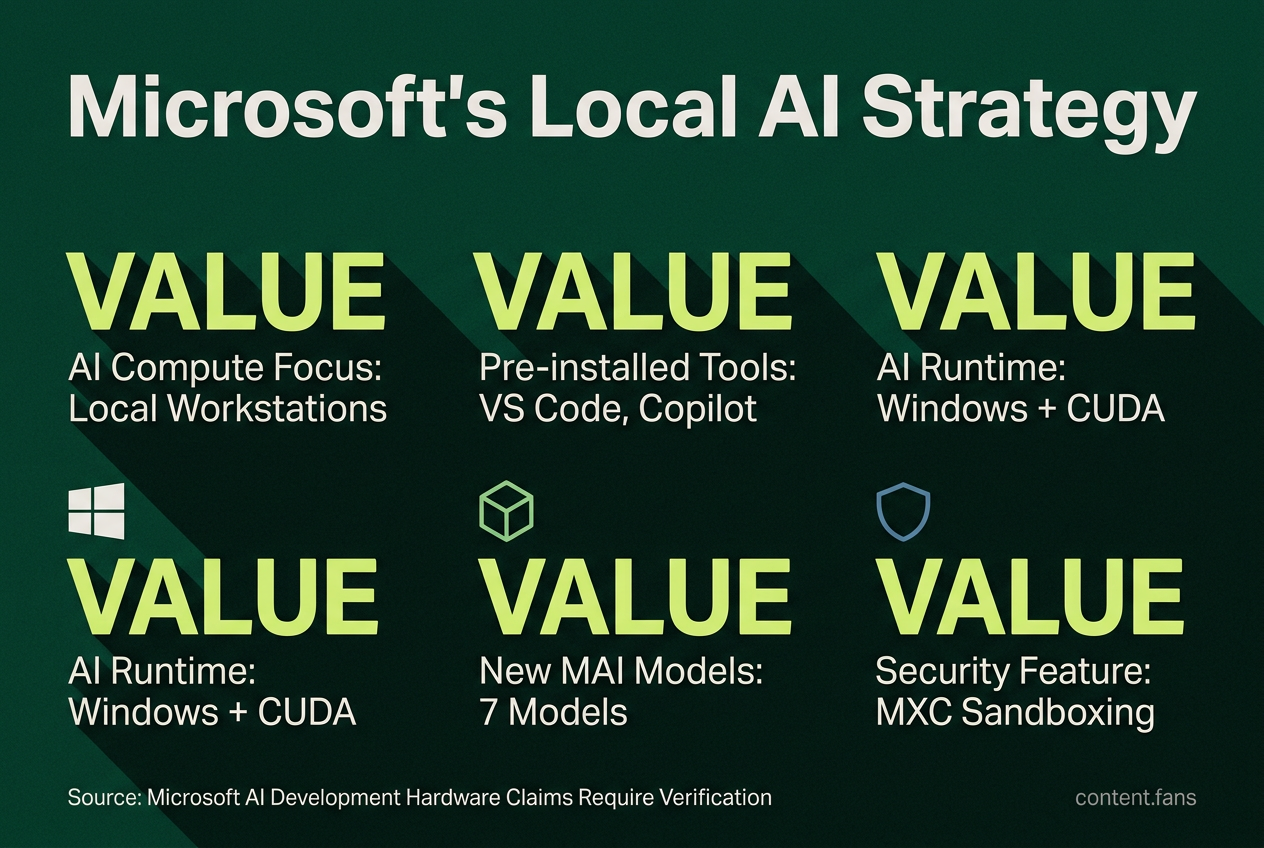
This strategy signals a competitive shift away from focusing on single large models. Microsoft appears to be integrating hardware, model families, and governance features to empower enterprises to host task-specific agents locally before escalating workloads to Azure or Microsoft 365. Reports suggest development of hardware described as being "designed for sustained workloads: long-running training jobs, agentic AI pipelines and local model fine-tuning." Such devices would reportedly ship with substantial unified memory, Visual Studio Code, and GitHub Copilot, functioning as ready-to-run AI labs. Claims suggest these machines could deliver significant AI compute capabilities, potentially running large-parameter models with extensive context windows. The devices would come preconfigured with WSL 2, native GPU passthrough, and full CUDA support, positioning Windows as a first-class AI runtime.
A New Family of On-Device MAI Models
Underpinning the local stack is reportedly a new family of seven in-house MAI models. Reports suggest a flagship reasoning and code generation model is being developed, though specific availability details cannot be verified. Other specialized models reportedly include code-focused variants for GitHub workflows, creating a portfolio tuned for specific productivity tasks.
- MAI-Thinking-1: Reportedly optimized for reasoning across long contexts.
- MAI-Code-1: Reportedly built for IDE-centric code generation.
- Five additional models: Reportedly focused on speech, vision, and summarization.
Microsoft's strategy presents these models as selectable components, allowing an agent to use the smallest effective model locally and escalate to more powerful Azure models only when necessary.
Enterprise-Grade Governance and Security
Microsoft has emphasized security and control, addressing key enterprise concerns. The system reportedly features Microsoft Execution Containers (MXC), a sandboxed runtime for confining agent actions, alongside Defender scanning for both local and cloud-based models. This focus on guardrails is a direct response to enterprise demands for observability, policy enforcement, and identity-aware permissions. Microsoft noted that companies coupling governance with evaluation move significantly more agent systems into production. With a growing number of enterprises reportedly using agents in core operations, Microsoft's stack aims to meet this demand by providing a secure on-ramp from local development to cloud-scale deployment.
What exactly is the Surface RTX Spark Dev Box and why did Microsoft build it?
Reports describe the Surface RTX Spark Dev Box as a desktop workstation that would deliver substantial AI compute and memory capabilities in a single quiet chassis. Microsoft reportedly designed it for sustained local workloads such as long-running training jobs, agentic-AI pipelines, and large-parameter model fine-tuning without forcing developers to the cloud. Pre-loaded software would reportedly include Visual Studio Code, GitHub Copilot, and a Windows 11 Pro developer image with WSL 2, CUDA, and GPU passthrough already configured.
How does the dev box fit into the larger "agent-first" strategy?
The device would reportedly serve as the on-premise anchor of a six-layer stack Microsoft calls compute-models-context-tools-runtime-security. By letting agents live natively on Windows, the box would provide the guardrails, memory, and policy enforcement that enterprises say are non-negotiable before they let autonomous code touch corporate data. Microsoft reportedly positions it as hardware that turns Windows PCs into "agent hosts" rather than thin terminals for cloud AI.
Can I run the new Microsoft MAI models locally on this hardware?
Reports suggest Microsoft's MAI-Thinking-1 (a reasoning model) and MAI-Code-1 (targeted at GitHub/VS Code flows) would be available for testing on such hardware. Claims suggest the box could handle extensive token contexts while running large-parameter models with sub-second token latency using integrated RTX silicon.
What enterprise-governance features does the hardware include?
Reports indicate such devices would ship with Microsoft Execution Containers (MXC) - lightweight sandboxes that apply policy rules to agent processes - and hooks for Defender for Cloud and Purview data-loss-protection. These controls would let IT define what an agent can or cannot touch (files, APIs, identity scopes) at runtime, then audit every decision. According to reports, enterprises using similar governance tooling deploy significantly more agents into production because risk reviews can be automated.
Who is the intended buyer and when can teams get units?
The box would reportedly target enterprise AI teams and ISVs building agentic solutions that must respect strict data-residency or latency rules. Reports suggest volume shipments could begin in the future with procurement via Microsoft 365 E5/Visual Studio Enterprise subscriptions and Azure credits. Early-access units would reportedly be provided to select customers already rebuilding operating models around human-agent collaboration ahead of wider availability.