
Microsoft Unveils Four IQ Services for Enterprise AI Agents at Build 2026
Serge Bulaev
Microsoft has introduced four new IQ services - Web IQ, Work IQ, Foundry IQ, and Fabric IQ - that may help enterprise AI agents work better by providing key information in separate layers. These services aim to make agent setup faster, safer, and simpler by handling different types of data such as live web content, organizational connections, business knowledge, and company metrics. Early feedback suggests these tools might speed up development, improve information quality for agents, and give IT teams better control. However, some details about how these services work and how easy they will be to use with other platforms are still unclear. Experts say that future adoption will likely depend on how well the new APIs perform and whether outside platforms can use them easily.

At its Build 2026 conference, Microsoft unveiled IQ services for enterprise AI agents - Web IQ, Work IQ, Foundry IQ, and Fabric IQ. These services form a reusable intelligence layer that developers can access from Copilot, Foundry, or custom runtimes. Microsoft is positioning this as a "context-as-a-service" platform designed to simplify the complex retrieval and permissions tasks that hinder many enterprise AI projects, as detailed in a Build blog post and covered by eCorpIT.
In essence, Microsoft aims to accelerate and secure AI agent grounding by separating context into distinct, purpose-built services: web data, workplace signals, enterprise knowledge, and business semantics.
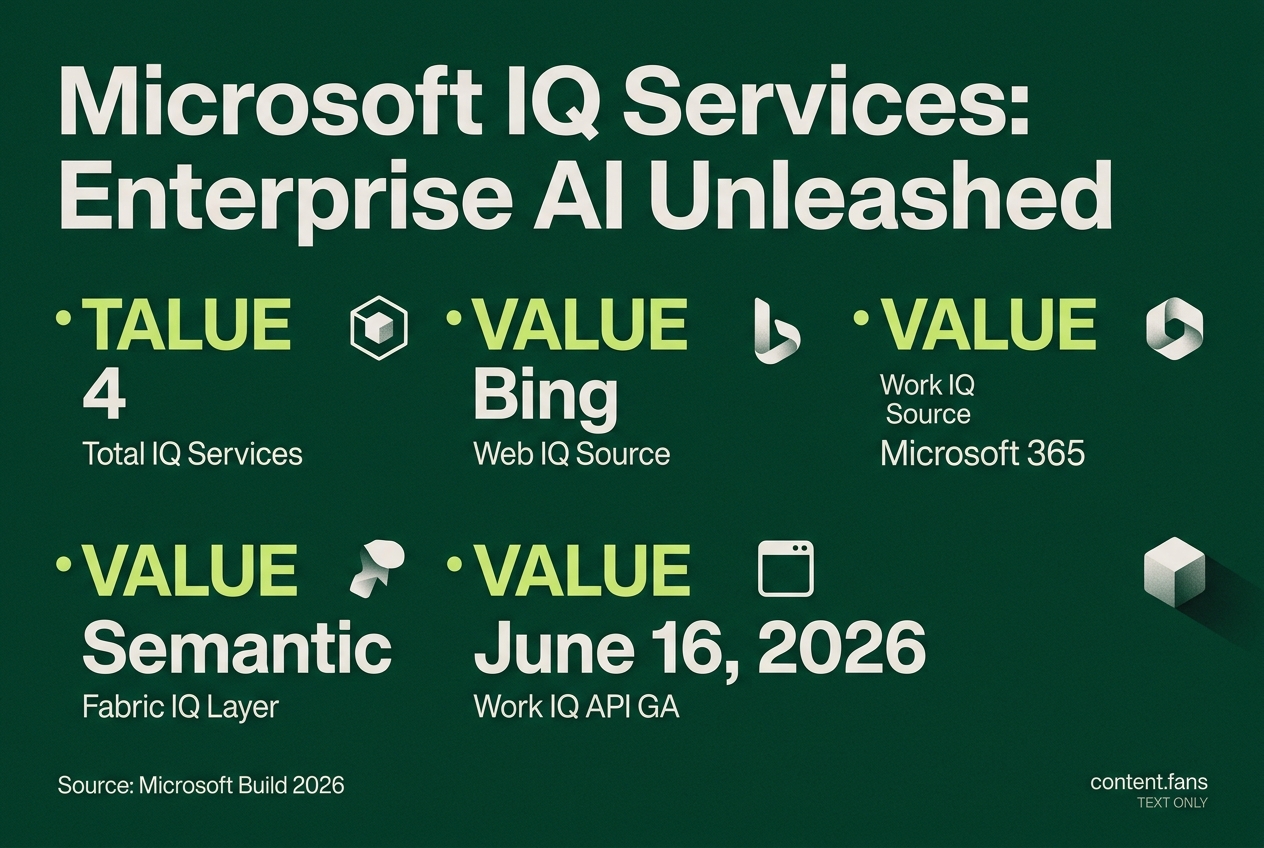
What each IQ service covers
Microsoft's new IQ services provide distinct context layers for enterprise AI agents. Web IQ offers live web data, Work IQ provides organizational signals from Microsoft 365, Foundry IQ delivers governed knowledge, and Fabric IQ models business metrics, enabling faster, safer, and more accurate agent development.
- Web IQ: Delivers live web passages, news, and media powered by Bing's retrieval technology.
- Work IQ: Surfaces signals from Microsoft 365 to map connections between people, files, and conversations.
- Foundry IQ: Provides access to governed enterprise knowledge bases through a unified API.
- Fabric IQ: Models key business entities and metrics using the Microsoft Fabric semantic layer.
Development and governance impact
Industry analysis points to several primary benefits for development teams. First, development cycles can accelerate as projects leverage the common context APIs instead of building custom retrieval pipelines. Second, grounding quality may improve when agents combine Work IQ's organizational graph with Web IQ's real-time external data. Third, governance capabilities are enhanced through the IQ layer integration with Microsoft's compliance controls, allowing IT to enforce consistent policies across multiple agents.
Availability windows and open questions
Microsoft has confirmed the IQ services are generally available today within GitHub Copilot, Foundry, and Copilot Studio. The Work IQ APIs will follow with general availability on June 16, 2026, offering direct programmatic access to organizational context. While Fabric IQ is already a workload in Microsoft Fabric and Web IQ has a product page detailing its low-latency performance, key details for Foundry IQ and Web IQ, including public API references, remain pending. The exact nature of Foundry IQ - whether it's a new managed service or a rebranding of Azure AI Search - is also yet to be clarified.
Competitive context
Microsoft's context-as-a-service strategy enters a market with established players. Key competitors include OpenAI Frontier's shared business context, Amazon Bedrock AgentCore's serverless runtime, and Google Vertex AI Agent Builder's Workspace connectors. While each competitor targets a different part of the agent stack, they all aim to solve the core enterprise challenge of providing reliable context for AI agents.
What to monitor next
Future market adoption will depend on several key factors:
- The real-world performance and reliability of the Work IQ API upon general availability.
- The speed at which Fabric IQ's semantic models deliver measurable improvements in agent accuracy.
- The ease with which third-party platforms outside the Microsoft ecosystem can integrate with the IQ service endpoints.
The resolution of these points will determine if Microsoft's context-as-a-service becomes a cornerstone of the enterprise AI landscape or remains a convenience for its own ecosystem.