
Microsoft restructures leadership for AI race, adopts startup model
Serge Bulaev
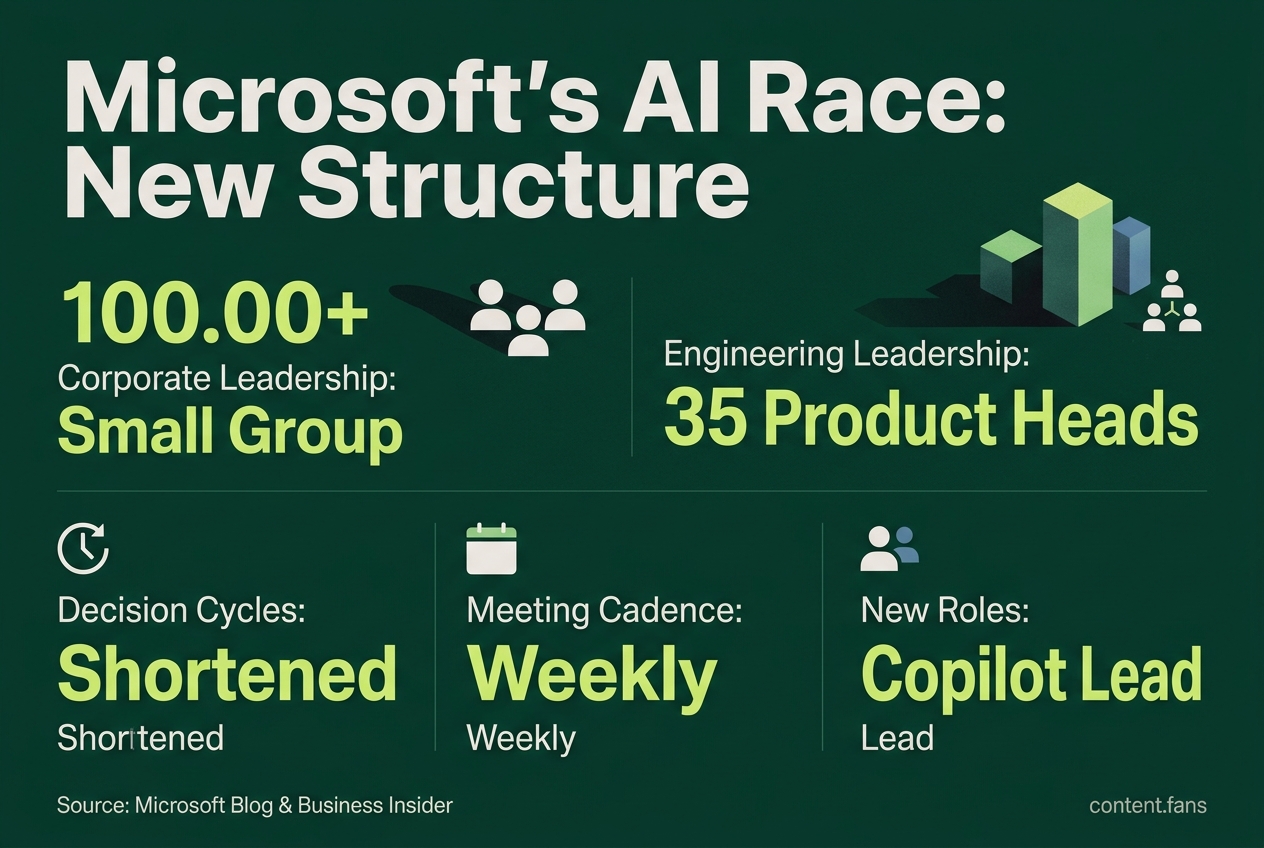
Microsoft has redesigned its leadership structure to work more like a startup, which may help the company move faster in developing AI. A smaller group of top leaders now meets weekly for decisions, and about 35 product heads focus on getting things done. The company has also created a special leadership team for its AI assistant, Copilot. Microsoft encourages employees to share new ideas quickly, and leaders can approve or reject them within days. This change suggests Microsoft wants to speed up its work on AI, with top leaders making decisions more often and focusing directly on important projects.
To accelerate its AI innovation, Microsoft restructures leadership into a startup-style operating model, breaking from its traditional corporate structure. CEO Satya Nadella has reportedly replaced the long-standing senior leadership team with smaller, flatter groups to shorten decision cycles. This change aims to free up executives for hands-on technical work and better connect engineering with commercial teams (Microsoft blog).
The new framework centers on two core bodies. A small corporate leadership group, including Nadella and other top executives, meets weekly for high-level governance. Meanwhile, an engineering leadership cohort of about 35 product heads drives execution. According to Business Insider, these teams are positioned "closer to the action," enabling faster decision-making and more direct accountability (Business Insider).
Focused roles and rising leaders
Microsoft has replaced its traditional senior leadership team with smaller, agile groups to accelerate AI innovation. This new structure features a core governance team and a separate engineering cohort, allowing top leaders to focus on strategy while product heads drive execution with fewer bureaucratic layers and faster approval cycles.
A dedicated leadership team now guides Microsoft's flagship AI assistant, Copilot, with Charles Lamanna overseeing the platform. The restructure has also elevated key figures like Pavan Davuluri, a 25-year veteran now leading Windows and devices. To foster innovation, Nadella expanded his "accelerator" sessions, where junior engineers present ideas directly to leadership for rapid approval, bypassing formal reviews.
Culture signals that support the structure
The structural changes are reinforced by a cultural shift toward a "learn-it-all" ethos, encouraging rapid testing and iteration. Nadella has emphasized that culture defines strategy, linking the company's mission to the massive computational power required for AI. This focus explains why the leadership reset prioritizes not just product innovation but also datacenter expansion and systems architecture.
One weekly rhythm, many fast loops
The most significant outcome of the new model is an increased operational tempo. Monthly steering meetings have been replaced by weekly checkpoints that mirror a startup's cadence. The corporate leadership group tracks key metrics such as:
- Budget allocations for AI infrastructure and research
- Progress of Copilot feature rollouts across Microsoft 365
- Hiring pipelines for AI scientists and responsible AI experts
- Compliance reviews tied to emerging regulations
This weekly rhythm allows the engineering cohort to reallocate resources within days instead of months. Internal estimates cited by Business Insider suggest this has already improved cross-team alignment and accelerated code deployment.
What the change may mean
Analysts observe that this flattened structure does not eliminate governance but rather concentrates it among leaders who are closer to the engineering work. Microsoft is betting that disciplined speed will be more effective than a broad hierarchy in a competitive market. As enterprise spending on generative AI reportedly tripled from 2024 to 2025, this move signals that AI initiatives like Copilot are now considered core business lines, not experimental side projects.
What exactly changed in Microsoft's senior leadership structure?
Satya Nadella has quietly retired the decades-old Senior Leadership Team (SLT) and replaced it with smaller, flatter groups that meet weekly.
- A corporate leadership circle (Nadella, Brad Smith, Amy Hood, Judson Althoff, Amy Coleman) handles company-wide governance.
- A 35-person engineering leadership group sits directly with product teams, cutting previous layers of approval.
The goal is to move decisions closer to the code and speed up AI releases.
Why is Microsoft giving its commercial business its own CEO?
In October 2025, Judson Althoff was promoted to CEO of Microsoft's commercial business, unifying sales, marketing, operations, and engineering under one leader.
Nadella says this frees the top technical executives (and himself) to focus on datacenter build-out, systems architecture, and AI science - the layers that determine how fast new models reach customers.
How does the new "startup model" work day-to-day?
- Weekly "AI accelerator" meetings: junior technical fellows pitch ideas directly to Nadella instead of waiting for formal exec reviews.
- A dedicated Teams channel lets any employee post prototypes; promising ones are spun into Copilot feature crews within days.
- Copilot leadership team (Charles Lamanna, Jacob Andreou, Ryan Roslansky) operates like an internal startup, owning roadmap, budget, and P&L for the assistant.
What measurable impact has the shift produced so far?
Microsoft cites 29 % productivity gains among employees who use its AI tools internally.
Enterprise adoption of generative AI inside Microsoft's customer base jumped from 55 % in 2023 to 75 % in 2024, and the company says flat teams and faster iteration are the biggest internal drivers behind the 2025 - 2026 product cadence.
Which other tech giants are copying the startup playbook?
PwC's 2026 AI predictions show "AI studios" - centralized hubs with sandbox access and reusable components - popping up at Google, Amazon, and Toyota.
Stanford's 2026 AI Index notes that industry now produces >90 % of frontier models, so speed of integration inside existing products has become the real battleground.