
Slack AI cuts messaging time by 30% with new summarization
Serge Bulaev
Slack AI may help users spend 30% less time on routine messaging, according to early tester feedback. Some companies reported saving about 97 minutes per week on searching and catching up, but these claims have not been verified by outside sources. The AI summarizes discussions, files, and messages, and now supports English, Spanish, and Japanese, with more languages possibly coming soon. Slack AI also works with over 2,000 apps to help with tasks like support and budgeting, while keeping customer data private. These features are only available as a paid add-on, and outside reviews of its effectiveness are still missing.

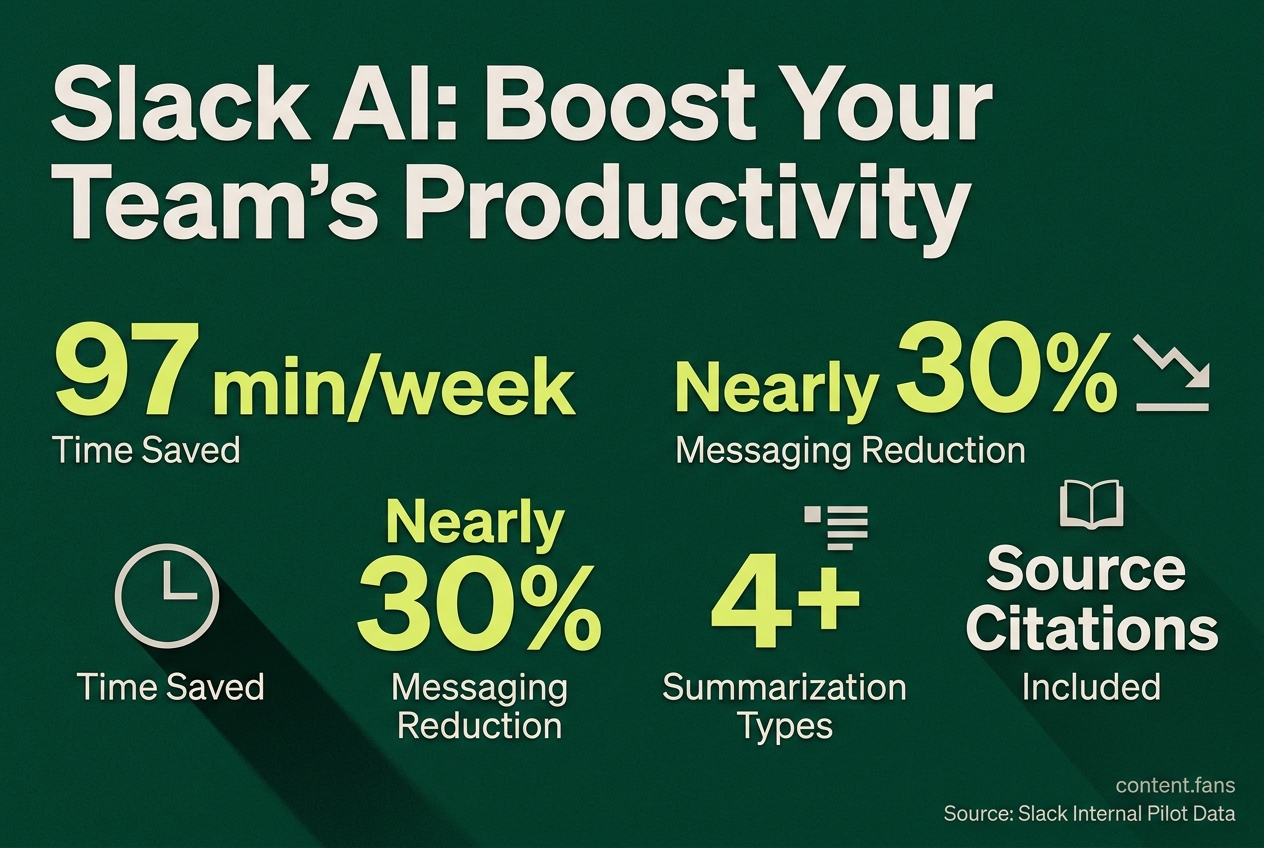
Slack AI helps teams save an average of 97 minutes per week on routine messaging, representing a nearly 30% reduction in time spent. Early adopters report significant time savings through its automated summarization and intelligent search, offering a powerful new way to boost productivity. Here is what you need to know about this increasingly essential business tool.
How Slack AI Reduces Messaging Time
According to internal pilot data, users save an average of 97 minutes per week (nearly 30% reduction). The source does not explicitly name specific companies in this pilot data. This efficiency gain stems from faster search, automated knowledge distillation, and more streamlined brainstorming.
The core feature driving these results is real-time conversation summarization, which captures highlights from discussions instantly. This directly targets the productivity loss associated with catching up on unread messages.
Structured FAQ
How does Slack AI's conversation summarization actually work?
Slack AI offers several specialized summarization features designed for different communication scenarios:
Slack AI reduces time spent on messaging by automatically summarizing conversations, channels, and files. It extracts key points from discussions, allowing users to catch up quickly without reading every message. This summarization works for threads, daily digests, and even unread messages to streamline information consumption.
| Feature | Purpose |
|---|---|
| Thread summaries | Capture the gist of long conversation threads instantly |
| Channel recaps | Daily digests of key highlights from selected channels |
| Conversation summaries | Summarize unread messages, last 7 days, or custom date ranges |
| File summarization | Auto-summarize PDFs, DOCX, PPTX, and XLSX files shared in channels |
All generated summaries include clear source citations, empowering users to verify information or explore specific highlights in greater detail. This design balances efficiency with the need for accuracy and context.
What languages does Slack AI support for summarization?
Slack AI provides summarization capabilities with expanding language support beyond its initial English-only launch. While Slack has announced plans for additional languages, specific availability varies by feature and timing.
Separately, the platform's AI-powered translation feature supports a broader range of languages, allowing for multilingual collaboration even where summarization may have limited language support.
How do third-party app integrations enhance productivity?
Slack AI native features are limited to thread summaries, channel recaps, and AI search. Autonomous capabilities for customer support, IT service, and workflow require third-party tools via the App Marketplace:
- Customer Support Automation: Agents from tools like ClearFeed and Intercom Fin can autonomously resolve support tickets using conversational context.
- IT Service Management: Salesforce Agentforce delivers instant IT help and automatically creates incident channels with the right team members.
- Workflow Optimization: Reusable AI skills allow teams to generate budgets or project plans by pulling data from connected SaaS tools using natural language.
These integrations elevate Slack from a simple messaging app to a centralized command hub where work is executed without constant context switching.
What makes Slack AI different from competitors like Microsoft Teams?
In a competitive landscape, Slack AI carves out a distinct niche. While Microsoft Teams Copilot focuses on Microsoft 365 integration and Zoom's AI Companion prioritizes meeting support, Slack AI differentiates itself with a message-centric approach:
| Strength | Slack AI Approach |
|---|---|
| Message-centric design | Built specifically for high-volume messaging environments rather than meetings-first |
| Semantic search | Meaning-based matching rather than keyword-only results |
| Third-party ecosystem | Extensive app integrations vs. more closed ecosystems |
| Huddle & thread focus | Specialized tools for asynchronous communication patterns |
Ultimately, the choice depends on a team's primary workflow. Organizations deeply embedded in the Microsoft ecosystem may benefit from Teams Copilot's integration with OneNote and Outlook. Teams focused on virtual meetings may find Zoom's real-time Q&A and whiteboard tools superior. However, for organizations whose work revolves around high-volume, asynchronous messaging, Slack AI presents a more specialized and powerful solution.
Is Slack AI worth the investment for my team?
Pricing and Availability:
- Slack AI is available as a paid add-on across all paid plans (Pro, Business+, and Enterprise).
- The feature has expanded availability across different plan tiers with growing language support.
Key Limitations to Consider:
- Autonomous actions like answering support tickets or routing requests require third-party app integrations.
- Language support for summarization features may be limited depending on your team's needs.
- The 97-minute weekly time-saving metric comes from Slack's internal data and has not yet been validated by independent benchmarks.
For teams heavily reliant on Slack, the productivity gains from high messaging volume will likely justify the cost of the add-on. New adopters should weigh Slack AI's powerful ecosystem and message-first design against the tighter integrations offered by competitors.