
Microsoft launches Frontier Company with $2.5B to embed 6,000 AI engineers
Serge Bulaev
Microsoft has launched Frontier Company with a $2.5 billion investment to embed over 6,000 AI engineers directly at customer sites, aiming to speed up AI use and results for businesses. This move may help Microsoft go beyond traditional software and cloud services by doing hands-on work at client locations. The new company faces competition from similar programs by Amazon, Anthropic, and OpenAI, but exact market sizes for this kind of service are not yet known. Early projects, such as with the London Stock Exchange Group, suggest possible productivity gains, but independent checks have not confirmed these results yet. Microsoft says clients will keep control of their data and code, which may set it apart from others, but it is still uncertain if this new approach will bring clear and lasting business value.

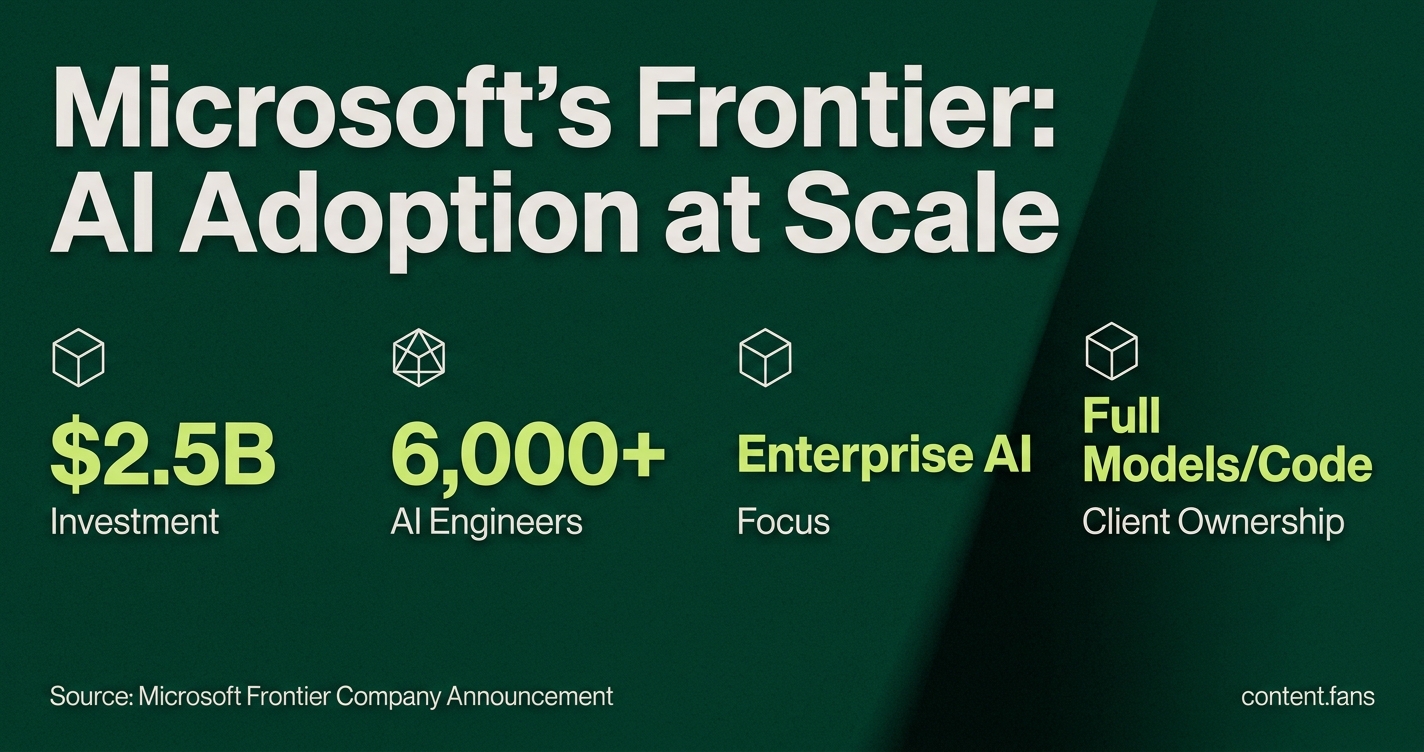
Microsoft has launched Frontier Company, a new unit backed by a $2.5 billion commitment to embed over 6,000 AI engineers directly with enterprise customers. This strategic initiative is designed to accelerate AI adoption and deliver tangible business outcomes by taking direct responsibility for implementation.
By shifting from software licensing to hands-on site work, Microsoft aims to create a powerful learning loop that connects its engineering expertise with real-world customer challenges, tightening the feedback cycle for product development.
Frontier Company's $2.5B Commitment and Scale
Microsoft Frontier Company is a new applied-AI services division backed by a $2.5 billion investment. It aims to accelerate enterprise AI adoption by embedding over 6,000 specialized engineers directly on-site with customers, moving projects from concept to production and ensuring measurable returns on investment.
Microsoft confirmed the new operation will begin by deploying roughly 6,000 industry, engineering, and AI professionals from its existing teams. The $2.5 billion funding is confirmed, but comparisons to competitor programs require further verification. Industry analysts suggest this substantial investment signals Microsoft's ambition to capture a dominant early share in the emerging "embedded AI" services market, for which market size estimates are not yet available.
The Competitive Landscape for Applied AI Services
Frontier Company enters a competitive field alongside various AI and cloud service providers. Anthropic has launched the 'Claude Campus' program (a 10-week paid initiative), and OpenAI has launched the 'OpenAI Residency' program, though these are not identical on-site engineering programs. In addition to these AI-native firms and cloud rivals, Microsoft will also compete and potentially partner with traditional systems integrators like Accenture and Cognizant, who currently dominate the advisory landscape. Key competitors in the embedded engineer space include:
- Palantir forward-deployed engineering teams
- Various cloud service providers with consulting arms
- Traditional systems integrators
As the "embedded AI" category is new, market share data is not yet available, meaning early successes could significantly influence future market benchmarks.
Early Customer Results and Use Cases
Microsoft has established partnerships with major enterprises including the London Stock Exchange Group through a strategic cloud services and data platforms partnership. Other pilot customers include Unilever, Land O'Lakes, and Novo Nordisk. A key differentiator is Microsoft's policy that clients retain full ownership of the models and code developed during the engagement, addressing data sovereignty concerns.
While independent audits are pending, internal metrics suggest promising productivity gains, with many AI interactions focused on analytical work and a significant number of users reporting enhanced capabilities.
Leadership and Strategic Intent
The new company is led by Rodrigo Kede Lima, the former President of Microsoft Asia. His extensive experience includes over two decades at IBM and managing 30,000 employees across 20 countries at Microsoft, providing a deep background in large-scale technology operations. Lima emphasizes a "human-first" approach, prioritizing customer control over intellectual property.
By embedding engineers directly, Microsoft assumes greater execution risk than with remote advising. This strategy demonstrates confidence in its Azure OpenAI stack but also ties its success directly to customer ROI, uptime, and compliance metrics. The coming year will reveal if this high-investment, hands-on model delivers substantial enterprise value and forces competitors to increase their own commitments.
What exactly is Microsoft Frontier Company?
Microsoft Frontier Company is a new $2.5 billion applied-AI consulting unit designed to embed more than 6,000 engineers inside large enterprises so AI projects move from pilot to production - and deliver measurable ROI - faster than traditional outsourcing models.
How does Frontier differ from other "forward-deployed" programs?
Frontier's scale and funding represent a significant investment in the embedded AI services market. Microsoft also promises customers full ownership of all models and data created during the engagement, an IP-rights stance many integrators do not match.
Who is running the new unit?
Rodrigo Kede Lima - former President of Microsoft Asia overseeing 30,000 employees across 20 countries - leads Frontier Company. His background includes extensive experience at IBM, where he held various leadership roles in cloud and AI strategy, combined with Microsoft's cloud and AI leadership roles.
Which customers are already seeing results?
Early adopters span multiple industries:
- London Stock Exchange Group - strategic partnership focusing on cloud services and data platforms
- Unilever - bespoke AI tools chosen and integrated with internal data to drive ROI
- Novo Nordisk & Land O'Lakes - embedded engineers connecting AI to pharma and agriculture workflows without moving data back to Microsoft
What business problem is Frontier designed to solve?
Satya Nadella frames Frontier as a "learning loop" that compounds human and token capital. The unit targets the enterprise gap where heavy AI spending fails to convert into clear returns, giving Microsoft a direct path to strengthen adoption of Azure, Copilot and related cloud services while competing with entrenched consulting giants such as Accenture and Deloitte.