
Microsoft, Amazon expand dedicated AI instances for secure enterprise data
Serge Bulaev
Microsoft and Amazon now offer dedicated AI instances that may help keep enterprise data separate from outside systems, which appears to appeal to high-security industries like finance and government. These dedicated instances are set up in private or isolated environments, and vendors commit to not keeping any customer data, although experts suggest this relies mainly on automated systems. Recent privacy incidents and regulations have increased demand for such setups, as companies want stronger control and audits over their data. Analysts note that while these private environments reduce risks, they may not remove them entirely, and some suggest companies might use a mix of isolated third-party models and self-hosted options for better security.

To enhance security for enterprise data, Microsoft and Amazon are expanding their dedicated AI instances, offering isolated cloud environments that prevent customer data from reaching public model-provider systems. This approach is becoming standard for high-security sectors like finance and government, allowing them to adopt powerful external LLMs without compromising established data governance controls. CIOs consider these private instances a critical risk-reduction measure, ensuring that all prompts, outputs, and embeddings are contractually excluded from third-party training and remain within the customer's network perimeter.
How Dedicated Instances Work
Dedicated instances run AI models within a customer's private cloud subscription. This single-tenant architecture uses private virtual networks to isolate all traffic and contractually guarantees that customer prompts and outputs are never used for external model training, keeping data entirely within the customer's control.
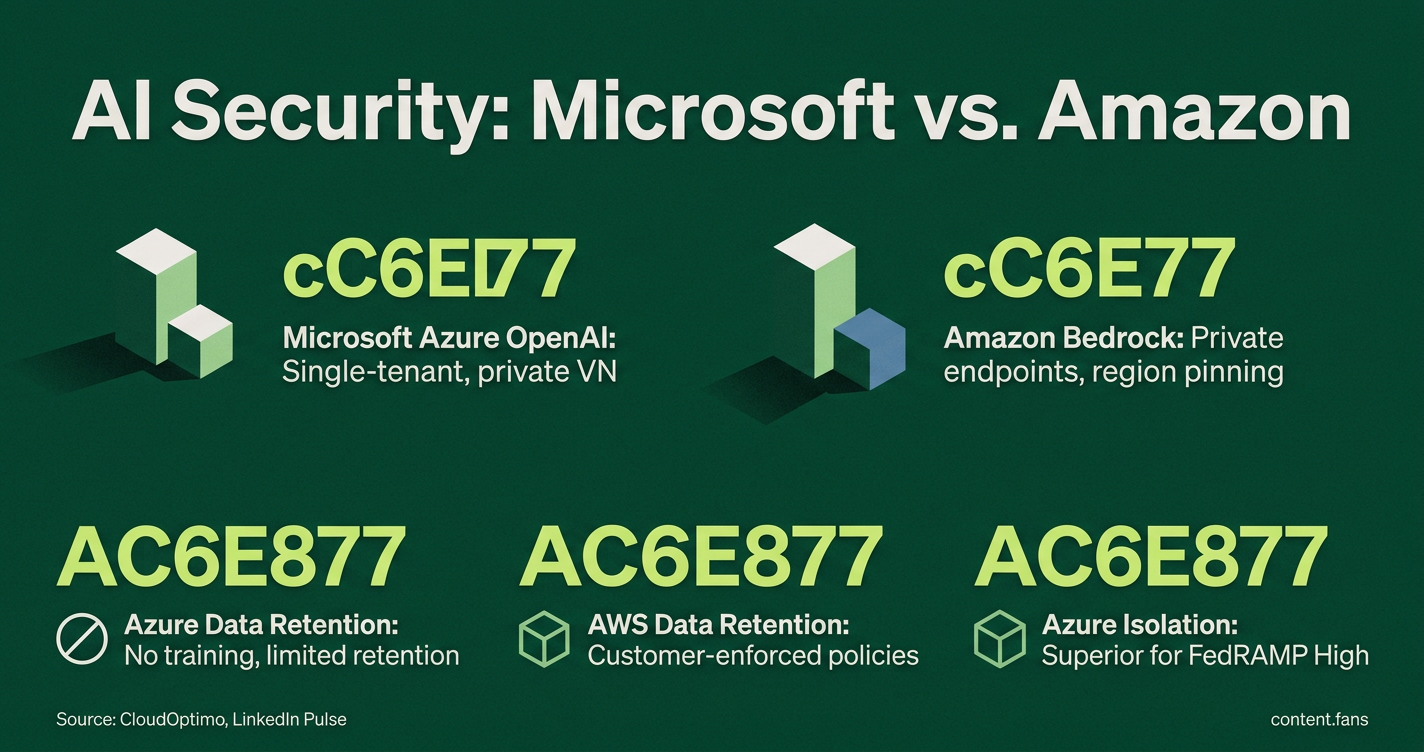
Microsoft's Azure OpenAI service places the model runtime in a single-tenant subscription, routing traffic exclusively through private Virtual Networks with encryption using Customer-Managed Keys. A CloudOptimo comparison highlights that Amazon's Bedrock provides a similar private environment for Anthropic models, featuring private endpoints and region pinning. Microsoft Azure OpenAI operates in a 'no training, limited retention' mode by default, with zero data retention only available via contractual negotiation for large enterprises. AWS does not have a universal zero data retention commitment; it provides tools for customers to enforce their own retention policies.
In contrast, while Google's Vertex AI offers private endpoints and strong VPC Service Controls, a LinkedIn Pulse security brief notes that models typically use a shared runtime without an enterprise isolation tier. Consequently, analysts often consider Azure's isolation superior for workloads requiring FedRAMP High, whereas Vertex excels in network exfiltration defense.
Privacy Incidents Shape Enterprise Demand
The demand for dedicated instances is a direct response to high-profile data retention failures that have eroded enterprise trust. For example, the July 2026 Grok Build incident was reported by security researchers (Cereblab) and covered by sources like AppReviewLab, GlitchWire, Gigazine, and The Hacker News. The tool by xAI uploaded entire Git repositories for simple tasks, with a test repo generating significant uploads, prompting xAI to disable the behavior on July 13, 2026, and delete uploaded data. Similarly, GDPR investigations into xAI's data harvesting practices resulted in an injunction from the Irish Data Protection Commission.
These events have led security teams to three core conclusions:
1. Vendor trust must be verified by independent audits of zero-retention policies.
2. Contracts must explicitly include zero-data-retention clauses for all LLM services.
3. Comprehensive, auditable logs of all prompts and responses are a regulatory necessity.
Deployment Checklist for Regulated Industries
To deploy LLMs safely, financial and healthcare organizations are adopting a standard security pattern:
1. Isolate the Model: Deploy the LLM within a private, single-tenant cloud environment.
2. Verify Critical Data: Route all numerical and compliance-sensitive calculations through trusted, deterministic backend systems for verification.
3. Sanitize I/O: Implement strict input sanitization and output validation gateways to prevent malicious data flows.
4. Log Everything: Maintain encrypted, auditable logs of all interactions in jurisdiction-specific locations, aligning with regulations like SEC record-keeping rules.
5. Audit Continuously: Engage third-party auditors to perform regular penetration testing for vulnerabilities like prompt injection and data exfiltration.
While dedicated instances significantly reduce security exposure, industry experts caution that they do not eliminate it. Risks from misconfigured network peering or unexpected changes to vendor telemetry defaults persist. Consequently, the long-term enterprise strategy may involve a hybrid approach, blending secure third-party models with self-hosted open-source alternatives to achieve complete strategic control over sensitive data and AI capabilities.