
Meta Ships Custom AI Chip, Targets 14 GW Compute by 2027
Serge Bulaev
Meta plans to start making a new AI chip, called Iris, in September 2026. This chip may help Meta lower costs and depend less on outside suppliers like Nvidia and AMD. The company aims to double its AI computing power from 7 GW in 2026 to 14 GW in 2027, but it appears power supply might be a bigger limit than making the chips. Meta will still buy many chips from Nvidia and AMD, so their market share might not change quickly. The main goal of Meta's new chip program seems to be saving money and making its AI systems run more efficiently.

Meta's plan to ship its custom AI chip, codenamed "Iris," is moving from internal memo to production silicon. According to a Reuters report, an internal memo confirms that the in-house accelerator will enter production in September 2026.
This strategic move aims to overhaul the cost structure of Meta's AI operations and reduce its reliance on external GPU suppliers. Analysts view this as a push for vertical integration to better control supply chains and manage long-term hardware pricing.
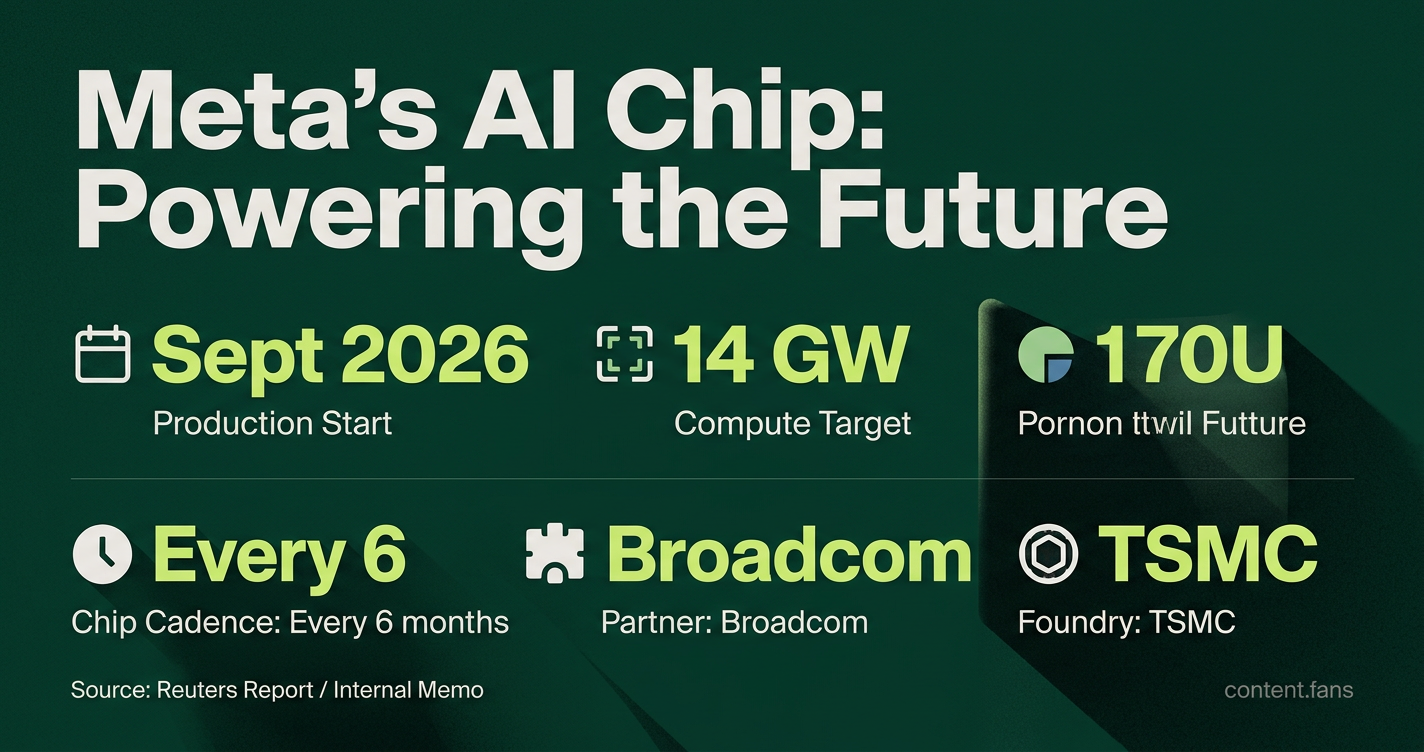
Unveiling "Iris": Meta's In-House Accelerator
Meta's custom AI chip, "Iris," is a fourth-generation Meta Training and Inference Accelerator (MTIA) set for production in September 2026. Co-developed with Broadcom and manufactured by TSMC, it's designed to lower computing costs and reduce dependence on third-party GPUs for ranking and recommendation models.
The Iris chip is part of the fourth generation of Meta Training and Inference Accelerator (MTIA) designs. The company partnered with Broadcom for co-development and has selected TSMC as its foundry partner. A TechDogs summary noted that the chip passed a validation phase without significant problems.
Key details from the memo include:
- Production Start: September 2026 with TSMC
- Release Cadence: New MTIA chip every six months through 2027
- Primary Workloads: AI inference for ranking and recommendation models in Meta's apps
- Strategic Goal: Lower compute costs and reduce reliance on Nvidia/AMD GPUs
- Key Partner: Broadcom (design agreement through 2029)
14 GW Compute Ambition and Data Center Buildout
The internal memo details an aggressive timeline to double Meta's AI compute power, scaling from current levels to an ambitious 14 GW by 2027. A significant portion of this expansion is slated for the second half of 2026 to align with the mass production of the Iris chip. This buildout is part of a massive infrastructure investment.
A major component of this plan is the Hyperion data center project, which is expected to provide substantial capacity. To power this massive expansion, Meta has secured power purchase agreements with nuclear plants and is investigating small modular reactors (SMRs) for future energy needs. Company executives acknowledge that Meta's power requirements could reach significant levels by the end of the decade.
Competitive Context and Market Impact
Meta has clarified that Iris is designed to augment its existing hardware, not replace GPUs from vendors like Nvidia and AMD. Management has assured staff that the company will continue to purchase a significant volume of accelerators from these partners. Consequently, market analysts do not foresee an immediate threat to Nvidia's data center share, though they suggest Meta's custom silicon will exert gradual pricing pressure.
While Broadcom and TSMC are clear beneficiaries of the design and fabrication contracts, Meta's primary goal is to improve margins and customize hardware for its specific AI models. Industry analysis indicates that for stable workloads, custom ASICs can significantly reduce the total cost of ownership (TCO) for inference compared to general-purpose GPUs. This highlights that Meta's chip strategy prioritizes economic efficiency over raw performance benchmarks.
What Comes Next
Looking ahead, Meta's roadmap includes subsequent MTIA generations, with plans for mass deployment in 2027. The company is targeting an aggressive six-month release cycle - faster than typical industry standards. However, experts suggest that the primary bottleneck for this ambitious plan is not chip fabrication but securing sufficient power, underscoring the critical importance of Meta's concurrent investments in energy infrastructure.