
Google: 83% of orgs need infrastructure upgrades for agentic AI
Serge Bulaev
A new Google Cloud report suggests that 83% of organizations may need to upgrade their infrastructure to handle agentic AI.

A new Google Cloud report reveals a critical readiness gap for the next wave of AI, finding that 83% of organizations need significant infrastructure upgrades for agentic AI. The study of 1,402 IT leaders indicates that most enterprises will hit a functional ceiling as they attempt to move autonomous agentic AI projects from pilot phases into full production.
A Widening Gap Between AI Ambition and Reality
Agentic AI systems create an 'inference tax' by coordinating multiple complex reasoning steps, which dramatically increases compute, networking, and storage demands. This operational strain, which can be significantly higher than for chatbots, outpaces the capacity of most current IT stacks, making upgrades essential for reliable deployment.
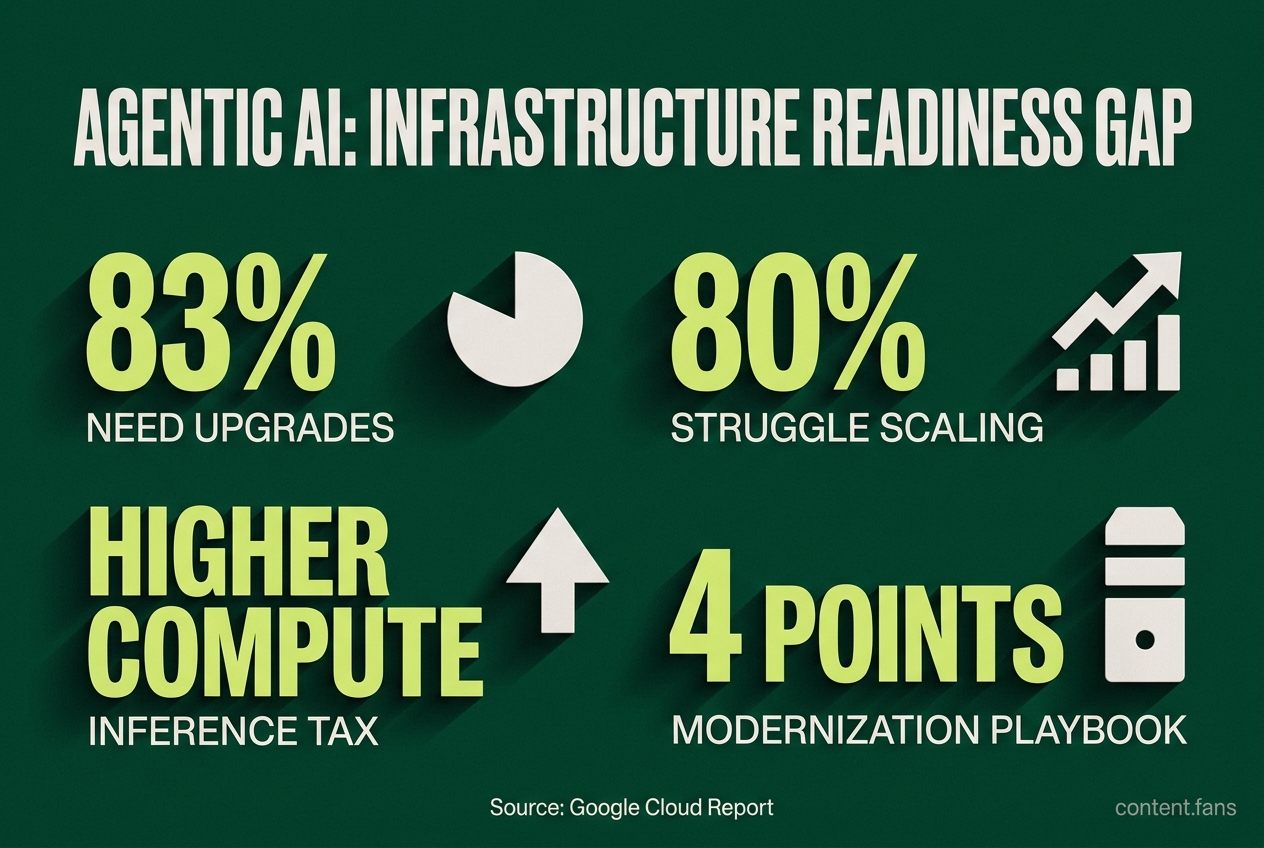
According to the 2026 State of Infrastructure in the Agentic AI Era report, this gap persists even as many organizations adopt hybrid multicloud environments. Four out of five organizations (80%) report struggles with security, governance, or MLOps when scaling agentic workloads, and a significant majority now consider energy efficiency a key factor in hardware decisions.
Why Agentic AI Strains Existing Stacks
Unlike simpler AI models, agentic systems coordinate multiple reasoning steps, complex tool calls, and retry chains. This activity significantly increases inference traffic, creating what some analysts call an 'inference tax' - a hidden cost that many organizations face. This can drive compute consumption substantially higher than a comparable chatbot workload, forcing a re-evaluation of GPU capacity.
Google's Four-Point Modernization Playbook
To address these challenges, Google's report outlines a four-point modernization playbook for enterprises:
- Fluid compute that matches silicon types to individual tasks.
- Governance tooling to track agent sprawl across teams.
- A unified data layer that annotates unstructured inputs automatically.
- Edge deployment of agents to cut latency at the point of action.
Storage and Networking Priorities
Modern agentic architectures require specific upgrades. Experts recommend a three-tier memory stack (ephemeral cache, hot storage, and long-term cold retention) and lossless network fabrics like RDMA over Converged Ethernet (RoCE) or InfiniBand to ensure real-time communication between agents. For clusters spanning multiple data centers, dedicated optical transport links are also advised.
Observability Cost Pressure
A significant operational burden comes from observability, which can consume a substantial portion of total infrastructure labor, according to industry reports. Organizations must implement centralized monitoring engines to track model routing, costs, and usage patterns to prevent uncontrolled agent retries from causing major budget overruns.
Market Spend Signals
Market spending reflects this infrastructure shift. While enterprise agentic AI spending is projected to grow significantly, the infrastructure portion is forecast to increase substantially. Industry projections show infrastructure's share of AI budgets rising as continuous inference workloads eclipse one-time training costs.
Ultimately, while enthusiasm for autonomous AI is high, the data shows that successful implementation is impossible without foundational investment. Businesses must strategically upgrade compute, networking, storage, and observability layers before agentic AI can deliver on its promise of running reliably at enterprise scale.
What exactly is the "agentic AI readiness gap" Google is flagging?
It is the shortfall between the infrastructure enterprises own today and what autonomous, multi-agent systems need to run in production. 83% of IT leaders told Google their current stacks cannot handle the continuous compute, storage, networking and observability loads that agentic AI creates, so upgrades are mandatory before pilots can scale.
Which infrastructure layers feel the biggest pinch from agentic AI?
- Compute: agents can consume significantly more tokens than chatbots, so GPU/TPU pools must grow fast.
- Networking: low-latency RoCE or InfiniBand fabrics are replacing standard Ethernet for lossless, high-throughput agent chatter.
- Storage: an exabyte-scale vector database near compute is now the recommended pattern to avoid siloed data.
- Observability: centralized dashboards for model routing, cost and version control already consume a substantial portion of infrastructure labor hours.
How much of the IT budget will this impact?
Agentic AI is pushing infrastructure costs to represent a growing share of total AI spending, according to early enterprise data. First-year platform investments can be substantial, with significant monthly LLM API costs per production agent in Fortune 500 firms.
What practical steps does Google suggest to close the gap?
- Fluid compute: dynamically match GPUs/CPUs to the task, avoiding over-provisioning for large context windows.
- Unified data layer: auto-annotate unstructured data so agents locate it without pipeline hunting.
- Enterprise governance tool-chain: curb "agent sprawl" across clouds and teams.
- Edge deployment: place agents close to the point of use to cut latency and egress fees.
What happens if we ignore the gap?
Projects stall. Gartner predicts that over 40% of agentic AI projects will be canceled by the end of 2027 due to escalating costs, unclear business value, or inadequate risk controls. In short, agentic AI rewards early movers but punishes teams that treat it like traditional generative AI.