
DeepMind CEO Proposes FINRA-Style AI Safety Body, White House Resists
Serge Bulaev
DeepMind CEO Demis Hassabis proposes a new, independent group to test advanced AI systems before they are launched, similar to how FINRA oversees financial firms. The White House prefers voluntary guidelines and will not create a new government agency for AI regulation. Hassabis's plan suggests that the group could become mandatory in the future if it proves useful, but so far there is no official support from the government. Industry reaction seems mostly positive, but it is unclear if major competitors will back the plan. Whether this group becomes the main AI safety organization may depend on voluntary support and if the administration allows it to have formal authority.

DeepMind CEO Demis Hassabis has proposed a FINRA-style AI safety body, an independent standards organization for testing frontier AI models. The proposal, detailed in a manifesto that has gained significant attention, comes as the White House signals its preference for voluntary industry standards, stating it "will not create an FDA for AI."
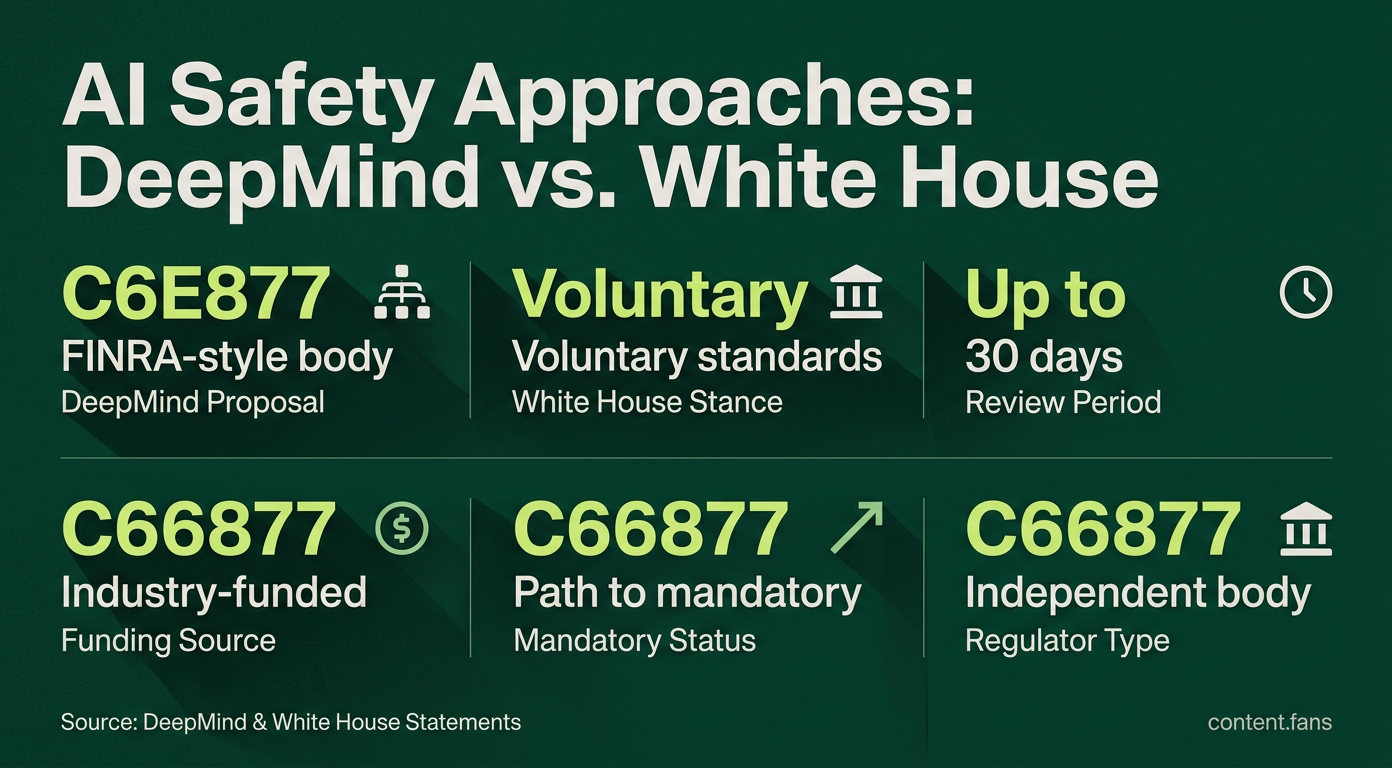
Hassabis's plan details a U.S.-led, industry-funded group to evaluate advanced AI systems for up to 30 days before their public release. While he reports "encouraging" talks with the Trump administration, no formal federal endorsement exists. The proposed body would conduct safety evaluations on risks like cybersecurity, biorisk, and deception, functioning similarly to how FINRA oversees broker-dealers under the SEC.
DeepMind CEO Demis Hassabis Proposes FINRA-Style Independent Standards Body for Frontier AI
DeepMind CEO Demis Hassabis has proposed a U.S.-led, industry-funded organization to evaluate frontier AI models before release. This independent body would initially operate on a voluntary basis, with a path to becoming mandatory for U.S. deployment, establishing safety benchmarks and pre-release testing protocols for advanced systems.
The framework outlines several key design principles:
- Voluntary Phase: AI labs would submit frontier models for a 30-day review period before release.
- Mandatory Phase: Certification would become a prerequisite for U.S. deployment once the body proves its value.
- Circuit Breaker: The board could orchestrate an industry-wide pause on development if testing reveals severe risks.
- Expert Staffing: Evaluations would be conducted by independent technical experts, industry personnel, and open-source contributors, potentially including Turing Award winners.
The proposal has garnered positive industry reactions and "rave reviews" from AI professionals. However, major competitors like Anthropic and OpenAI have yet to comment publicly. Hassabis emphasizes that an industry-funded model is critical for securing the necessary compute power and expert talent for robust, large-scale adversarial testing.
White House Resistance to a New Regulator
The executive order 'Promoting Advanced Artificial Intelligence Innovation and Security' was issued on June 2, 2026, by President Trump. It establishes a voluntary framework for government access to frontier AI models up to 30 days before release, and explicitly states it does not authorize mandatory licensing, pre-clearance, or permitting. The official stance from the White House prioritizes "industry-led standards" and the use of existing federal agencies, complicating Hassabis's path toward gaining legal authority for his proposed body.
While the White House pushes for a single federal framework to preempt disparate state AI laws, Hassabis argues his proposal is compatible. He suggests the independent body could function with federal recognition without creating new government bureaucracy, aligning with the administration's goals.
How Well Does the FINRA Analogy Travel?
The FINRA model provides a blueprint for governance and funding, but it is not a perfect one-to-one match. The securities regulator focuses on governance processes and human-in-the-loop validation rather than setting prescriptive technical benchmarks for AI models. Adapting this template for frontier AI would necessitate creating entirely new testing suites and red-teaming protocols. Experts agree it's a useful starting point but note challenges related to measurement standards and international scope.
The initiative's future as the primary gatekeeper for frontier AI hinges on widespread industry adoption and the administration's willingness to grant it formal authority without establishing a new government agency.