
AI Reshapes 50-55% of US Jobs, Cuts Junior Developer Roles 20%
Serge Bulaev
Reports suggest that artificial intelligence may be changing 50-55% of jobs in the US by automating routine tasks, though most analysts see this as shifting tasks rather than eliminating entire jobs. Entry-level software developer roles reportedly fell about 20% as AI tools can now write basic code, and other fields like trade and retail might also be affected. While some estimates say about 10-15% of jobs could be lost over five years, many organizations are focusing on reskilling workers and redesigning job tasks. The impact appears to be uneven, and experts suggest that companies investing in training and clear management may adapt better to these changes.
Advances in artificial intelligence are reshaping US jobs and entire professional functions in real time. While the primary impact is task reallocation rather than wholesale job loss, the rapid pace of change creates urgent challenges for leaders and workers alike.
How roles are shifting in 2026
Current analyses show artificial intelligence is changing a significant portion of American jobs by automating routine work and elevating the need for human judgment. While most positions are augmented rather than eliminated, job descriptions carry new expectations, particularly in finance, engineering, and software development.
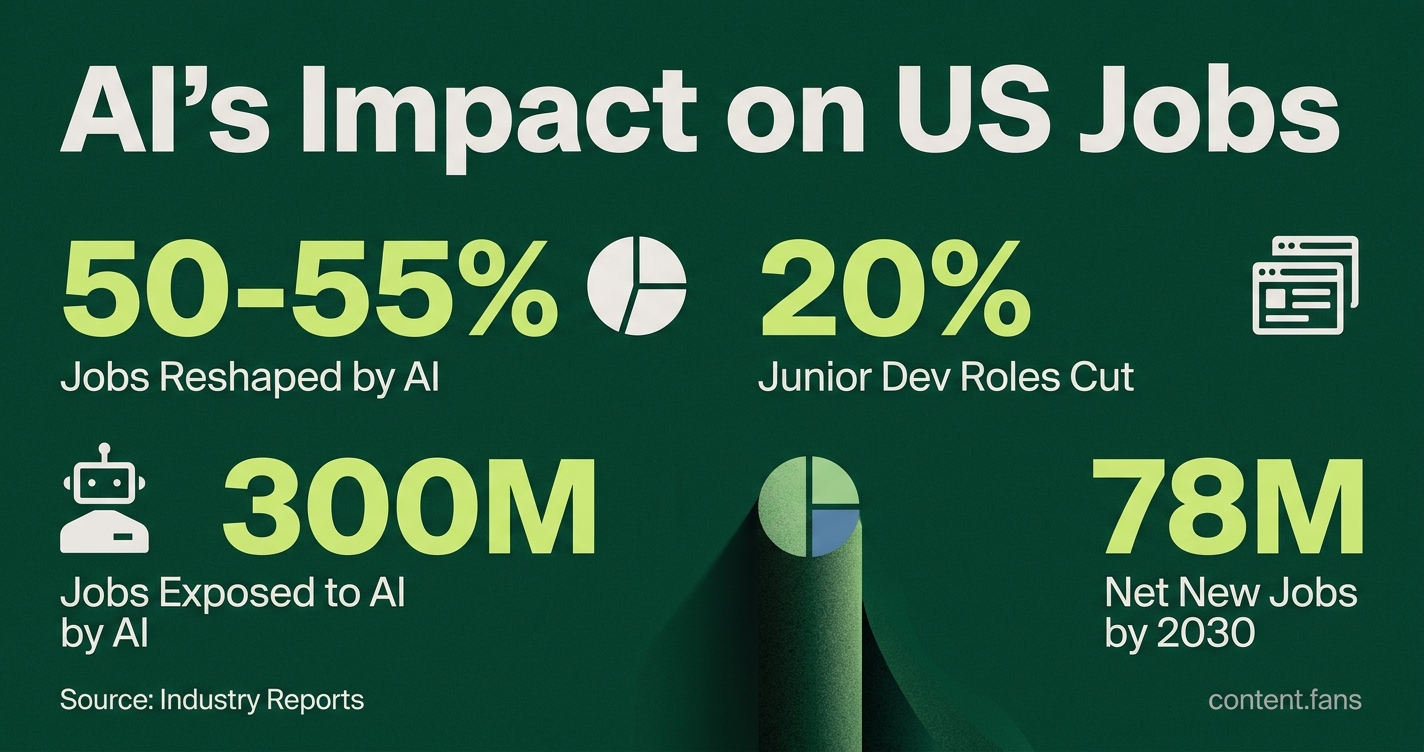
Over the next two to three years, 50% to 55% of jobs in the US will be reshaped by AI, while 10% to 15% could be eliminated. This trend is pressuring entry-level software developers, with industry reports indicating employment challenges for younger coders as generative tools now handle first-draft code.
Physical labor is also being impacted. Robotics with advanced computer vision can now perform tasks like pipe repair, threatening trade jobs once considered secure according to industry reports. Globally, Goldman Sachs estimates 300 million jobs are exposed to AI automation, and while the World Economic Forum estimates AI will replace 85 million jobs by 2026, it also projects 170 million new jobs created and 92 million displaced by 2030 for a net gain of 78 million.
Workforce planning moves from layoffs to redesign
Facing a probable net negative employment balance, large enterprises are prioritizing strategic task redesign and hiring for AI oversight roles. In contrast, small and midsize firms anticipate modest job gains, focusing on productivity boosts. Both must now rethink entry-level career paths to ensure new talent can develop skills despite the automation of traditional apprenticeship tasks.
Reskilling programmes that show measurable returns
Several high-profile corporate initiatives provide compelling evidence that targeted upskilling generates significant value:
- Major aerospace companies have trained substantial numbers of employees in AI and data skills through partnerships with online learning platforms, with industry reports suggesting strong returns on investment.
- PwC invested $1 billion (USD) to train 75,000 U.S. employees in AI, combining online modules with hands-on labs and prompting parties.
- Amazon's Machine Learning University converts non-technical staff into ML specialists, easing pressure on external recruitment.
These examples highlight that success in reskilling is driven by scale, personalized learning, and strong leadership support, which correlate directly with faster competency gains and reduced employee attrition.
Change management: Four phases in practice
To navigate this transition, many organizations are adopting a structured, four-phase change management process:
- Diagnostic and alignment - map task impacts, surface resistance, and clarify governance.
- Foundation building - agree on decision rights, set usage standards, and train facilitators.
- Practice and expansion - pilot one high-impact workflow, track real usage not just deployment.
- Institutionalisation - embed AI metrics into performance reviews and operating rhythms.
Experts emphasize that successful adoption hinges on addressing job-loss anxiety upfront and securing visible executive sponsorship. Without these, even well-designed AI initiatives can stall.
What the evidence may indicate
Current data strongly suggests that augmentation will outweigh elimination. While an estimated 10-15% of jobs may be lost over five years, the more immediate reality is that tasks within a significant portion of all roles are changing. The primary risks appear to be the displacement of entry-level workers and a widening wage gap between AI-proficient and non-proficient employees. Organizations that invest proactively in structured reskilling and transparent change management are best positioned to adapt and thrive.
How many U.S. jobs are actually being reshaped by AI right now?
A significant portion of roles are actively redefined as tasks get reallocated between people and algorithms. Two-thirds of these positions keep their titles but carry radically new expectations: less time on analysis, more on AI oversight and exception handling. Only 10-15% face elimination over the next five years, so the headline is augmentation, not replacement.
Why are junior developers feeling the squeeze first?
Entry-level coders have seen employment challenges in recent years according to industry reports. Agentic frameworks now automate the exact "apprenticeship" tasks - unit tests, boiler-plate code, small bug fixes - that used to train new hires. Companies are redesigning early-career tracks around AI pair-programming rather than traditional mentoring, shrinking the pipeline for brand-new developers.
Which sectors outside tech are already seeing disruption?
According to Cognizant reports, a significant portion of jobs could be impacted by AI, with retail being heavily affected as AI-powered checkouts and dynamic pricing take over. Manufacturing may lose substantial positions in coming years. Even trade roles long seen as robot-proof - pipe fitters, bulldozer operators, line cooks - are now threatened by AI-guided physical robots that can read blueprints or flip burgers.
What separates the companies that gain workers from those that lose them?
Size matters. Large enterprises report net negative employment impacts from AI, while small and mid-size firms still forecast modest boosts. The difference: SMEs focus on task reallocation inside existing budgets; bigger players automate whole workflows and redeploy capital into infrastructure. Power and data-center construction is one bright spot, fueling demand for electricians, engineers and HVAC technicians.
How can organizations speed up reskilling without blowing the budget?
Major companies have upskilled substantial numbers of employees and reported strong returns on investment according to industry reports. Both successful programs share three levers:
- AI-powered skills mapping that pinpoints exactly which micro-skills each worker lacks
- Hybrid learning (digital courses plus live workshops) so staff practice on real company data
- Internal mobility tracks that turn domain experts into AI overseers instead of hiring externally