
Meta weighs new cloud business to rent AI compute
Serge Bulaev
Meta Platforms may start a new business to rent out extra AI computing power and offer access to its models, but plans are still being developed with no set launch date or pricing. The project, called "Meta Compute," appears to be in an early, exploratory phase rather than close to release. Meta's big spending on AI infrastructure could lead to periods of extra capacity that might be rented to outside customers. However, Meta is also still buying large amounts of computing power from other providers, and it is unclear if or when this new business will launch. The plan could change, and it seems to depend on Meta's internal needs and what competitors do.

Meta Platforms is exploring a new cloud business to rent out its surplus AI computing power and provide access to its proprietary models. Meta Compute is Meta's internal AI infrastructure initiative that could potentially be leveraged for this cloud service. This signals a significant strategic pivot, though plans are still in an early, exploratory phase with no confirmed launch details (Reuters). The move follows CEO Mark Zuckerberg's confirmation that monetizing unused capacity is 'definitely on the table,' as the company evaluates turning its massive data center investments into a new revenue stream while simultaneously purchasing compute from other providers.
Why Meta is exploring a cloud option
Meta is exploring a cloud service to monetize its vast and growing AI infrastructure. By renting out surplus GPU capacity created by massive data center investments, the company aims to offset significant capital expenditures and generate new revenue, turning a cost center into a potential profit driver.
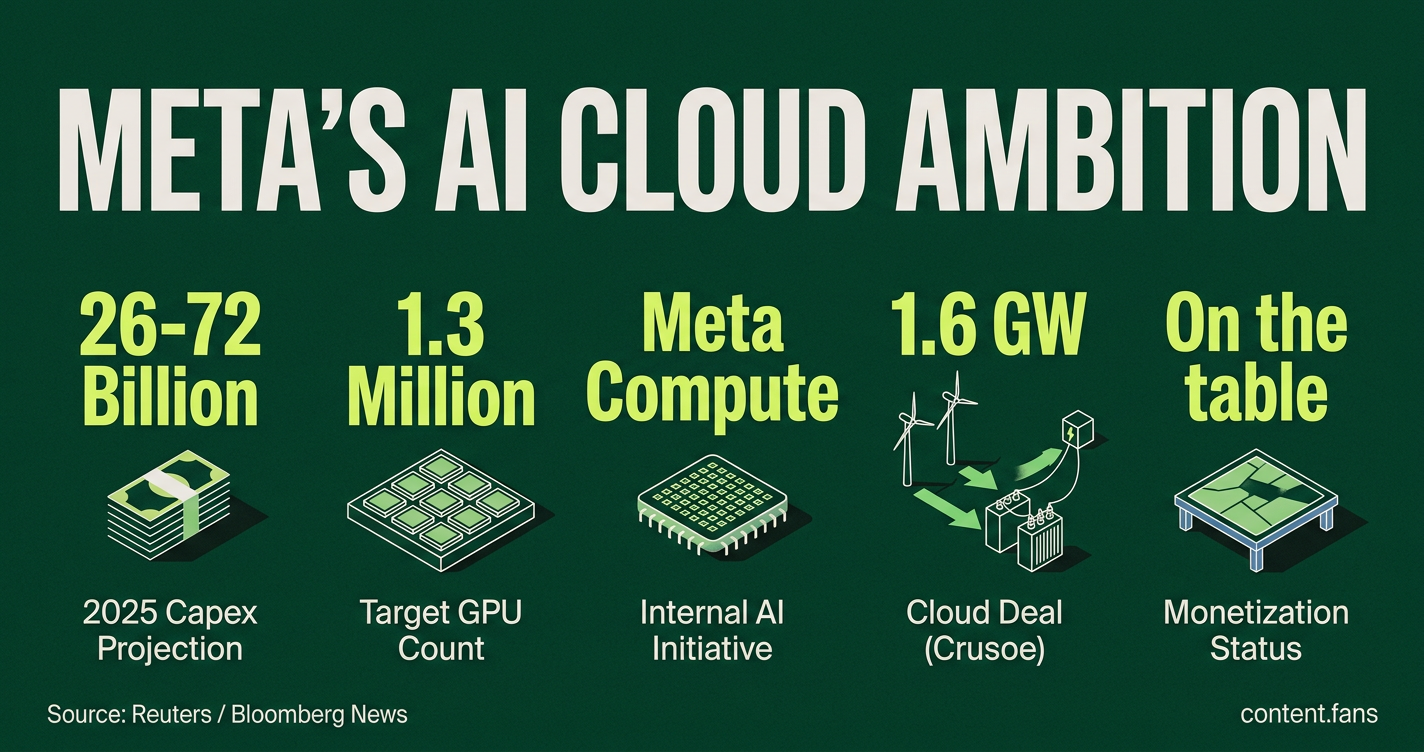
Meta projected 2025 capex of $66 - 72 billion to support AI infrastructure growth. Meta's 1.3 million GPU target supports its internal AI products (Search, Ads, etc.) and open-source Llama releases, with the goal of meeting demand. However, monetizing any extra capacity that becomes available could help offset major capital outlays and address shareholder concerns over long investment return cycles.
Meta is also a consumer of third-party cloud services, including a 1.6GW deal with Crusoe and a significant cloud deal with Google. This dual position as a potential seller and buyer highlights the complex challenge of balancing internal AI demand with long-term infrastructure utilization.
What the early blueprint looks like
Initial plans for "Meta Compute" reportedly revolve around two core product tracks:
- Raw GPU Instance Rentals: Offering hourly rental of raw GPU capacity, a model used by specialist providers like CoreWeave.
- Managed Model APIs: A managed service layer providing developer access to Meta's frontier AI models via an API, conceptually similar to AWS Bedrock.
Internal engineering efforts are focused on critical infrastructure requirements for a multi-tenant service, including tenant isolation, per-FLOP billing models, and compliance frameworks. While differentiation through social-graph data or custom MTIA silicon is a possibility, these features are still in the evaluation phase.
Open questions before a formal launch
Significant hurdles and unanswered questions remain before a potential launch. Reports emphasize that the strategy "could change," and Meta must still address several key business and operational gaps, including:
- Go-to-Market Strategy: Building an enterprise sales team and defining support SLAs for external customers.
- Public Roadmap: Developing and communicating a clear product roadmap to attract developers and businesses.
- Regulatory Compliance: Completing the necessary regulatory filings required for a commercial cloud service.
Furthermore, Meta's extensive infrastructure investments suggest its immediate priority may be securing GPU supply for internal research rather than generating external revenue. The project's future likely depends on Meta's internal compute demand, its ability to utilize its own infrastructure efficiently, and the competitive landscape shaped by cloud giants like AWS, Microsoft Azure, and Google Cloud.