
Perplexity bans ads for AI agents, focuses on subscriptions
Serge Bulaev
Perplexity has stopped running ads for its AI agents, and now seems to prefer making money from subscriptions and sharing revenue with publishers. This move may be because ads for AI agents raise new issues, like making it hard for users to know if an answer is paid for, and risks of bias. Industry groups suggest rules such as clear labels for paid responses and regular checks for bias. Reports suggest this change to subscriptions might help Perplexity keep users and find new ways to earn money without losing trust. Other AI companies may also follow similar strategies as they figure out how to balance making money and being trustworthy.

The recent development where Perplexity introduced sponsored follow-up questions marks a significant strategic exploration, as the AI answer engine tests new monetization approaches while navigating the complex ethical and practical questions surrounding how AI tools should handle advertising that users may never directly see.
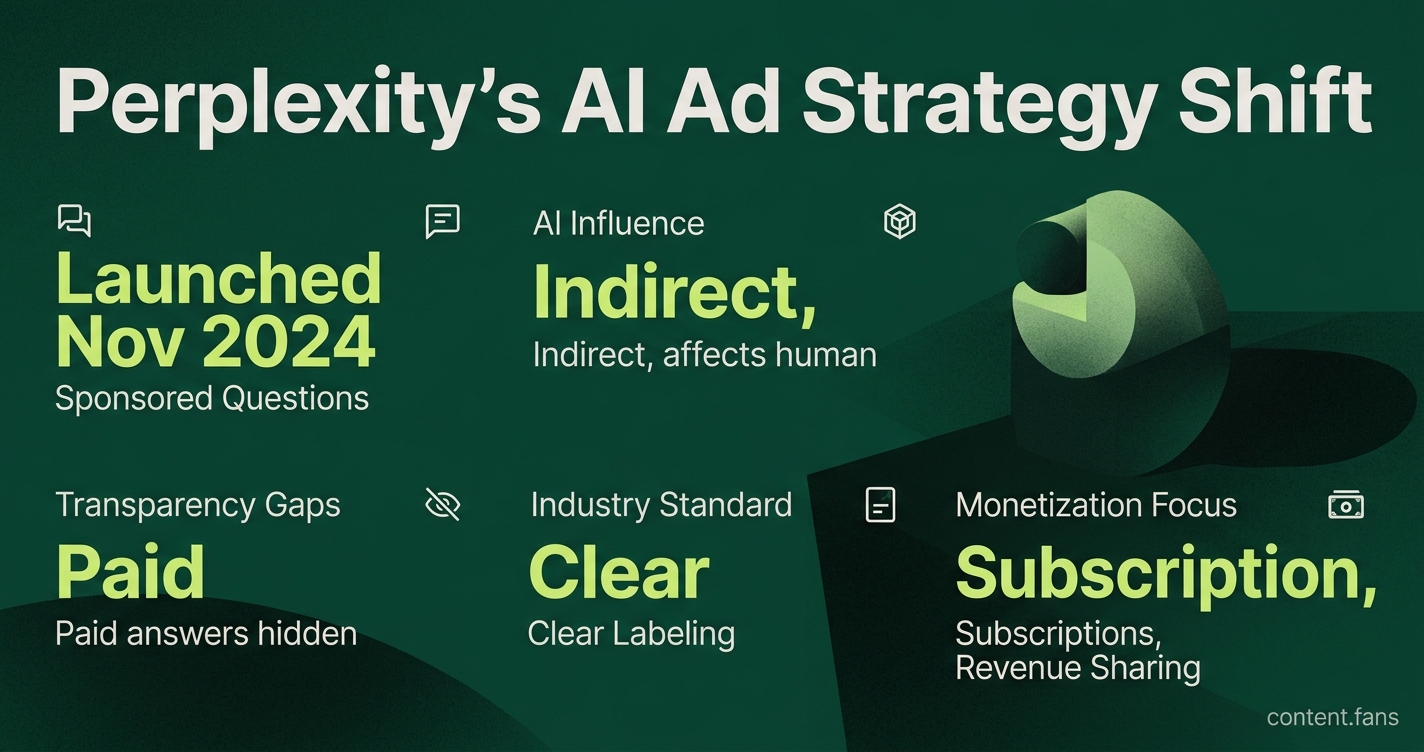
Perplexity's move follows a period of experimentation that began with sponsored questions in late 2024. The company is exploring various revenue models while prioritizing user trust, subscriptions, and publisher revenue sharing.
How the experiment unfolded
Perplexity has been testing its monetization strategy with advertising while addressing significant ethical and practical concerns. The company is evaluating how serving ads to AI agents might impact user trust and create challenges in transparently disclosing sponsored content, while also exploring subscriptions and publisher revenue sharing.
| Key date | Reported milestone |
|---|---|
| Nov 2024 | Sponsored "Related Questions" go live in beta |
| Ongoing | Company continues testing various monetization approaches |
| Current | Exploring balance between ads, subscriptions, and revenue sharing |
Why ads for agents differ from ads for people
- Indirect Influence: The decision-maker is an algorithm, but the consequences affect the human user who relies on its output.
- Transparency Gaps: An AI agent might only present the paid answer, effectively hiding the fact that the content is sponsored from the end-user.
- Distortion at Scale: Inherent model biases and the potential for hallucinations can warp or misrepresent commercial messages on a massive scale.
Industry bodies are establishing guardrails for this gray area. The Interactive Advertising Bureau urges "regular AI audits for bias and integrity," while privacy specialists at IAPP highlight the importance of human oversight and transparent data practices. Industry reports suggest that many national brands want clear labeling for any commercially influenced AI recommendation.
Emerging standards taking shape
- Clear Labeling: Any response or ranking influenced by a commercial payment must be explicitly identified.
- Audit Trails: Systems must provide explainable logs detailing why a specific promotion was surfaced.
- Privacy by Design: Users must have control over the data their AI agent uses.
- Systematic Bias Testing: Regular audits are needed to detect and correct demographic or behavioral discrimination.
Business impact
As reported by industry analysts, exploring various monetization approaches including subscriptions could strengthen user loyalty while maintaining revenue streams. Analysts suggest that publisher citation programs - where creators are paid for referenced content - can create a vital secondary income stream without compromising user trust. This balanced approach may set the standard for how other AI search tools monetize their platforms.
Why is Perplexity exploring different advertising approaches?
Perplexity is testing advertising formats while carefully considering how sponsored content might impact user trust. The company is evaluating whether users might question whether AI-generated answers are genuinely helpful or commercially biased, even with clear labels.
What timeline led to this exploration?
The company began testing ad formats like sponsored questions in November 2024. Perplexity continues to evaluate different monetization approaches while focusing on answer integrity and exploring the balance between ad-based revenue and other models.
What ethical concerns surround advertising to AI agents?
Advertising to AI agents raises critical issues of transparency and consumer autonomy. Since an AI serves as an intermediary, users may not know when a recommendation is paid for, creating risks of covert persuasion and undisclosed conflicts of interest not covered by traditional ad standards.
What do industry surveys reveal about AI advertising ethics?
Industry reports suggest that a significant portion of national brands believe strong ethical and privacy standards are essential for AI-driven recommendations. This reflects a broad consensus that AI-mediated advertising must be honest, auditable, and explainable, with robust bias testing and clear human oversight.
What alternative monetization models is Perplexity pursuing?
Alongside testing ads, Perplexity is focusing on subscription revenue and publisher-citation programs. The latter compensates content creators when their work is cited in AI outputs. This model aligns with a growing trend toward outcome-based pricing, where revenue is tied to measurable results rather than ad impressions.